In many Moroccan businesses, documents still circulate in paper form: contracts piled in binders, invoices received by post, identity documents scanned manually, delivery notes stacked in folders. This approach persisted for a long time because it was hard to see how IT could make a real difference. Yet today, the costs of paperwork show up clearly in the numbers: time spent searching for a document, filing errors, pieces missing at audit time, physical storage space, and the risk of loss in a fire or flood. Document digitisation addresses all of this. It is not a project reserved for large organisations: it is a gradual process, accessible to any Moroccan SME. This guide explains what digitisation means, why it is accelerating in Morocco, and how tools like Crystal IA, developed by CRYSTAL IT in Rabat, embed OCR and automatic classification directly in your management software.
The hidden cost of paper management in Moroccan SMEs
Every paper document hides a cost that managers rarely measure precisely: the time spent finding it. Industry figures consistently show that office workers lose several tens of minutes per day searching for information. Applied to an SME of ten people over a year, this friction is equivalent to a full headcount occupied in searching rather than producing.
Beyond search time, paper management creates genuine operational risks. A missing document during a tax audit, a contract whose version on file may not be the latest, a customer request impossible to fulfil because the originals cannot be found: these situations, common in non-digitalised Moroccan SMEs, have direct consequences for customer relationships, compliance and company credibility. On top of this, space dedicated to physical storage, printing costs and courier fees are all expense lines that shrink progressively once archives move to digital.
Digitisation and DMS: what are we talking about?
Document digitisation means converting paper-based media into digital files that are stored, indexed and accessible from an IT system. A DMS — Document Management System — is the tool that organises this digital flow: it centralises documents, classifies them according to defined rules, links them to the files they belong to and controls access permissions.
The real value of digitisation does not come from scanning itself, but from indexation: a digital document searchable by keyword, linked to the right customer or contract, accessible from a computer or phone by authorised users, is a completely different thing from an isolated file sitting in a shared folder. This level of structure is what transforms a pile of digital scans into a genuine asset for the business.
- Centralisation: all documents in a single repository, accessible remotely.
- Indexation: each document searchable by date, type, customer, supplier or file.
- Audit trail: who created, viewed or modified a document, and when.
- Access control: each team member sees only the documents relevant to them.
- Version history: full change log preserved for sensitive documents.
OCR and artificial intelligence: automating document reading
Manual data entry was long the bottleneck of digitisation. Scanning a document produces an image, not usable data: information still had to be re-read and re-typed into the software, cancelling much of the expected time saving. OCR (optical character recognition) changed this by enabling software to read the content of a document and extract structured information automatically.
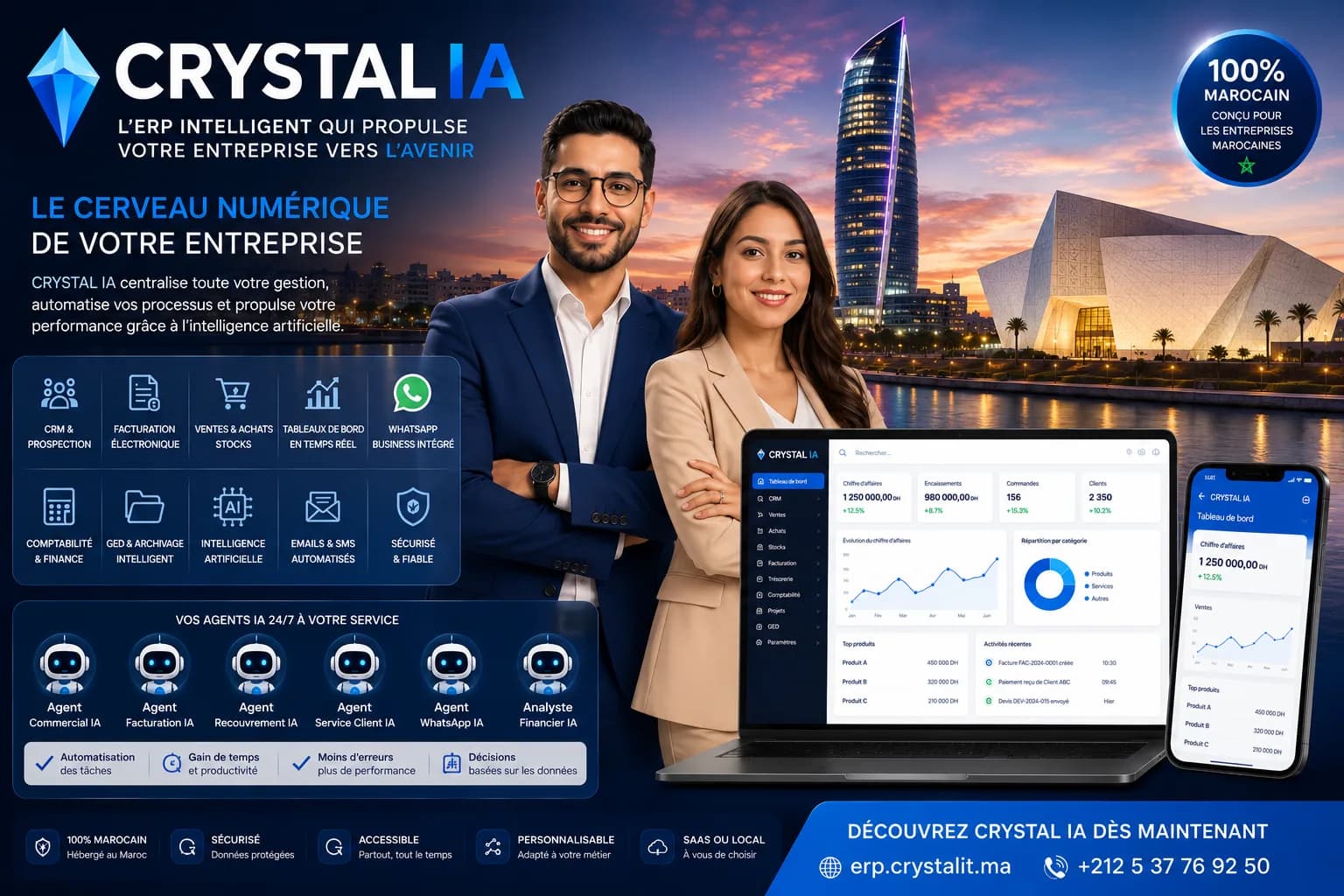
The new generation of tools goes further with artificial intelligence. Crystal IA, the AI engine developed by CRYSTAL IT, does not just read characters: it identifies the document type, extracts relevant fields (dates, amounts, references, names) and classifies it automatically in the right folder. This is precisely the technology at the heart of CRYSTAL ASSUR IA: insurance dossier documents — driving licences, ID cards, accident reports, policy conditions — are read, extracted and classified without manual intervention. The case manager no longer searches for documents: they find them instantly.
Electronic archiving and the legal framework in Morocco
Digitisation does not happen in a legal vacuum. In Morocco, two legal dimensions directly govern electronic archiving. Law no. 05-53 on the electronic exchange of legal data recognises the legal value of electronic documents under specific conditions — notably guaranteeing their integrity and authenticity over time. Law 09-08 on the protection of personal data, supervised by the CNDP, applies whenever archived documents contain information identifying natural persons.
For Moroccan SMEs, these requirements translate into two practical precautions. First, electronic documents must be kept in conditions that guarantee their integrity: a durable format, regular backups, and impossible untracked modification. Second, archives containing personal data — customer names, contact details, employee data — must be handled in compliance with law 09-08: defined purpose, limited retention period, restricted access rights, and CNDP declaration where required. A well-configured DMS solution builds these constraints in by design.
Concrete benefits for a Moroccan SME
Beyond principles, digitisation produces measurable effects very quickly. The first is time saved on search: finding a document in seconds instead of rummaging through binders is a tangible advantage for every team. The second is security: a digital document backed up in the cloud withstands fire, theft and loss, unlike its paper counterpart.
The third benefit, often underestimated, is the fluidity of remote work. Being able to access a complete file from a phone or laptop, wherever you are, changes the responsiveness of the business. Finally, cost reduction is real if gradual: printing, paper, physical storage, couriers — all expense lines that lighten month after month.
- Instant search: find any document in seconds.
- Security and continuity: digital archives backed up, resilient against disasters.
- Remote access: files available from any authorised device.
- Cost reduction: less printing, paper and physical storage space.
- Easier compliance: access tracking, controlled retention periods, managed permissions.
How to succeed in a digitisation project: key steps
A digitisation project requires preparation. The first step is a document inventory: what types of documents does the business produce or receive, in what volume and through which channels? This mapping makes it possible to prioritise: start with high-volume or high-stakes documents (customer contracts, HR paperwork, supplier invoices) and tackle the historical archive in a second phase.
The second step is choosing tools. For an SME, investing in a standalone DMS is not always the right approach: leveraging document capabilities already built into your ERP or management software is often more effective. The third step is supporting teams: digitisation succeeds when users adopt the new practices, which means involving them early and providing practical training.
- Document inventory: types, volumes, reception and emission channels.
- Prioritisation: address active high-volume flows first, then historical archives.
- Tool selection: favour document capabilities integrated in your management software.
- Team training: real adoption is the key to return on investment.
- Compliance from the start: durable formats, restricted access, defined retention periods.
Crystal IA and CRYSTAL IT: OCR at the heart of your management software
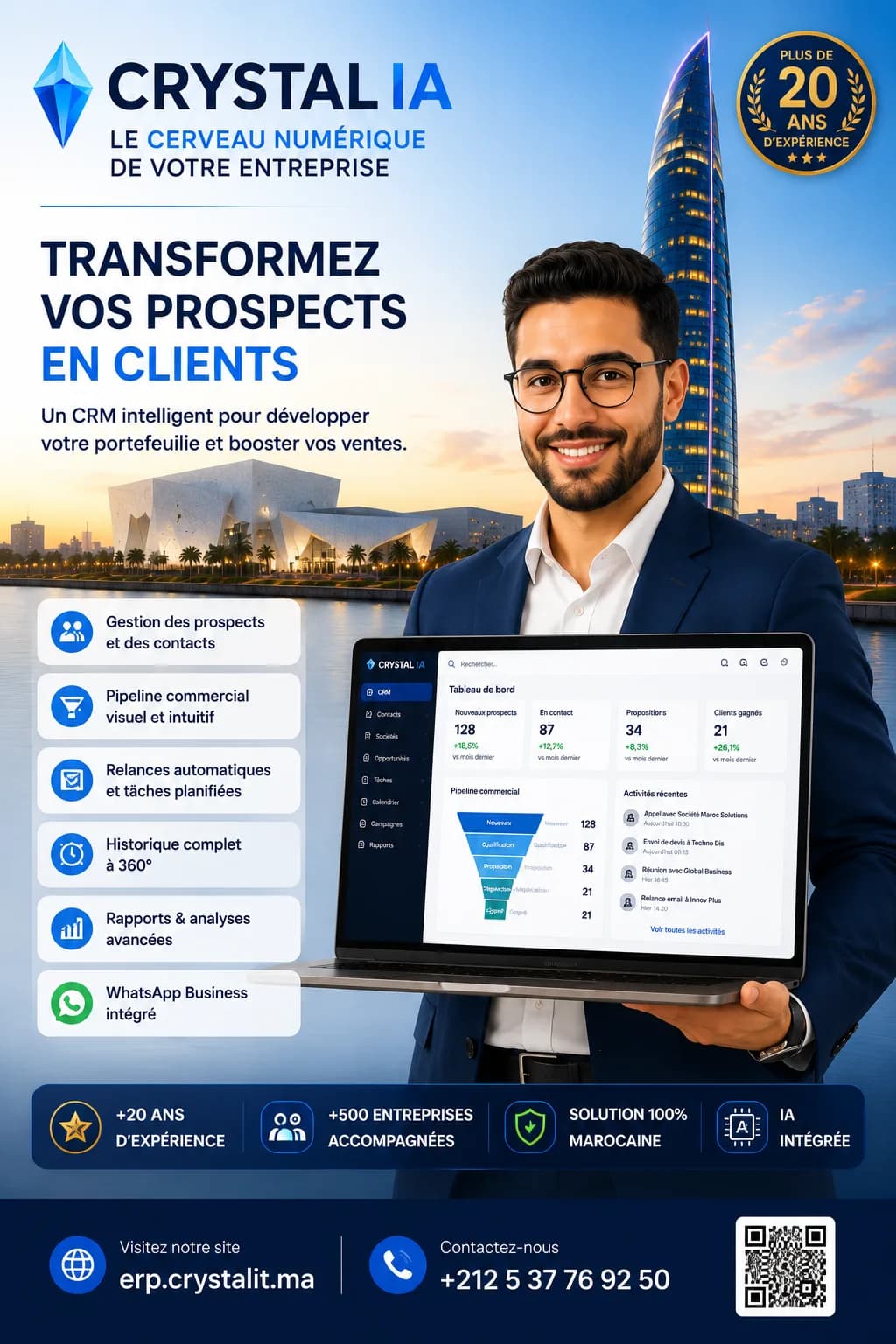
CRYSTAL IT has embedded intelligent digitisation directly in its business solutions. Crystal IA, the AI engine that powers the entire software ecosystem, brings OCR and automatic classification to the professions with the highest document volumes. The most developed application is CRYSTAL ASSUR IA for insurance agents and brokers: contracts, premium notices, accident reports and identity documents are read, extracted and classified automatically, freeing case managers from manual sorting and significantly reducing archiving errors.
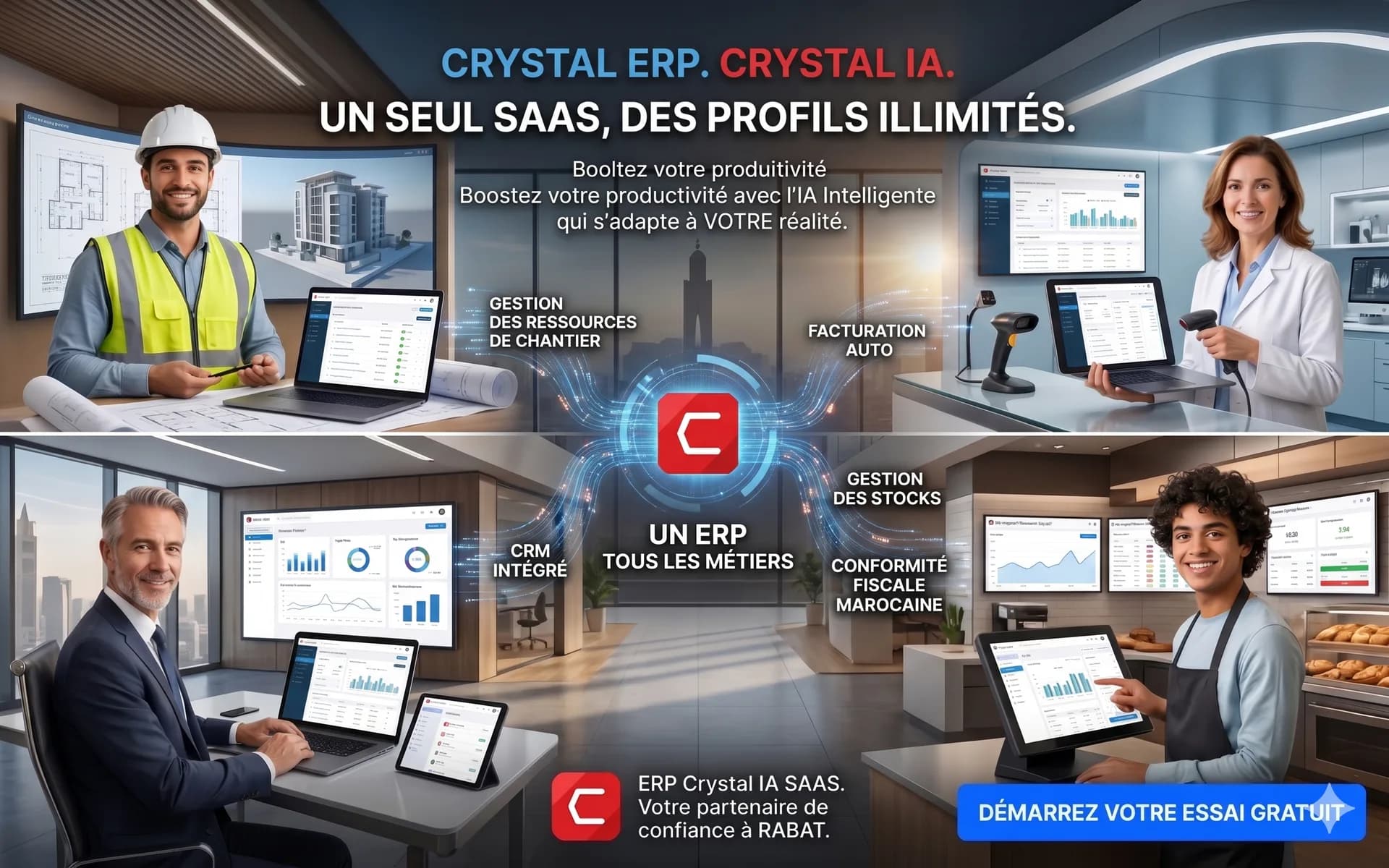
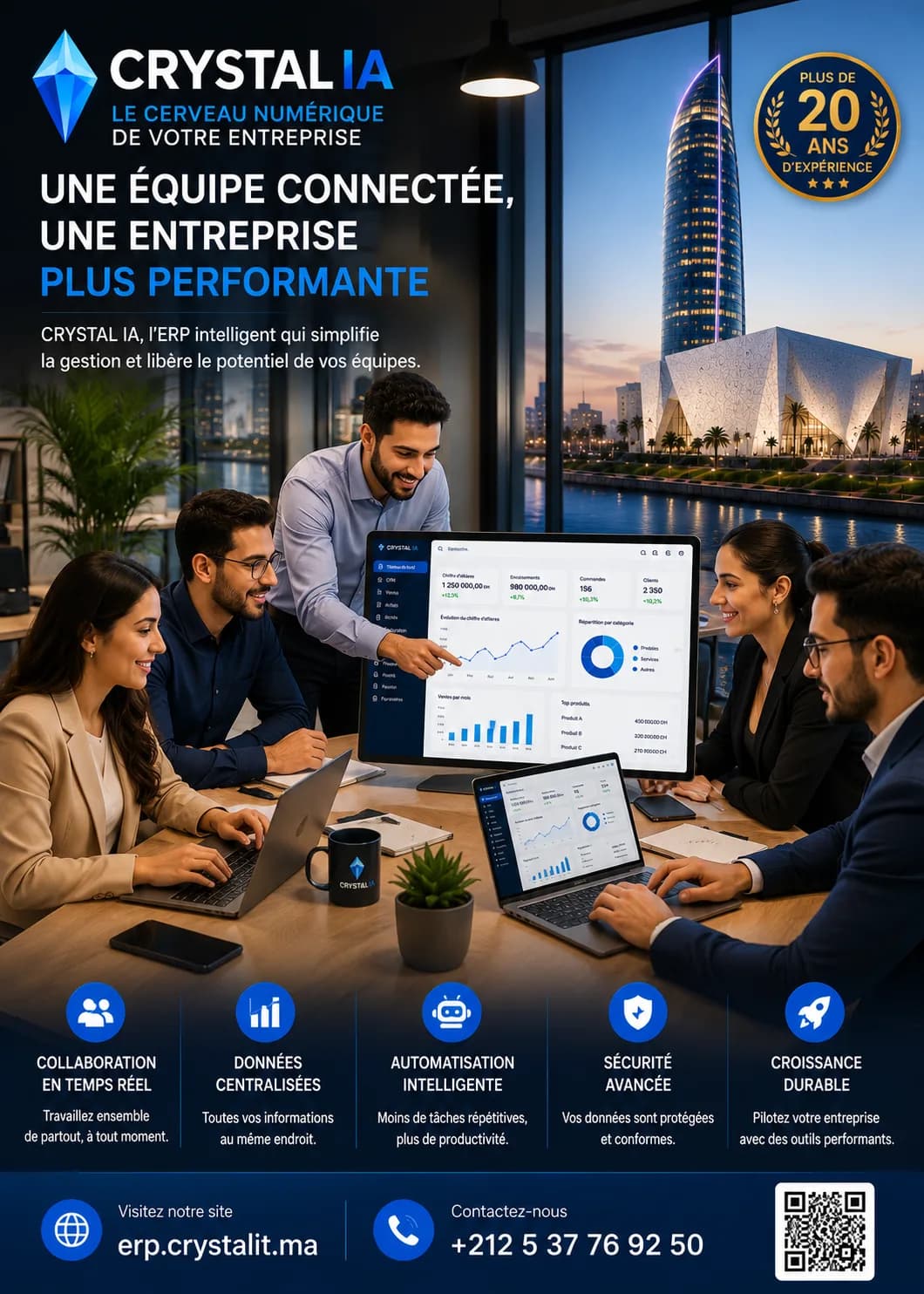
The same logic extends to other sectors: accounting firms, distribution companies, B2B service providers all receive documents daily that need to be read, archived and linked to the right file. Integrating Crystal IA into this flow turns a time-consuming task into an automated process, without changing tools or imposing an entirely new system on teams. For a Moroccan SME wanting to start digitising without a heavy project, this is often the fastest and most cost-effective entry point — carried by a Rabat-based publisher with over 20 years of experience.
Document digitisation is not a major IT project reserved for large corporations: it is a series of concrete decisions — starting with the right documents, choosing the right tools, involving the teams — that progressively free up time, reduce risks and prepare the business to work more smoothly and securely. In Morocco, where personal data regulations (law 09-08) and the transition to mandatory electronic invoicing are raising the bar for structured archiving, SMEs that start now gain a head start. With Crystal IA, CRYSTAL IT puts OCR and automatic document classification directly in the software your teams already use. To discover how intelligent digitisation could integrate into your daily management, request a personalised demonstration from our teams in Rabat: we will start from your own concrete cases, with no commitment.
The CRYSTAL IT solution on this topic
Have a project or a question? Let's talk with a CRYSTAL IT expert.
Request a demo