The market for insurance broking software has never been so crowded: specialised CRMs, all-in-one platforms, comparators, AI building blocks… Every publisher promises to save you time and secure your compliance. The result: many brokers make their choice on the basis of a well-rehearsed demonstration, then discover in production that the tool does not fit their processes, that data migration is a nightmare, or that a feature described as "included" is in fact a paid module. This guide, written for French firms as well as for brokers working between France and Morocco, sets out the criteria that genuinely make the difference in 2026, how to assess them objectively, and the classic pitfalls to avoid before you sign.
Start from your processes, not from the feature list
The most common mistake is to compare software packages on their feature list. Yet two tools that tick the same boxes can deliver radically different experiences depending on how they sequence your daily tasks. Before you even look at a demo, map out your value chain: where your new business comes from, how you issue a policy, how you track a claim, how you collect premiums and reconcile insurer statements.
A good broking software package must fit this flow without re-entry. The real question is not "can the tool produce a quote?" but "how many clicks and copy-pastes between my quote, my policy and my accounting?". It is this end-to-end fluidity that determines the time actually saved, and it only becomes visible on your own cases, not on a demonstration database.
The core functions to require
Beyond the CRM, a firm management software package must cover the entire cycle. Some building blocks are non-negotiable in 2026: if one is missing or only available as a costly option, the tool will leave you with a patchwork of solutions to stitch back together.
- Policy management: underwriting, endorsements, terminations, renewals and coverage tracking.
- Claims management: notification, tracking, supporting documents, indemnification and recourse.
- Collections and premiums: tracking, follow-ups, production statements and reconciliation of insurer statements.
- 360° policyholder record: complete history, documents and communications centralised.
- Reporting and steering: dashboards for production, portfolio and performance.
Compliance: the criterion that eliminates
In France, compliance is not a marketing option: it is a criterion that eliminates. The Insurance Distribution Directive (DDA) and the ACPR recommendation on the duty to advise require you to record the gathering of needs, to produce an advice statement and to keep an enforceable audit trail. Software that does not natively generate these documents exposes you during an inspection.
To this are added the GDPR — hence the question of where your policyholders' data is hosted, ideally within the European Union — and LCB-FT obligations. Question each publisher precisely on these points: where the data is hosted, how the duty to advise is documented, what traceability exists in the event of a dispute. A serious provider answers plainly; a provider who dodges the question should put you on alert.
AI: telling the gimmick from the useful
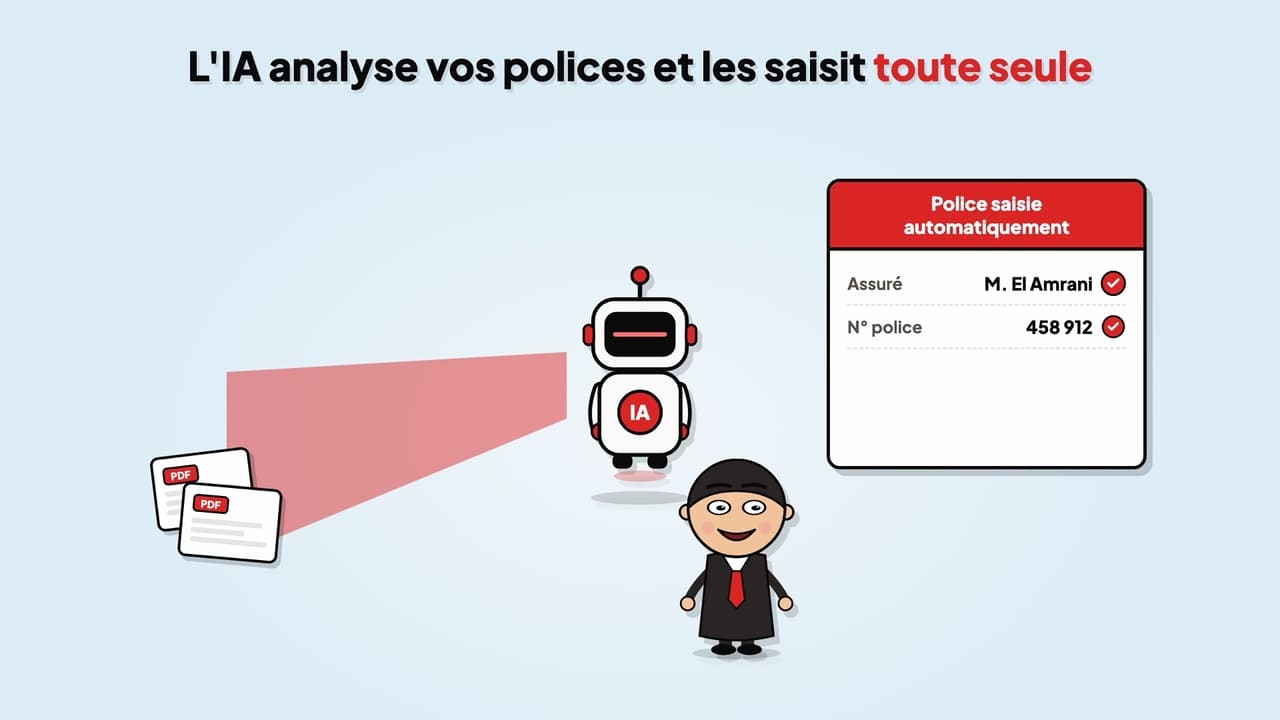
In 2026, almost every publisher advertises "AI". The word no longer means anything in itself: what counts is the concrete use and the time it saves you. The applications that have proven themselves in broking are targeted and measurable: OCR that reads a document or a statement and pre-fills the record, automatic sorting of incoming emails, follow-up on incomplete claims files, or help in detecting cross-selling opportunities.
Be wary of spectacular but vague demonstrations. The right question to ask: "on which specific task in my daily work does this AI save me time, and how do we measure it?". To explore this subject further, we detail the genuinely profitable uses in our article dedicated to AI for insurance brokers (AI for insurance brokers: the use cases that save time).
Data migration, support and real cost
The best software in the world fails if the migration is botched. Demand a clear migration plan: which data is transferred (policies, policyholders, history, open claims), in what format, with what reliability check. Also ask who supports you: a dedicated contact, training for your teams and responsive support often do more for adoption than functional richness.
Finally, think in terms of total cost, not the headline price. A subscription at €30 a month that multiplies paid modules and charges for every additional user can cost more than an integrated offer. This is precisely the approach of CRYSTAL ASSUR, the broking software published by CRYSTAL IT and already used by more than 500 firms and companies: a complete business foundation, powered by AI, with close-at-hand support. CRYSTAL IT is now adapting its current version to the French market — brokers here can discover it on our dedicated page (Crystal Assur for insurance brokers in France).
Choosing broking software is not decided on a spec sheet but on three questions: does it fit my processes without re-entry, does it cover my compliance (DDA, duty to advise, GDPR), and does the AI it offers save me measurable time? Add to this the quality of data migration and support, and think in terms of total cost. Take the time to test on your real files before you sign. CRYSTAL IT, a business software publisher for more than 20 years, places this requirement at the heart of CRYSTAL ASSUR, which it is adapting to the French market: tell us about your firm, the first conversation is free and with no commitment.
Have a project or a question? Let's talk with a CRYSTAL IT expert.
Request a demo