HR management software in Morocco is often the last tool to be computerised in an SME: payroll is calculated in a spreadsheet, leave is tracked manually and employment contracts sit in filing cabinets. This fragmentation costs time, generates errors and exposes the company to non-compliance risks under Morocco's Labour Code. Yet digitising HR management does not require a complex project: an HR module integrated within an ERP covers the essentials — employee records, leave, payroll, documents — without multiplying tools. This guide sets out what an HR management solution must cover for a Moroccan SME in 2026, the pitfalls to avoid and how Crystal ERP (erp.crystalit.ma) streamlines daily HR operations without adding overhead.
HR challenges for Moroccan SMEs in 2026
HR management in a Moroccan SME still relies too often on disconnected tools: a spreadsheet for payroll, a shared notebook or file for leave, paper files for employment contracts. This artisanal setup works up to a certain headcount threshold, then becomes a bottleneck: calculation errors accumulate, absences get lost in WhatsApp exchanges, payslips are issued late and CNSS audits reveal inconsistencies.
Three problems recur systematically in SMEs without a dedicated HR tool: no real-time visibility over leave (who is absent, who is entitled to what?), payroll calculation errors linked to monthly variables (overtime, bonuses, deductions), and difficulty producing compliant, archived documents when the Labour Inspectorate or CNSS carries out a control. Digitising HR means first addressing these three gaps.
- Manual leave tracking: incorrect balances, lost requests, undetected scheduling conflicts.
- Payroll calculated outside the system: frequent errors on overtime, bonuses and CNSS/IGR deductions.
- Scattered employee records: contracts, certificates and attestations impossible to find when needed.
- No dashboards: zero visibility on payroll costs, turnover rate or absenteeism.
What an HR management solution must cover
An HR solution suited to a Moroccan SME does not need to be an enterprise-grade HRIS. It must cover the fundamentals of the employee lifecycle — from hiring to contract termination — without overcomplicating processes. The decisive criterion is integration: a standalone HR application that does not communicate with accounting and invoicing multiplies data re-entry and error risks. A native HR module within an ERP eliminates this problem at the root.
The indispensable modules for a Moroccan SME are clearly defined: employee records management (personal details, contract, seniority, qualifications), leave and absence tracking with an approval workflow, payroll calculation and payslip generation compliant with Moroccan law, and document archiving. These fundamentals cover 90% of the daily needs of an HR function in a company of 10 to 200 employees.
- Employee records: complete file per employee, position history, digitised contractual documents.
- Leave management: automatic balances, approval workflow, absence calendar visible to managers.
- Payroll calculation: monthly variables processed, payslips generated, bank transfer statements produced.
- Legal compliance: CNSS, IGR, social declarations, automatic update of statutory rates.
- Archiving: secure document access, modification tracking, compliant long-term storage.
Payroll and compliance with Morocco's Labour Code
Payroll is the most sensitive part of HR management: a calculation error leads to disputes, a late payment creates tension and an incorrect CNSS declaration can result in a tax reassessment. In Morocco, payroll is governed by precise rules that the software must integrate natively: CNSS employee and employer contributions, IGR deduction according to the progressive tax scale, and overtime pay calculated in accordance with the Labour Code.
Beyond calculation, traceability is paramount. In the event of a Labour Inspectorate check or CNSS audit, the company must be able to produce archived payslips, payment statements and the corresponding social declarations. A well-designed solution generates these documents automatically and stores them securely. Statutory rate updates (CNSS rates, IGR thresholds) must be automatic: in SaaS mode, these updates are applied without any action from your team.
- CNSS employee and employer contributions calculated automatically at current rates.
- IGR: progressive tax scale applied by bracket, with deductions for professional expenses and family dependants.
- Overtime: statutory uplift tracked hour by hour and integrated into the payslip.
- Generation of payslips, bank transfer statements and CNSS/DAS declarations.
- Automatic update of statutory rates in SaaS: zero manual configuration after each regulatory change.
Leave and absence management: a daily operational priority
Leave management is often the first process to be digitised in an SME, because it is the main source of daily friction: an employee submits a leave request without formal approval, a manager no longer knows how many days remain for their team, an unplanned absence is not recorded in time. A leave management module resolves these issues by automating the request-approval workflow and keeping balances up to date in real time.
Morocco's Labour Code sets minimum legal entitlements that the software must respect: the accrual of paid annual leave at one and a half working days per month of actual service, with an increase based on seniority. Public holidays and exceptional leave events are added on top. A solution designed for the Moroccan market integrates these rules natively, with no manual configuration risk.
- Leave balance calculated automatically according to legal rules and the employee's seniority.
- Approval workflow: online request, manager approval, HR notification, automatic balance update.
- Absence calendar: team-wide view to anticipate scheduling conflicts and plan cover.
- Exceptional leave and Moroccan public holidays built into the default configuration.
- Complete audit trail: all requests, approvals and modifications archived and accessible.
HR dashboard and headcount management
Beyond operational management, an HR solution must give directors and HR managers the indicators needed for decision-making: monthly and annual payroll costs, average cost per employee and per department, absenteeism rate, turnover rate. These figures, time-consuming to consolidate manually, are available in a few clicks from an integrated HR dashboard.
The objective is informed decision-making: knowing whether payroll costs are in line with the budget, anticipating leave periods to prevent operational gaps, identifying departments with high absenteeism before it affects performance. For a broader perspective on business management by indicators, see our guide on management dashboards (Business dashboard in Morocco: managing your company in real time).
- Payroll costs: monthly and annual tracking, budget versus actual by department.
- Absenteeism: rate by employee, by team and by period — early detection of warning signals.
- Turnover: inflows and outflows, average time in role, reasons for leaving.
- Seniority and age pyramid: anticipation of departures and recruitment needs.
- HR data export for accounting reporting and the annual social report.
Crystal ERP: the integrated HR solution for Moroccan SMEs
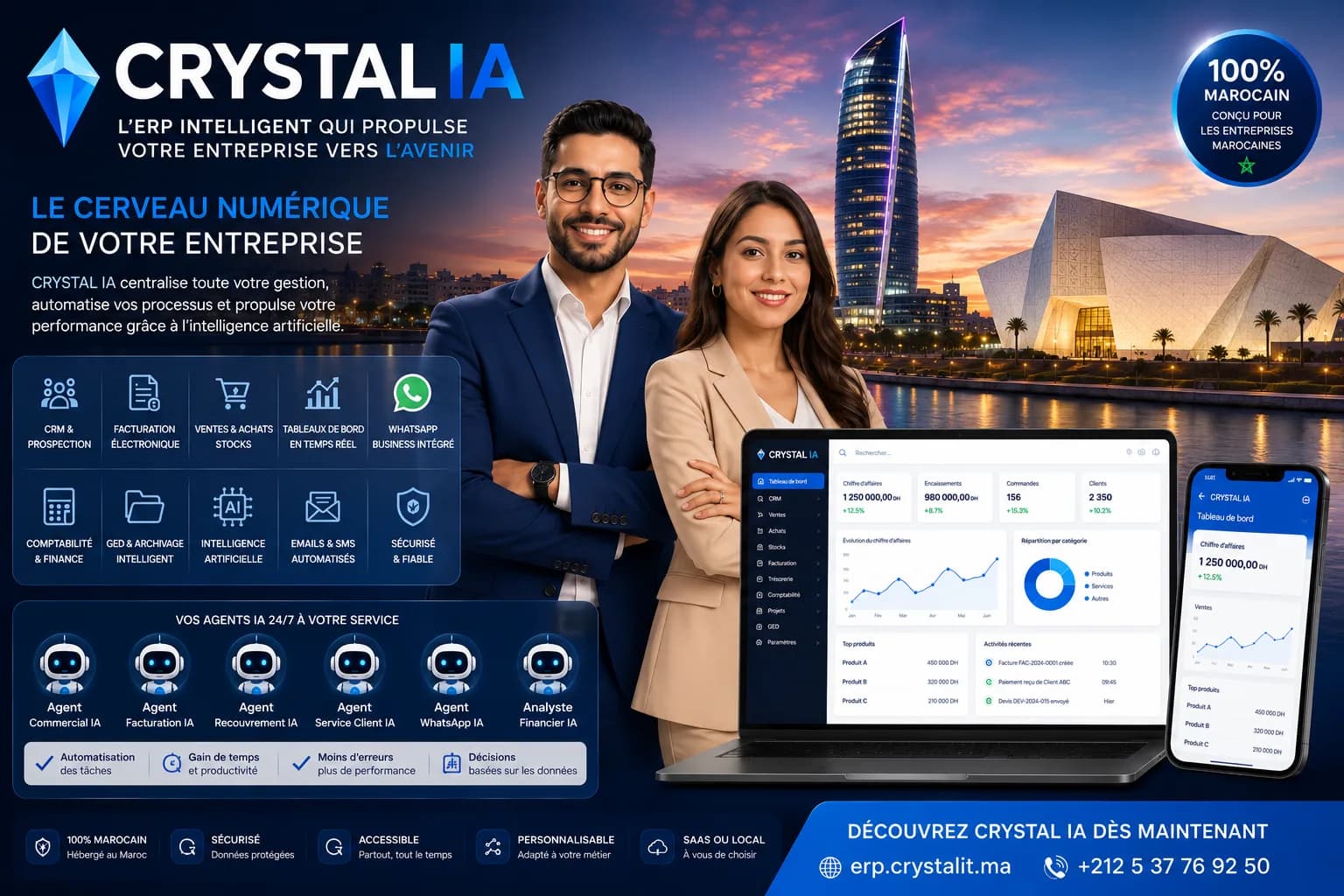
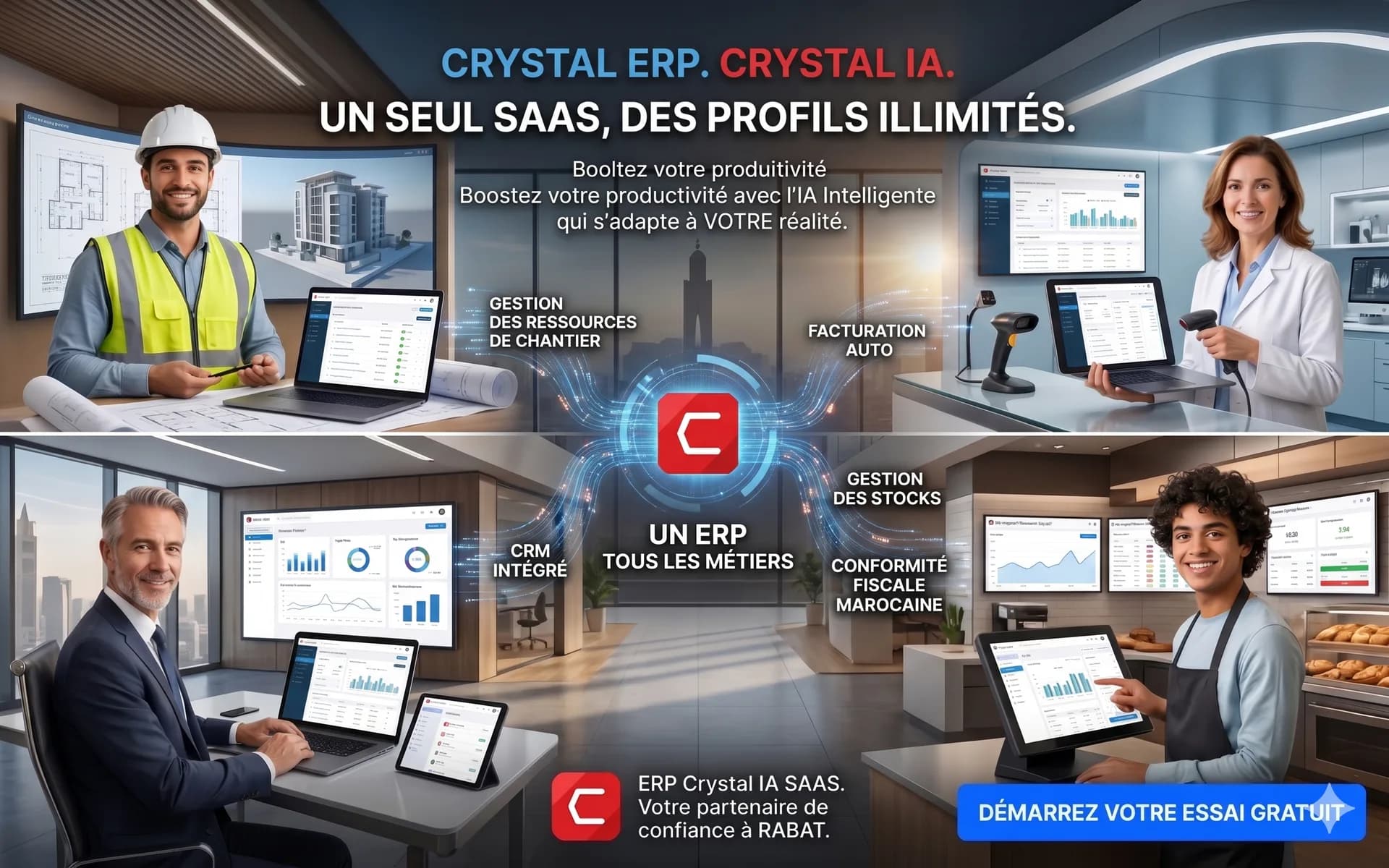
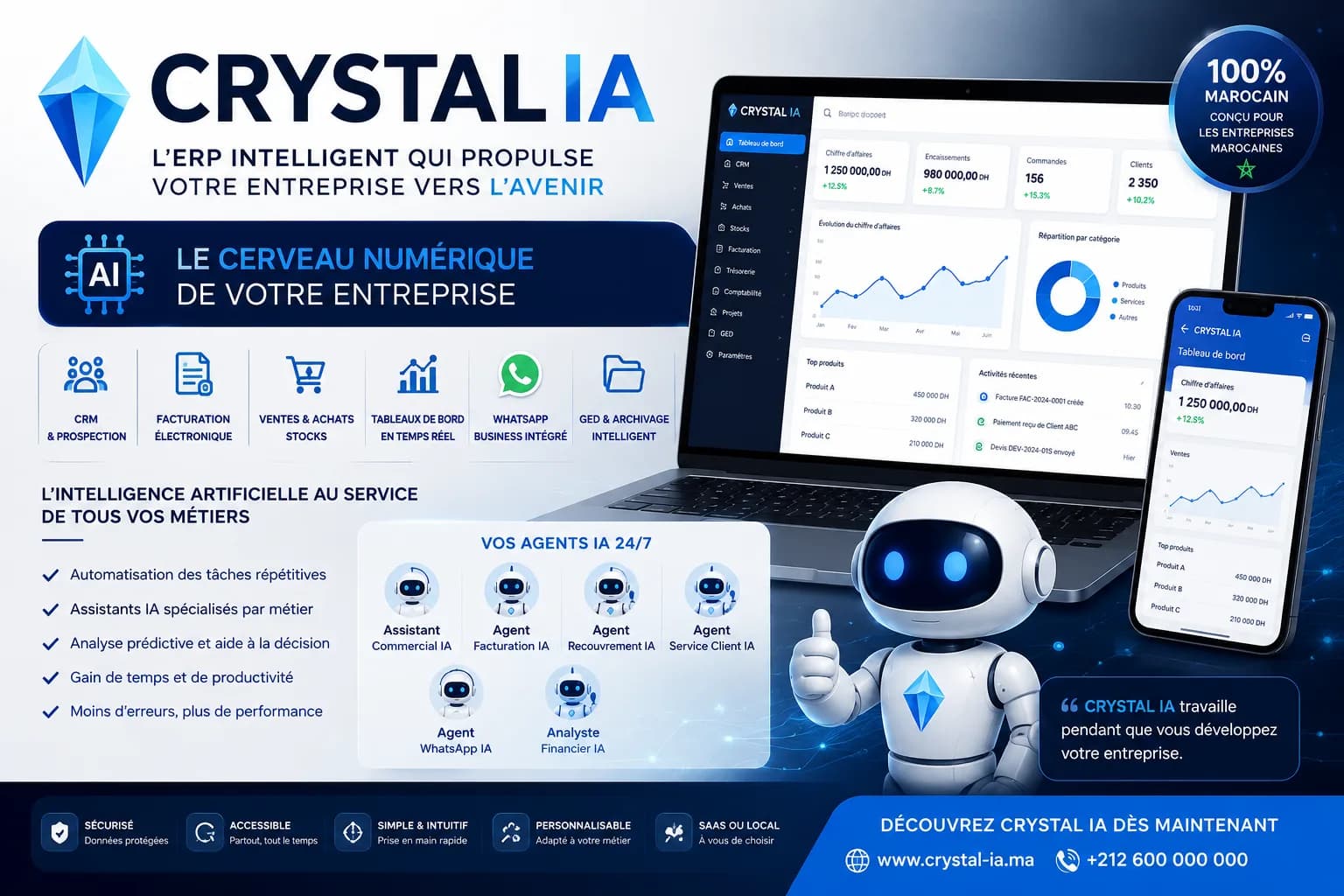
Crystal ERP (erp.crystalit.ma) is the SaaS ERP developed by CRYSTAL IT — a publisher based in Rabat with more than 20 years of experience in management software for Moroccan companies — which integrates HR management within the same platform as accounting, purchasing, sales and stock. The benefit of this integration is tangible: payroll calculated in the HR module automatically generates the corresponding accounting entries, without re-entry. The employee record, payslips and leave are accessible from a single tool, with access rights tailored to each user profile.
As a SaaS solution, Crystal ERP automatically incorporates regulatory updates — CNSS rates, IGR brackets, Labour Code changes — without any intervention from your team. This provides permanent compliance assurance, particularly valuable for SMEs without a full-time HR director. For a deeper dive into payroll management specifically, see our dedicated guide (Payroll management in Morocco: CNSS, IR and pay slips for SMEs).
Digitising HR management in a Moroccan SME is not a large-scale undertaking: it begins with choosing a solution that covers the fundamentals — employee records, leave, payroll, CNSS and IGR compliance — and integrates naturally into your management ecosystem. A standalone HR module generates re-entry work; an integrated ERP like Crystal ERP (erp.crystalit.ma) moves data from the employee record through to accounting entries without interruption. CRYSTAL IT, a Moroccan publisher based in Rabat for more than 20 years, understands the specifics of Morocco's Labour Code and social obligations, and keeps statutory rates up to date automatically in its SaaS solution. Contact the CRYSTAL IT team for a Crystal ERP demonstration tailored to your headcount and HR organisation.
The CRYSTAL IT solution on this topic
Have a project or a question? Let's talk with a CRYSTAL IT expert.
Request a demo