In many Moroccan SMEs, the manager learns the true state of the business at the end of the month: revenue consolidated by the accountant, stock counted during the inventory, customer follow-ups done when delays become critical. In the meantime, decisions are made in the dark — ordering too much stock, giving poorly calibrated discounts, letting a receivable slip. A business dashboard is not a luxury reserved for large companies: it is the tool that lets an SME manager move from intuition-based management to fact-based management, in real time. In this article, we explain which indicators to track, what a dashboard must genuinely offer, and how solutions like Crystal ERP, developed by CRYSTAL IT in Rabat, give Moroccan SMEs this visibility without heavy investment.
Why gut-feel management costs Moroccan SMEs dearly
For a long time, the manager's intuition was the company's main dashboard. They knew, without looking at figures, whether the business was doing well or not — because they were everywhere at once, knew every customer and handled every order. This model works for very small structures. But as the business grows, intuition loses touch with reality: too many flows, too many people involved, too much dispersed information for any one person to maintain a reliable mental picture.
The consequences are tangible: a manager who does not track receivables in real time discovers an unpaid invoice six weeks after the due date. A director who does not monitor stock continuously reorders goods already sitting in the warehouse. A manager who waits for the monthly close to know their margin makes commercial decisions based on obsolete figures. The cost of this lag is not always visible in financial statements, but it is paid in missed opportunities, cash-flow pressure and management errors.
The limits of Excel files for managing an SME
Excel is the most widespread management tool in Moroccan SMEs, for good reasons: it is flexible, accessible and requires no deployment project. In the early years it does its job. The problem arises when the business becomes more complex and the files multiply: one spreadsheet for sales, another for stock, a third for cash flow, often managed by different people.
At that point, information becomes fragmented. Data is outdated by the time it is consulted — it had to be entered manually, consolidated from multiple sources and validated. Formulas break, versions diverge, and the manager no longer knows which file is authoritative. Worse, some information is simply missing: actual margin per customer, receivables recovery rate, stock turnover. This is not the user's fault; it is the structural limitation of a tool built to calculate, not to steer.
- Stale data: the file reflects the situation at the time of the last update, not today's reality.
- Siloed information: each department has its own file, with no automatic consolidated view.
- Re-entry errors: copy-pasting between tools multiplies the risk of human error.
- No alerts: no automatic signal when a receivable passes its due date or stock falls below the minimum threshold.
- Laborious reporting: building a monthly summary takes hours — time lost on formatting rather than analysis.
Key indicators for a well-managed SME
Before choosing a tool, you need to know what you want to track. Not all indicators are equal: some are immediate warning signals, others guide medium-term decisions. For a Moroccan SME manager, a handful of indicators deserve permanent monitoring.
Selecting the right KPIs is also a matter of context: a trading company will focus primarily on margins and stock turnover, while a service business will pay closer attention to its customer portfolio and collections. The key is to choose actionable indicators — the ones that, when they turn red, trigger a decision.
- Real-time revenue: knowing what has been invoiced today, this week and this month, without waiting for the monthly close.
- Gross and net margin: knowing the actual profitability of each product, product family or customer, not just sales volumes.
- Forecast cash flow: anticipating incoming and outgoing flows over 30 and 60 days to avoid unexpected overdrafts.
- Customer receivables and DSO: spotting payment delays as soon as they appear, not a month later.
- Stock level and turnover rate: avoiding stockouts and excess inventory, both enemies of profitability.
- Sales pipeline: visualising quotes in progress and their conversion rate to anticipate future revenue.
What a real business dashboard must offer
An effective business dashboard is not a simple collection of charts: it is a synthetic, real-time view of the company's actual activity. The difference from an Excel report is that data is fed automatically from operations — every sale recorded, every invoice issued, every stock movement — with no additional manual entry.
To be truly useful to an SME manager, the dashboard must allow a quick move from the overall picture to the detail: seeing at a glance that revenue is behind the month's target, then clicking to identify which sales rep, product or region explains the gap. This drill-down capability is what transforms a screen of numbers into a decision-making tool. Designed this way, the dashboard does not replace the manager's judgement: it gives them, at the right moment, the information they need to decide better and faster.
Crystal ERP: integrated dashboards for Moroccan SMEs
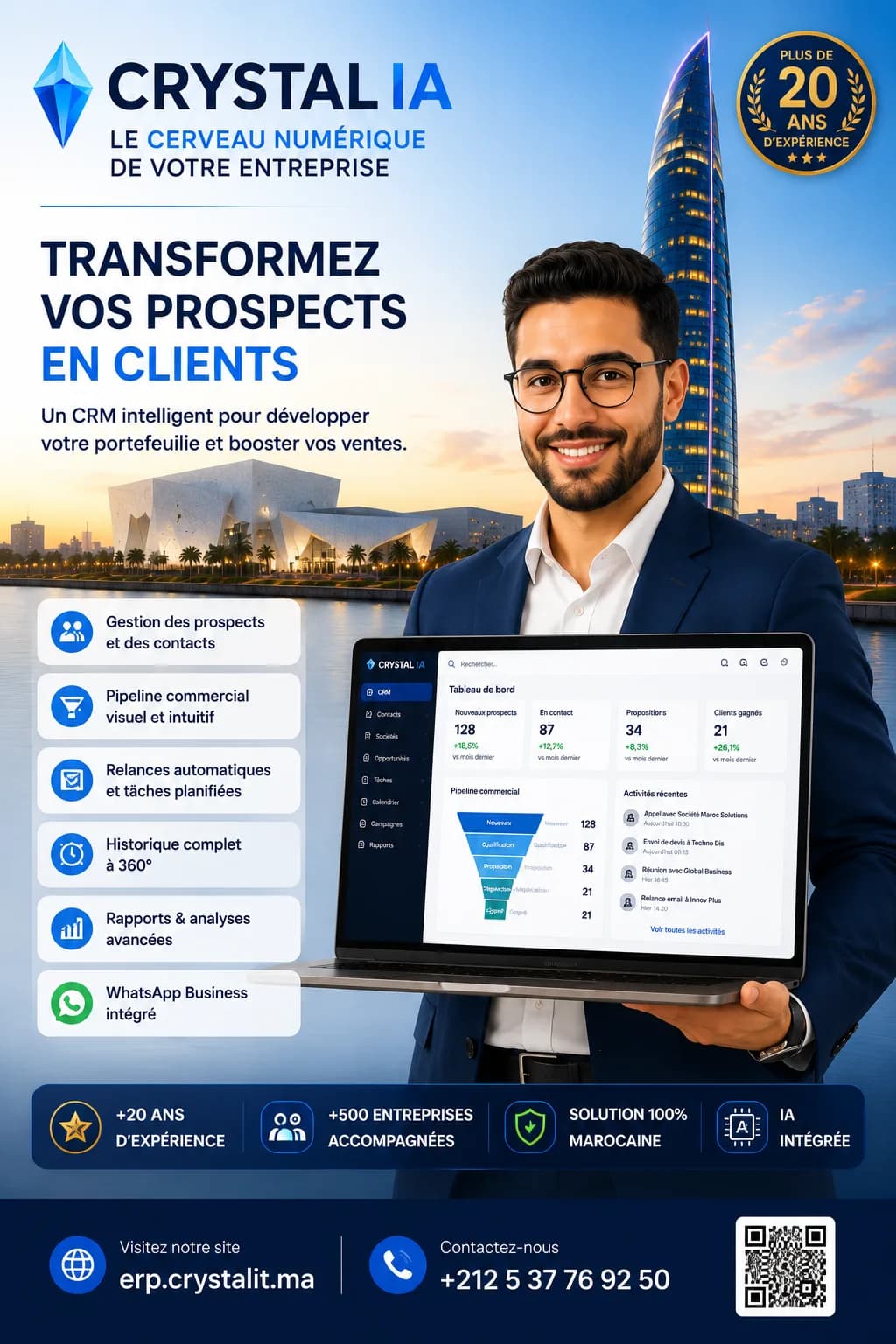
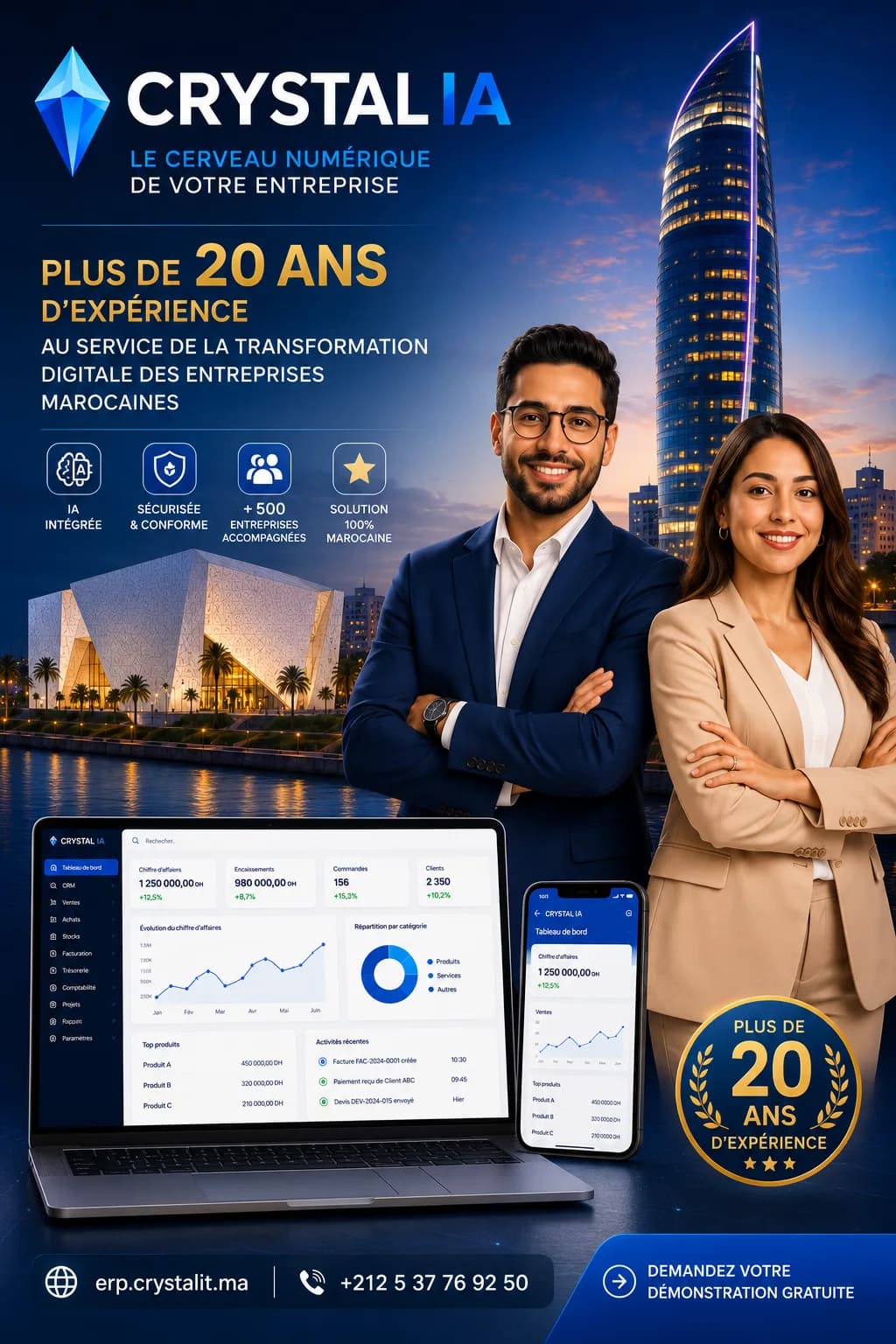
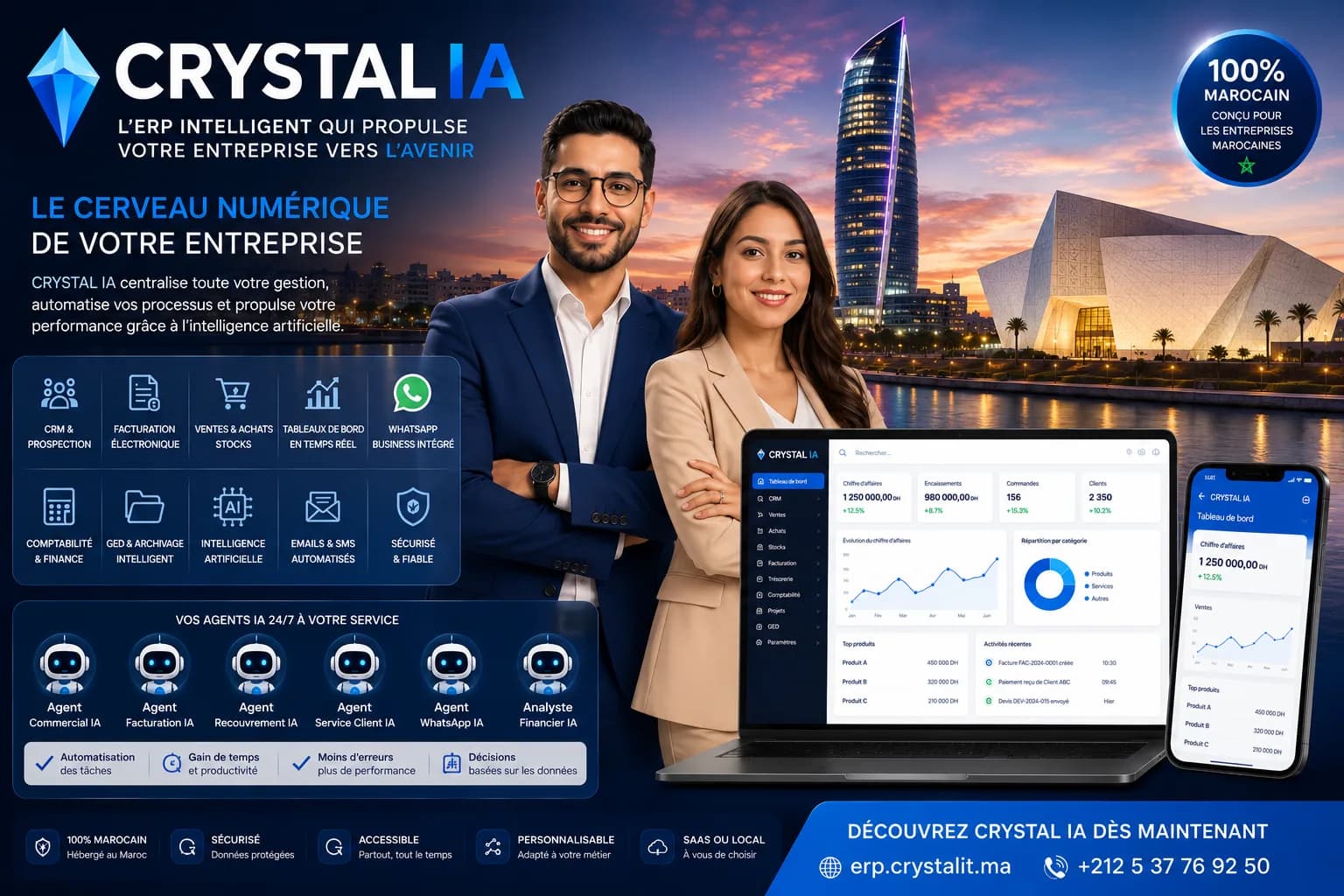
Crystal ERP, the SaaS management software developed by CRYSTAL IT in Rabat, includes dashboards directly connected to the company's real activity. No need to consolidate data from multiple tools: sales, stock, purchases, cash flow and customer relationships automatically feed the indicators as soon as an operation is recorded. The manager consults their figures from any device, in real time, without waiting for the end of the month.
Crystal IA, the artificial intelligence engine that powers the CRYSTAL IT ecosystem, goes further: a conversational assistant lets users query their management data in natural language. Need to know which customers have not paid for more than 45 days, or which products show the best margin this quarter? Just ask the question. The AI-powered customer scoring also helps sales teams prioritise their actions and focus effort where the return on investment is strongest.
Where to start: from blind management to real-time visibility
Moving from Excel-based management to real-time monitoring does not require a large IT project. The best approach is to start with the process that generates the most friction or opacity — often sales tracking and invoicing — and deploy the solution progressively, module by module.
Three principles guide a successful transition. First, start from the real need: which figures are missing day to day, which decisions are made without reliable data? Second, choose a solution that grows with the business — a SaaS ERP like Crystal ERP allows you to start with the sales cycle and add stock, purchasing and accounting as needs evolve, without upgrading infrastructure. Third, involve the teams from the start: a dashboard is only as good as the data that feeds it, which means operational teams must record their daily operations correctly.
- Identify the two or three indicators that matter most to your business.
- Start with the module that generates the most immediate value: invoicing, sales management or stock.
- Train the teams: data quality determines dashboard quality.
- Expand progressively: cash management, purchasing, accounting, CRM — the ERP follows the growth of the business.
Managing a company in real time is no longer a privilege of large organisations: it is now within reach of any Moroccan SME that chooses the right tools. A business dashboard connected to real operations means never making a decision in a vacuum — and never discovering a month too late that a receivable has slipped or stock has overflowed. With Crystal ERP, powered by Crystal IA, CRYSTAL IT puts more than 20 years of expertise at the service of Moroccan managers who want to finally see their business as it really is, not as they imagine it to be. Want to see what your figures really reveal? Contact our teams in Rabat for a personalised demonstration of Crystal ERP and discover, with your own real data, what real-time management changes day to day.
The CRYSTAL IT solution on this topic
Have a project or a question? Let's talk with a CRYSTAL IT expert.
Request a demo