Choosing an ERP is one of the most structuring decisions a company can make: the tool will concentrate its sales, purchasing, inventory, invoicing and accounting, and stay with it for years. In Morocco, the offering is wide — from international suites to local vendors — and it is easy to get it wrong, either by over-sizing or by choosing a tool that does not speak to local realities. This guide reviews the criteria that genuinely matter, the question of budget, the choice between SaaS and licence, and the most common mistakes, to help you decide with full knowledge of the facts.
Start from your real needs, not the feature list
The first mistake is to compare ERPs on the number of features. A tool that 'does everything' but that no team uses properly is worth less than a simpler tool that is genuinely adopted. The right starting point is not the vendor's catalogue, but your own activity: where are you losing time today? Re-entry between quotes and invoices, poorly tracked inventory, forgotten customer follow-ups, laborious accounting closures?
This diagnosis allows you to prioritise. A trading SME does not have the same priorities as a services firm or a car dealership. By listing your critical processes and the concrete friction points, you obtain a realistic specification — and you avoid paying for modules you will never use.
SaaS or licence: which mode to choose?
The choice of deployment mode has lasting consequences. The on-premise licensed ERP is installed on your own servers: you own it, but you bear the infrastructure, maintenance, backups and updates. The SaaS (cloud) ERP is hosted by the vendor and accessible from a browser, against a subscription: no server to buy, automatic updates, access everywhere.
For the vast majority of Moroccan SMEs, SaaS is now the obvious choice: it puts the ERP within reach without a heavy investment, guarantees continuity (backups, professional security) and — a decisive argument at the time of electronic invoicing — ensures continuous regulatory updates with no migration project. The on-premise licence still makes sense for organisations with very specific constraints, but it requires internal IT resources.
How much does an ERP cost in Morocco? Think in total cost
The question of price always comes up, but it is often poorly framed. The cost of an ERP is not limited to the displayed price: you must think in total cost of ownership, over several years. In SaaS, the model is generally a subscription per user per month, which includes hosting, maintenance and updates. With a licence, you must add to the initial price the servers, installation, annual maintenance and version upgrades.
Beyond the vendor's invoice, factor in the cost of configuration, of migrating your data, of training teams and of the internal time mobilised. A 'cheap' but poorly supported ERP can cost far more than a better-supported solution: the real indicator is not the price, but the ratio between total cost and the time genuinely saved once the tool is adopted.
The criteria specific to the Moroccan context
A generic ERP designed for another market may look attractive on paper, but stumble on details that matter day to day. In Morocco, several criteria deserve particular attention, as they determine compliance and the quality of support.
To check without fail:
- Local compliance: Moroccan VAT, legal mentions, and readiness for the DGI's mandatory electronic invoicing.
- The vendor's proximity: a contact in your time zone, who knows the realities of Moroccan companies.
- Language and support: responsive assistance, in a language your teams master.
- Local references: number of real installations and the vendor's track record on the market.
- The ability to evolve: an ERP that grows with you, module by module, without rebuilding everything.
The mistakes that derail an ERP project
Most failures come not from the software, but from the way the project is run. Knowing them helps you avoid them.
The most common pitfalls:
- Wanting to deploy everything at once instead of starting with the core (sales cycle and invoicing) and then extending.
- Neglecting training and team involvement, which determine real adoption.
- Choosing on price alone, without assessing support or the vendor's longevity.
- Underestimating the migration of existing data, an often long and delicate step.
- Forgetting the regulatory changes to come, and having to redo everything a few months later.
Crystal ERP: a choice designed for Moroccan companies
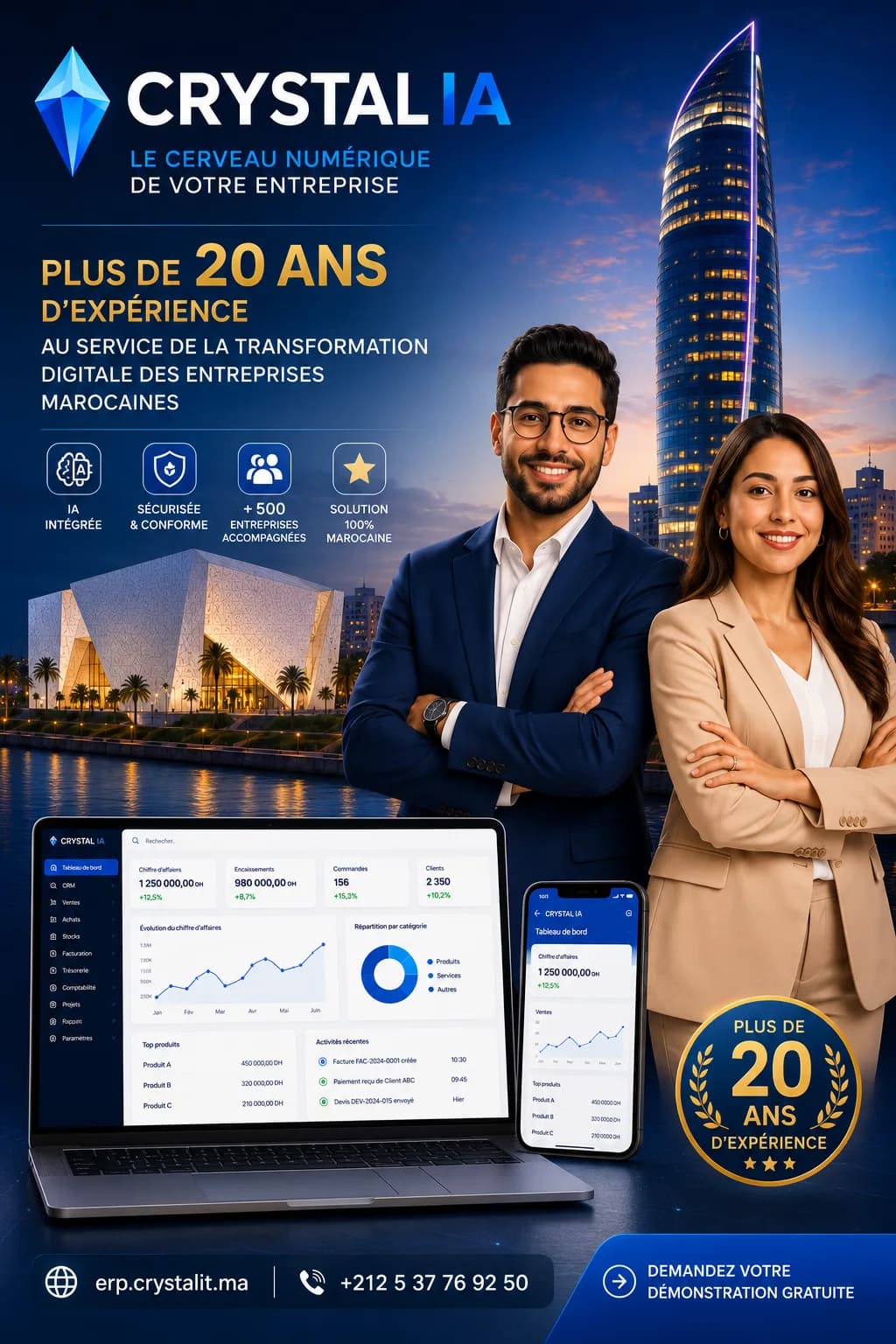
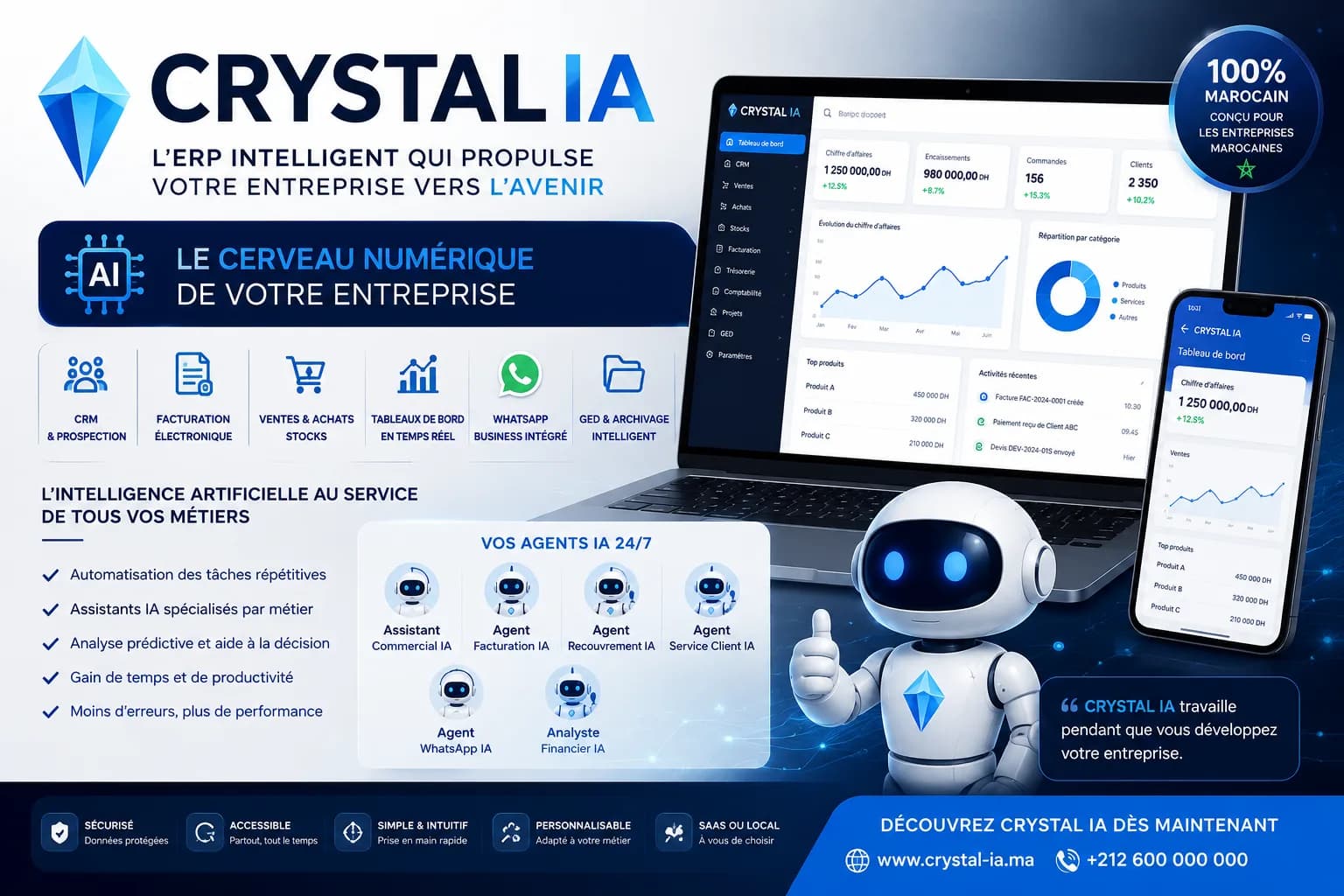
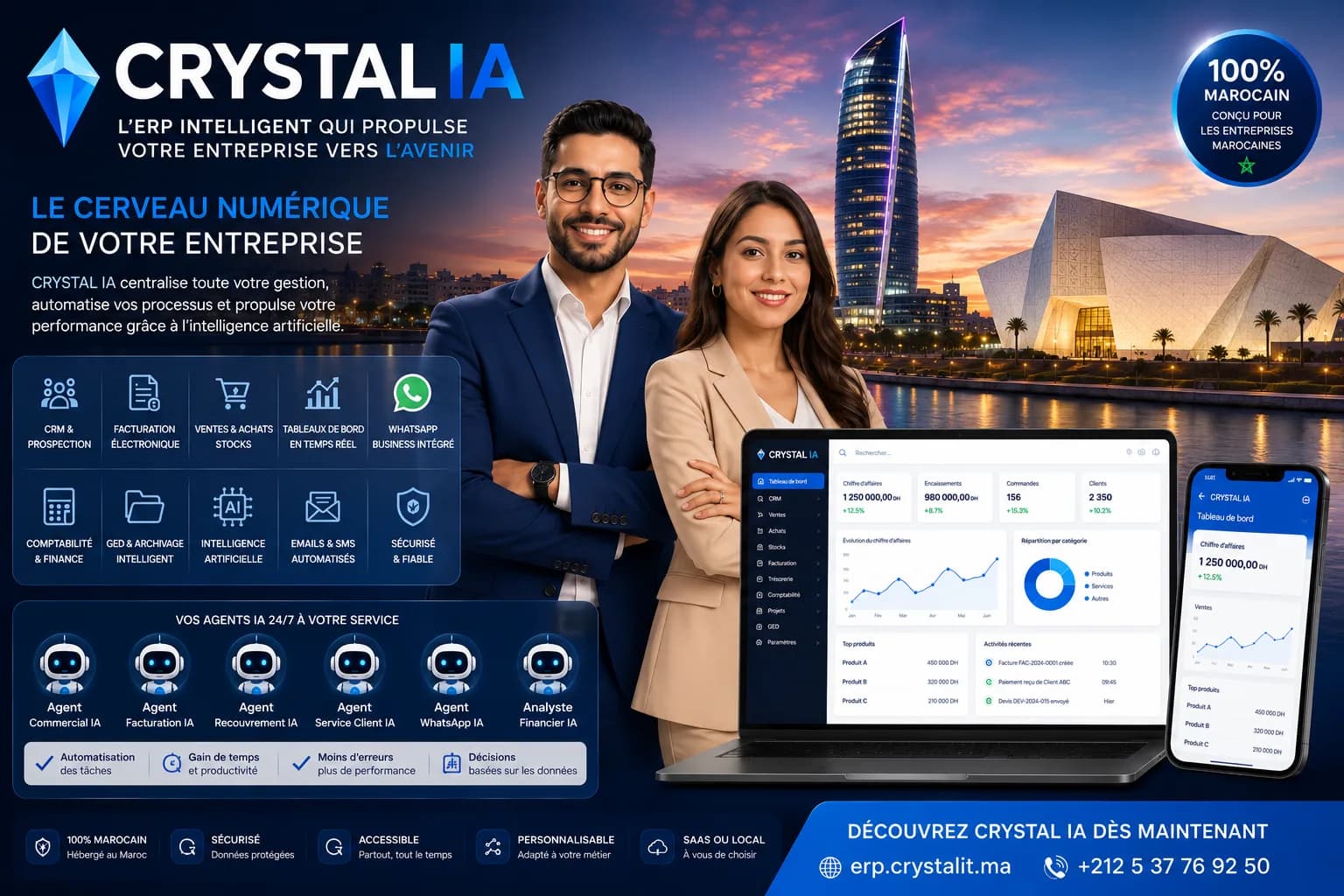
Crystal ERP, developed by CRYSTAL IT in Rabat, ticks the criteria that make the difference in the Moroccan context. It is an all-in-one SaaS ERP — quotes, orders, deliveries, invoices, inventory, purchasing, sales, accounting and CRM — accessible everywhere and updated continuously, including in step with regulatory changes. The built-in AI Chat assistant, powered by Crystal IA, makes it accessible even to teams who are not experts in management software.
Above all, behind the tool there is a local vendor with more than 20 years of experience and close support. For a Moroccan SME, this is the guarantee of a partner who understands its business, supports it at launch and remains reachable — exactly what separates a successful ERP project from one that gets bogged down.
Choosing an ERP well means starting from your real needs, thinking in total cost rather than displayed price, favouring SaaS for its flexibility and continuous updates, and never neglecting local compliance or support. In Morocco, these criteria point towards an integrated, lasting solution backed by a local vendor. Crystal ERP, powered by Crystal IA, was designed in this spirit. The best way to check that it fits your activity is to see it work on your own cases: request a personalised demonstration from the CRYSTAL IT teams in Rabat, with no obligation.
Have a project or a question? Let's talk with a CRYSTAL IT expert.
Request a demo