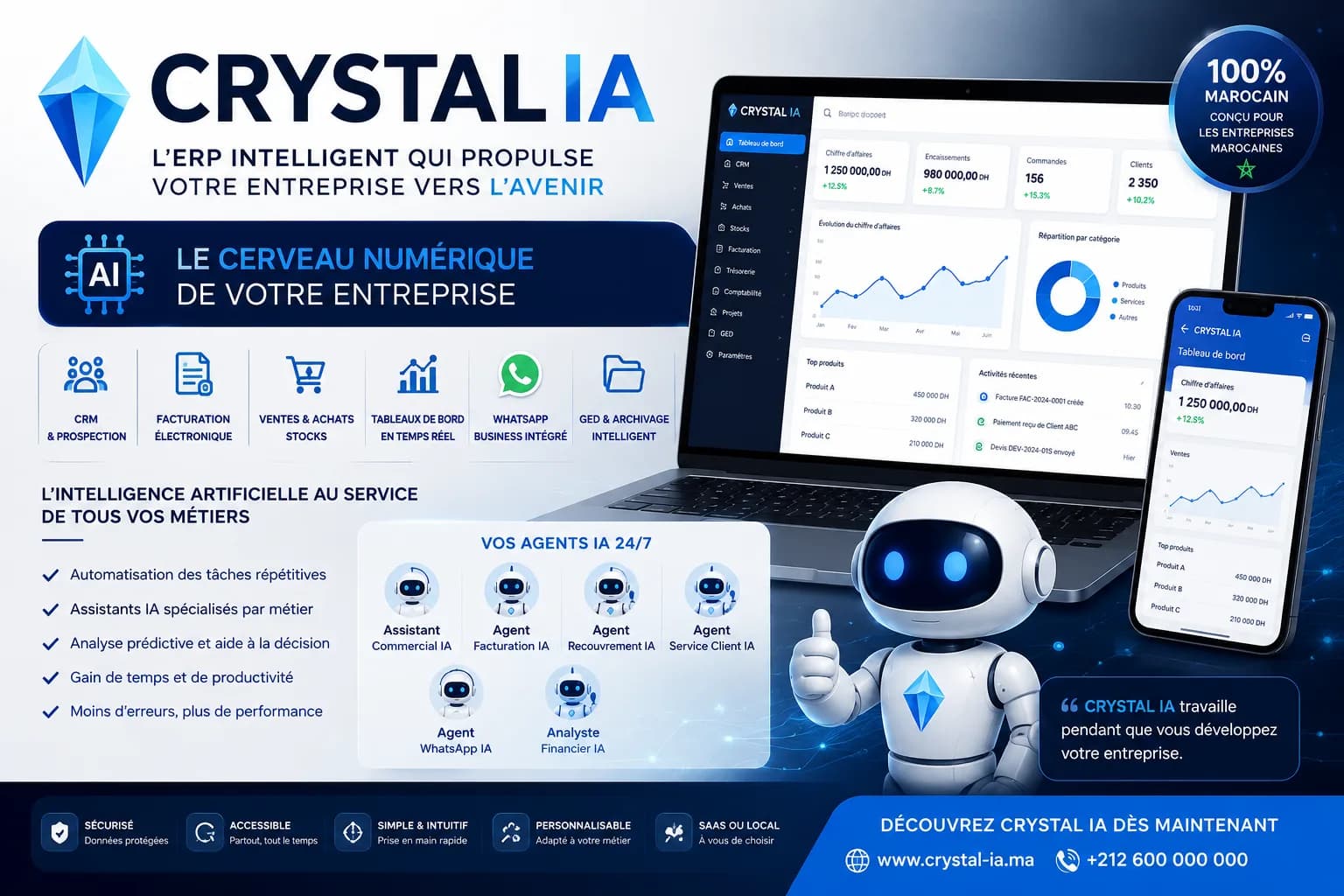
Transport and logistics management software in Morocco has become a strategic tool for road haulage companies, distributors, wholesalers with their own fleet, and logistics providers delivering across the national territory. Coordinating dozens of vehicles, planning efficient delivery routes, monitoring shipment status in real time, managing drivers and their documents, and invoicing customers as soon as a delivery is confirmed are tasks that quickly outgrow spreadsheets or basic invoicing software. Moroccan transport companies face growing challenges: the rise of e-commerce multiplying parcel flows, shipper requirements for full delivery traceability, pressure on fuel and vehicle maintenance costs, and the DGI electronic invoicing reform that progressively applies to B2B transactions (Electronic invoicing in Morocco in 2026). Crystal ERP (erp.crystalit.ma), developed by CRYSTAL IT in Rabat with more than 20 years of experience in management software for Moroccan companies, integrates transport management features into its commercial management module: fleet, routes, delivery notes, automatic invoicing and DGI compliance in a coherent flow. This guide describes what transport management software must cover for a Moroccan logistics company.
The logistics challenges facing Moroccan transport companies in 2026
Transport and logistics companies in Morocco operate in a rapidly changing environment. The rise of e-commerce and the proliferation of delivery platforms have fragmented flows: where a distributor once managed grouped deliveries to a few professional clients, they now need to orchestrate dozens or hundreds of deliveries per day to addresses scattered across an entire region. This evolution requires planning and tracking tools far more sophisticated than a simple delivery note register. Shippers — supermarkets, industrialists, e-retailers, importers — demand real-time visibility on their shipments, digital proof of delivery, and performance reports (on-time delivery rate, average lead time, return rate) that have become contract selection and renewal criteria.
Controlling operating costs is another central challenge. Fuel typically represents 30 to 40 % of a transport company's costs; vehicle maintenance and renewal is the second major expense. Without analytical tracking by vehicle and by route, it is impossible to calculate the true cost per kilometre, identify the most expensive vehicles to operate, or compare the profitability of different route types. Added to these operational challenges is the DGI electronic invoicing reform: transport companies invoicing professional clients or public entities must progressively adopt structured invoicing compliant with UBL 2.1 format, validated by Simpl-TVA. The applicable indicative deadlines and revenue thresholds should be confirmed on the official DGI portal.
- Fragmented tools: paper delivery notes, fleet tracking in a spreadsheet, invoicing in separate software — repeated data entry and cascading error risks.
- No real-time visibility: the customer does not know where their goods are; the manager does not know whether the driver is following the planned route.
- Uncontrolled operating costs: without analytical tracking by vehicle, it is impossible to calculate the true cost of a delivery and identify areas to optimise.
- Delayed invoicing: when the invoice is not generated as soon as the delivery is confirmed, the payment period lengthens and cash flow deteriorates.
- DGI compliance: the electronic invoicing reform imposes structured formats for B2B transactions — non-compliant software becomes a regulatory risk.
Fleet management and delivery route planning
Fleet management is the operational foundation of a transport company. It starts with the vehicle register: each lorry, van or light commercial vehicle is recorded with its technical characteristics (registration, payload, useful volume, reference fuel consumption), its regulatory documents (registration certificate, insurance, roadworthiness certificate, tachograph check) and its maintenance and breakdown history. The software tracks regulatory deadlines and triggers automatic alerts before documents expire and before scheduled services, avoiding infringements and unexpected downtime. Drivers are also registered with their licences, qualifications (hazardous goods, refrigerated transport), availability and driving history.
Route planning is the second fundamental building block. It consists of grouping the day's deliveries according to optimisation criteria — geographic zone, deadline constraints, vehicle capacity, customer priority — and assigning them to available vehicles and drivers. A transport management system structures this planning: it imports the orders to be delivered, groups them by zone, calculates the optimal sequence and generates route sheets for each driver. Crystal ERP (erp.crystalit.ma) enables routes to be created from pending customer orders, assigns each route to a vehicle and a driver, and automatically generates the corresponding delivery notes so the driver sets off with a complete file. To go further on the commercial management linked to transport, see our guide (Business management software in Morocco: the complete guide for SMEs).
- Complete vehicle register: characteristics, regulatory documents, maintenance history and deadline alerts — no surprise downtime.
- Driver management: licences, qualifications, availability and driving history per driver, for optimal route assignment.
- Route planning: grouping deliveries by zone, optimising sequence, assigning to vehicle and generating route sheets.
- Preventive maintenance alerts: scheduled services, roadworthiness checks, insurance renewal — triggered automatically by mileage or date.
- Fuel consumption tracking: fuel entered at each fill per vehicle, calculation of the true cost per kilometre and identification of fuel-heavy vehicles.
Real-time delivery tracking and proof of delivery management
Real-time delivery tracking has become a standard expectation from transport companies' clients, whether distributors, e-retailers or industrial shippers. Knowing a lorry is on its way is no longer enough: clients want to know the estimated delivery time, be alerted in the event of a delay, and receive a digital proof of delivery as soon as the goods are handed over. This demand for transparency is pushing transport companies to adopt tracking tools that connect the management office with drivers in the field, and clients with the status of their deliveries.
The digital proof of delivery (POD) replaces the paper delivery note signed by hand, which used to get lost in lorries or arrive at the office days late. With a digital tool, the driver has the client sign on their mobile device as soon as the goods are handed over; the proof of delivery is immediately recorded in the system, time-stamped and linked to the corresponding delivery note. If the client refuses the goods or reports a problem (damaged parcel, incorrect quantity), the reason for refusal is recorded with a supporting photo, automatically triggering a complaints-handling workflow. Crystal ERP integrates this process into its commercial management module: once delivery is confirmed, the delivery note moves to 'delivered' status and automatically triggers the corresponding invoice — eliminating the delay that usually elapses between physical delivery and invoicing. To go further on stock management linked to delivery flows, see our guide (Inventory management software in Morocco).
- Real-time delivery status: each delivery note passes through the stages assigned → in progress → delivered or returned, with a timestamp at each transition.
- Digital proof of delivery (POD): electronic client signature on mobile device, optional photo, immediate recording in the system.
- Refusal reason tracked: refused or partially delivered goods recorded with reason and photo, triggering the complaints-handling workflow.
- Automatic delay alerts: if the planned delivery time is exceeded, the manager and client are alerted without manual intervention.
- Delivery performance KPIs: on-time delivery rate, average lead time by zone and by driver, return rate — exportable for client reports.
Commercial management, customers and transport pricing
A transport company manages a complex commercial relationship with its clients: service contracts with delivery time and quality commitments, differentiated rate schedules by transport type (parcel, full loads, pallets, oversized goods, refrigerated transport), contractual discounts by client or by volume, and monthly consolidated invoices summarising all deliveries made during the month. Managing this complexity in a spreadsheet exposes the company to billing errors — forgotten deliveries, wrong rates applied, fuel surcharges omitted — that can represent several revenue percentage points unbilled or costly client disputes.
A transport management system integrates a CRM module tailored to the sector's specifics: a client file with their transport contracts, specific rate schedules and service requirements, a complete history of deliveries and incidents, and payment tracking. Crystal ERP (erp.crystalit.ma) automatically applies the correct rate when the delivery note is created — taking into account transport type, actual or volumetric weight, distance, contractual discounts and applicable surcharges — and consolidates the month's deliveries into a summary invoice sent on the date specified in the contract. This automatic flow from delivery to invoice drastically reduces billing errors and accelerates collections. To go further on commercial management, see our dedicated guide (Business management software in Morocco: the complete guide for SMEs) and our article on accounts receivable management (Accounts Receivable Collection Software for Moroccan SMEs).
- Transport client file: contracts, rate schedules by transport type, discounts and payment terms — automatically applied to each delivery.
- Multi-criteria pricing: price per actual or volumetric weight, per pallet, per route, per kilometre — with fuel surcharges updatable globally.
- Monthly summary invoice: all deliveries of the month grouped into a single invoice with detail by delivery note and by transport type.
- Payment tracking: aged balance by client, automatic reminders on unpaid invoices and integration with the cash flow module.
- Complete history by client: all deliveries, incidents, complaints and payments on one screen — basis for commercial negotiations and contract renewals.
Integrated transport invoicing and DGI compliance in 2026
Invoicing is the point where all flows in a transport company converge: each completed delivery becomes a billing line, each signed delivery note generates a receivable, and the final invoice summarises all services rendered under the client's contract. This flow is often the weakest link in transport companies that do not have an ERP: paper delivery notes arrive at the office late, some get lost, entering services is manual and prone to omissions, and invoicing stretches over several weeks after the end of the logistics month. The result is a systematic deterioration in settlement times and cash flow.
The DGI electronic invoicing reform amplifies this need for structure. Transport companies invoicing professional clients or public entities must progressively adopt invoicing in UBL 2.1 format, validated by the DGI's Simpl-TVA platform before it is legally valid — a simple PDF is no longer sufficient for B2B transactions. The indicative schedule provides for an obligation from 2026 for large companies (turnover > MAD 200 million) and progressively for medium-sized companies from mid-2026; SMEs with turnover < MAD 10 million are concerned from 2027. These deadlines are indicative and must be confirmed on the official DGI portal (Electronic invoicing timeline in Morocco). Crystal ERP (erp.crystalit.ma) generates transport invoices in UBL 2.1 format with the mandatory fields (client ICE, IF, VAT breakdown by rate), submits them to Simpl-TVA for validation and archives them electronically — in the same flow as delivery note management, with no third-party tool or re-entry. To understand the structured format requirements, see our guide (UBL 2.1 format for electronic invoicing in Morocco: complete guide).
- Automatic invoice from delivery note: as soon as delivery is confirmed (POD), the invoice is generated without re-entry at the correct rate and quantities.
- DGI-compliant UBL 2.1 format: ICE, IF, VAT breakdown and service lines in the structured format expected by Simpl-TVA — no manual conversion.
- Simpl-TVA integration: invoice submitted for DGI validation directly from Crystal ERP, within the usual invoicing flow.
- Time-stamped electronic archiving: all transport invoices archived and immediately available in the event of a tax audit or client dispute.
- Payment tracking and reminders: payments recorded by delivery note, automatic reminders and integration with the cash flow dashboard (Cash Flow Management for Moroccan SMEs).
Transport and logistics management in Morocco has entered a new era: the multiplication of delivery flows, shipper traceability requirements and the DGI electronic invoicing reform make it essential to adopt an integrated transport management system. A tool that connects route planning, delivery tracking, fleet management and invoicing in a coherent flow — from order to collection — transforms a reactive, disorganised and costly transport operation into a controlled, traceable and profitable service. Crystal ERP (erp.crystalit.ma), developed by CRYSTAL IT in Rabat with more than 20 years of experience serving Moroccan companies, covers this entire flow in a solution integrated with accounting (Accounting software in Morocco), purchasing (Purchase management software in Morocco) and CRM (CRM software in Morocco: managing client relationships and growing…). Contact the CRYSTAL IT team for a demonstration of Crystal ERP tailored to your transport activity and your fleet size.
Have a project or a question? Let's talk with a CRYSTAL IT expert.
Request a demo