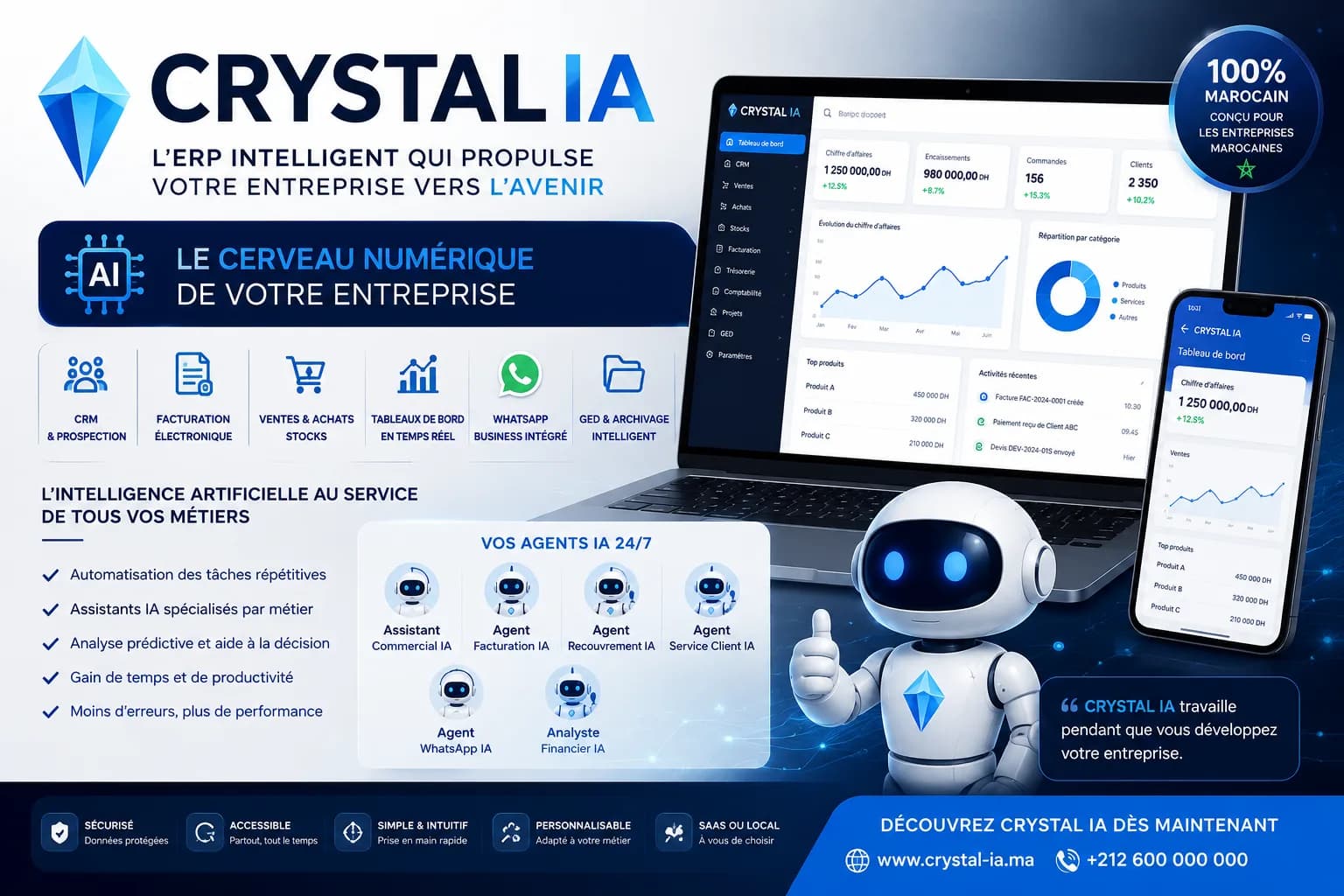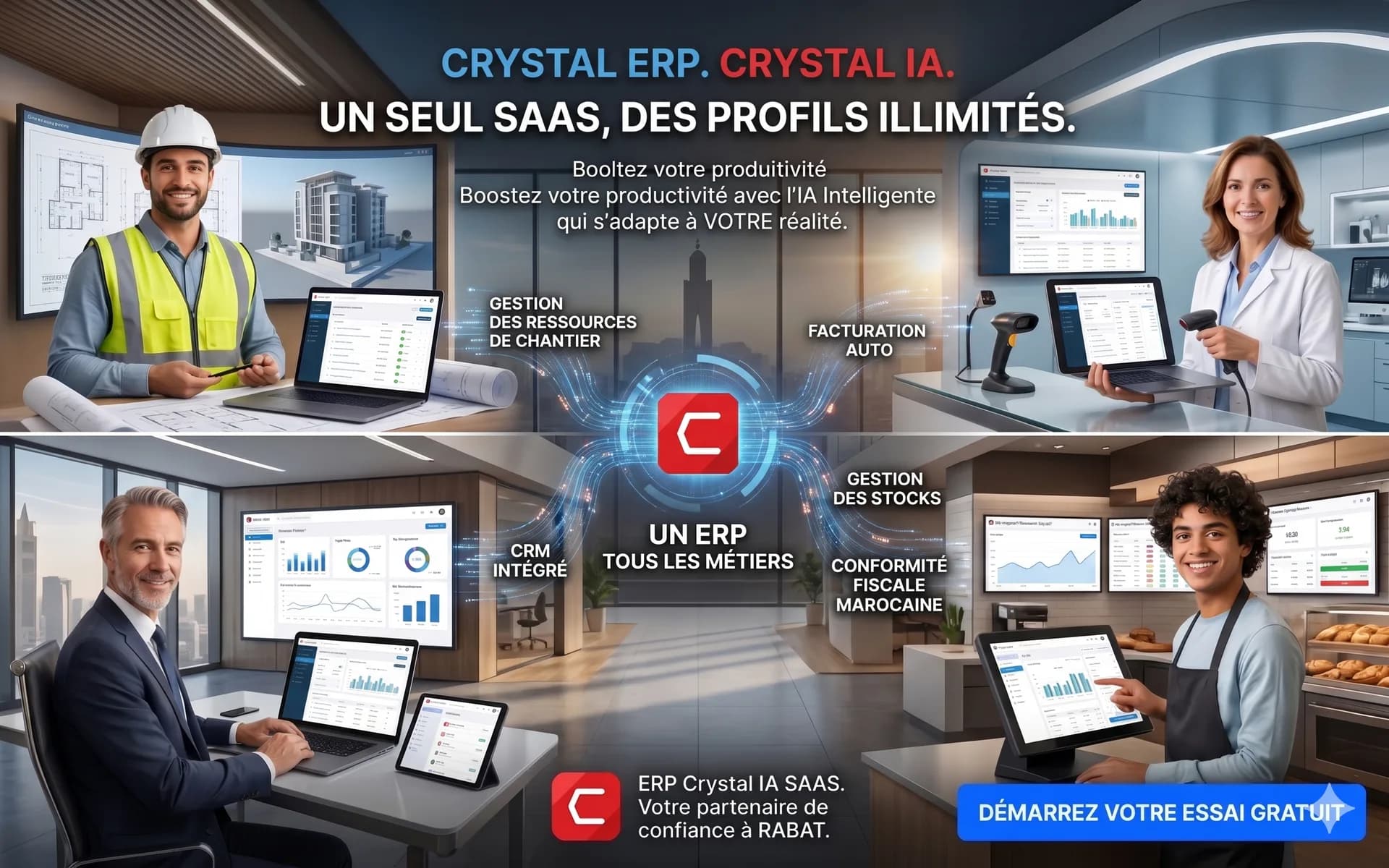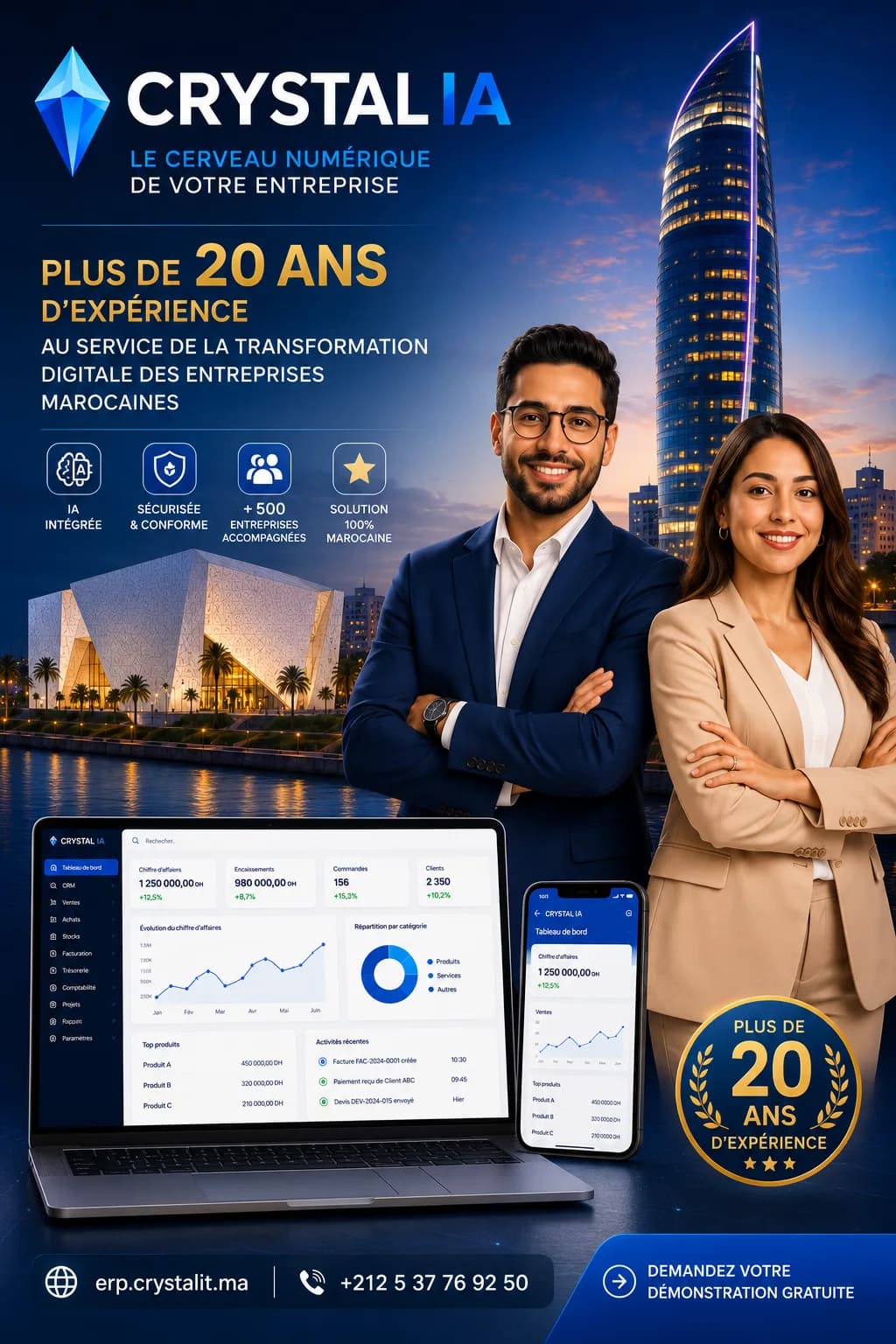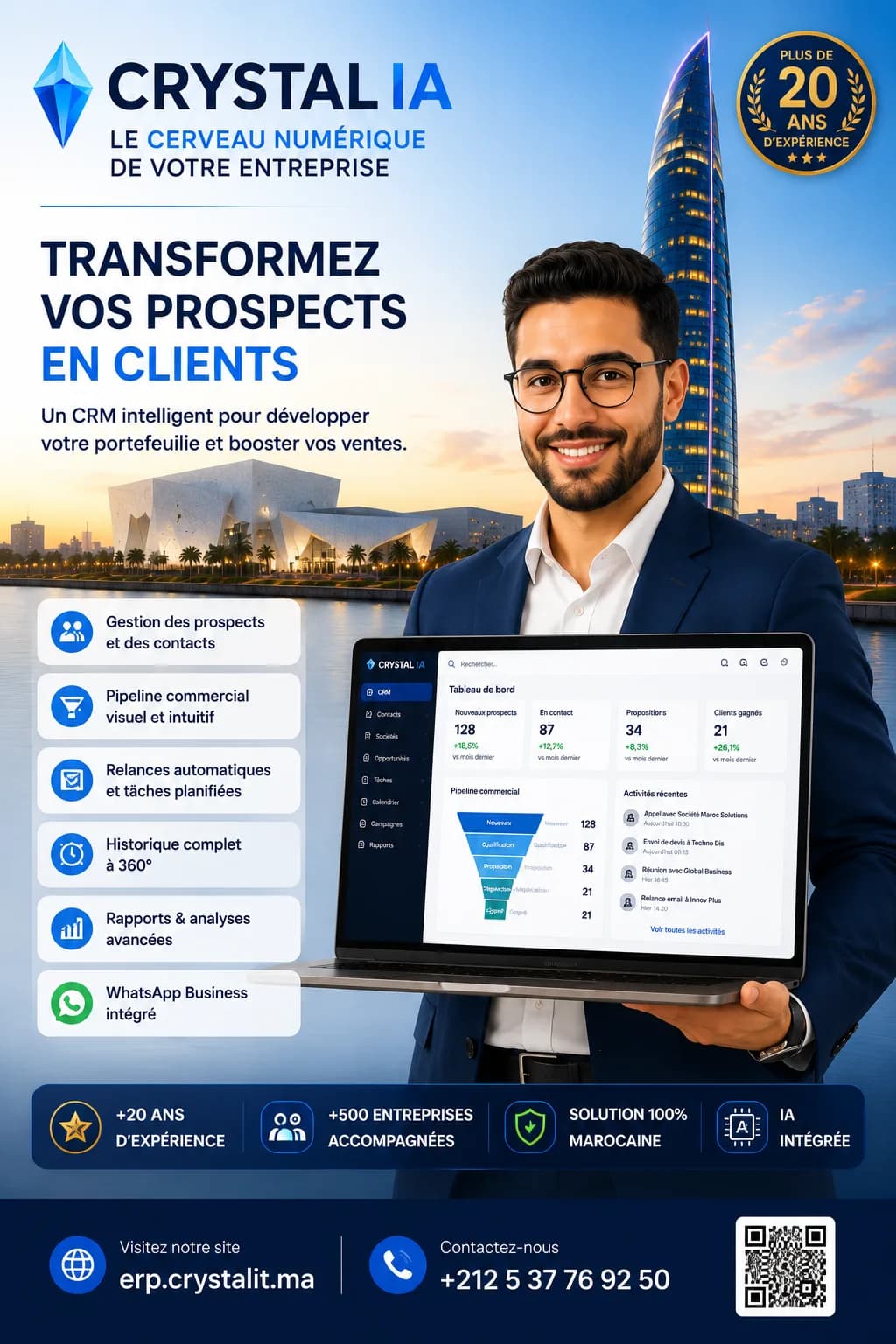
In Morocco, client relationships in many SMEs still rest on the memory of sales reps, a contact book and scattered email exchanges. While the team is small and the portfolio limited, this works. But as the business grows — more prospects, more clients, more sales reps — information gets lost, follow-ups fall through the gaps and no manager really knows the status of each opportunity. This is the problem CRM software solves, for small businesses as much as for larger ones. This article explains what a CRM is, what it should cover in the Moroccan context, and how to choose a tool that genuinely improves commercial management instead of weighing it down.
What exactly is a CRM?
CRM (Customer Relationship Management) refers both to an approach — centring the business on the client relationship — and to the software tool that puts it into practice. A CRM is the living database of your commercial activity: it centralises all information on your prospects and clients, the history of every interaction, the status of ongoing opportunities and the sales pipeline. Every sales rep and manager has access to current data — no more uncertainty about who said what to whom, no more duplicate follow-ups on the same client.
For a Moroccan SME, a CRM is not reserved for large sales teams. It is the tool that lets a manager know in seconds how many opportunities are in progress, which ones have stalled, which clients have not been contacted in too long, and which follow-ups are due this week. This real-time steering is impossible when information stays in sales reps' phones and inboxes.
The limits of managing clients without a CRM
Without a CRM, client knowledge belongs to individuals, not to the business. When a sales rep leaves, takes leave or is absent, the follow-up on their portfolio stops with them. Contacted prospects are never followed up at the right time, hot opportunities cool, and existing clients receive duplicate calls or — worse — are never called back. This dependence on individuals is one of the main barriers to growth for Moroccan SMEs.
A spreadsheet is the other false friend of the sales rep. A shared Excel file does not notify you of upcoming follow-ups, does not cross-reference information across team members, does not measure conversion rates between pipeline stages and gives no visibility on the actual value of the pipeline. As soon as a team has more than two or three sales reps, spreadsheet management costs more than it delivers.
- Loss of client knowledge when a sales rep leaves.
- Follow-ups forgotten or duplicated, for lack of centralised tracking.
- Inability to measure pipeline conversion rates.
- No real-time visibility on actual commercial potential.
- Data scattered across emails, phones and shared files.
What a CRM should cover for a Moroccan SME
A good CRM software in Morocco is not just an enhanced contact directory. It must cover the entire commercial cycle, from the first contact to long-term loyalty, and integrate with the other management tools. Here are the essential functions to require when evaluating a solution.
The quality of a CRM is also measured by what it allows you to remove: double data entry, forgotten follow-ups, manually built reports. A well-chosen tool frees up time rather than consuming it.
- Unified prospect and client record: contact details, interaction history, shared documents.
- Pipeline management: visualisation of opportunities by stage, value and closing probability.
- Automatic follow-ups and reminders: never miss a deadline or let an opportunity go cold.
- Full interaction history: calls, emails, meetings, all linked to the client record.
- Commercial dashboards: conversion rate, performance by sales rep, revenue forecast.
- Mobile or SaaS access: sales reps in the field can access information from their phone.
CRM and the sales cycle: from first contact to loyalty
The CRM delivers its full value over the length of the commercial cycle. In the prospecting phase, it helps qualify leads — distinguishing cold contacts from real opportunities — and structure follow-up: what action to schedule, on what date, following which exchange? This structure is particularly valuable in B2B sales in Morocco, where cycles are long and often involve several contacts at the client's end.
In the loyalty phase, the CRM changes role: it becomes the institutional memory of each client. What have they bought, at what frequency, what difficulties have they encountered? This information enables you to anticipate their needs, propose the right product at the right time and nurture the relationship beyond the simple transaction. A loyal client costs less to serve than a new client to win: the CRM is the tool that makes this loyalty systematic and measurable.
Artificial intelligence for the CRM: client scoring and intelligent alerts
The new generation of CRM software no longer just records: it helps to decide. Client scoring is one of the most concrete contributions of AI applied to sales management. Rather than leaving each sales rep to judge intuitively which opportunities deserve priority follow-up, an algorithm automatically evaluates the potential of each client or prospect based on their purchase history, behaviour and recent interactions.
This is one of the functions that Crystal IA, CRYSTAL IT's artificial intelligence engine, brings directly into Crystal ERP. AI-powered client scoring helps Moroccan sales teams concentrate their effort where the chances of closing are highest, rather than dispersing their time across an unpriorised portfolio. For a sales manager or SME owner, this decision support is concrete and immediately measurable in results.
CRM integrated in an ERP or standalone tool: the right choice for an SME
Two main families of solutions compete in the market: specialist CRMs (often powerful but disconnected from the rest of management) and CRMs integrated into an ERP or commercial management system. For the vast majority of Moroccan SMEs, the second option is far preferable, for a simple reason: the value of a CRM comes from the data that feeds it, and the most reliable data is what comes directly from management — invoices, payments, deliveries, purchase history.
With a standalone CRM, this data does not flow in automatically: it has to be entered twice, with all the errors and desynchronisation risks that implies. With Crystal ERP, the CRM is part of the same system as sales, purchasing, invoicing and stock. A sales rep immediately sees their client's latest quote, outstanding receivables or recent purchases — without juggling multiple tools. This continuity of information is what transforms a CRM from a directory into a genuine commercial lever.
- Management data accessible directly in the client record: invoices, quotes, payments.
- No double entry between CRM and commercial management.
- Client scoring and AI assistant available in the same tool.
- Accessible in SaaS mode, everywhere, on all devices.
- A single local vendor for everything — sales, stock, accounting, CRM.
Client relationship management is not primarily a technology matter: it is a commercial discipline that the right tool makes systematic and measurable. For a Moroccan SME, a CRM adapted to the local context — integrated with commercial management, accessible everywhere in SaaS, reinforced by AI — is no longer a luxury: it is what enables structured growth without sacrificing the quality of the relationship. Crystal ERP, powered by Crystal IA, integrates this CRM logic at the heart of all management: every client is known, followed and valued over the long term. To discover what an integrated CRM could change in your commercial activity, request a personalised demonstration from the CRYSTAL IT teams in Rabat: we will show you the solution on your own use cases, with no obligation.
Have a project or a question? Let's talk with a CRYSTAL IT expert.
Request a demo