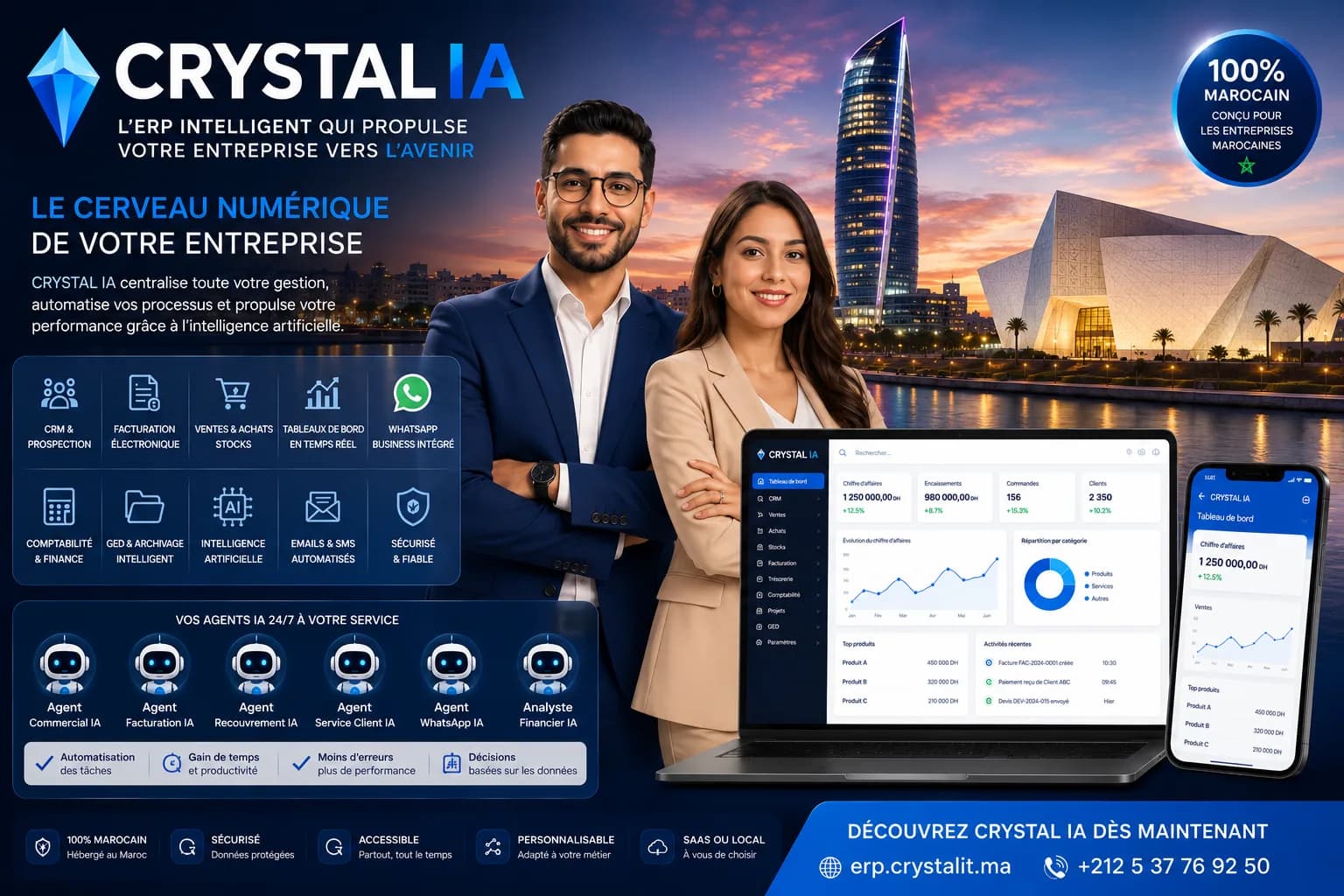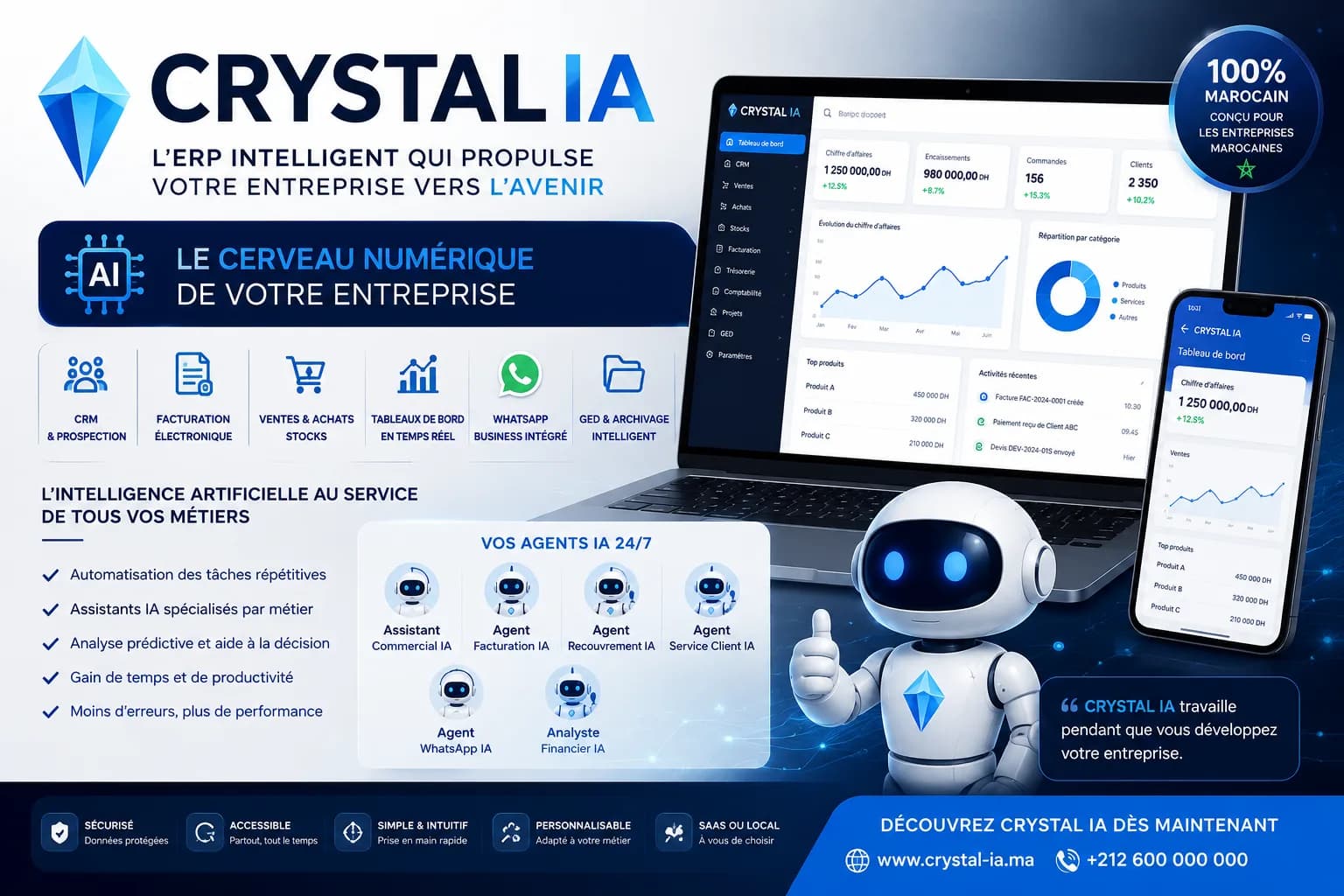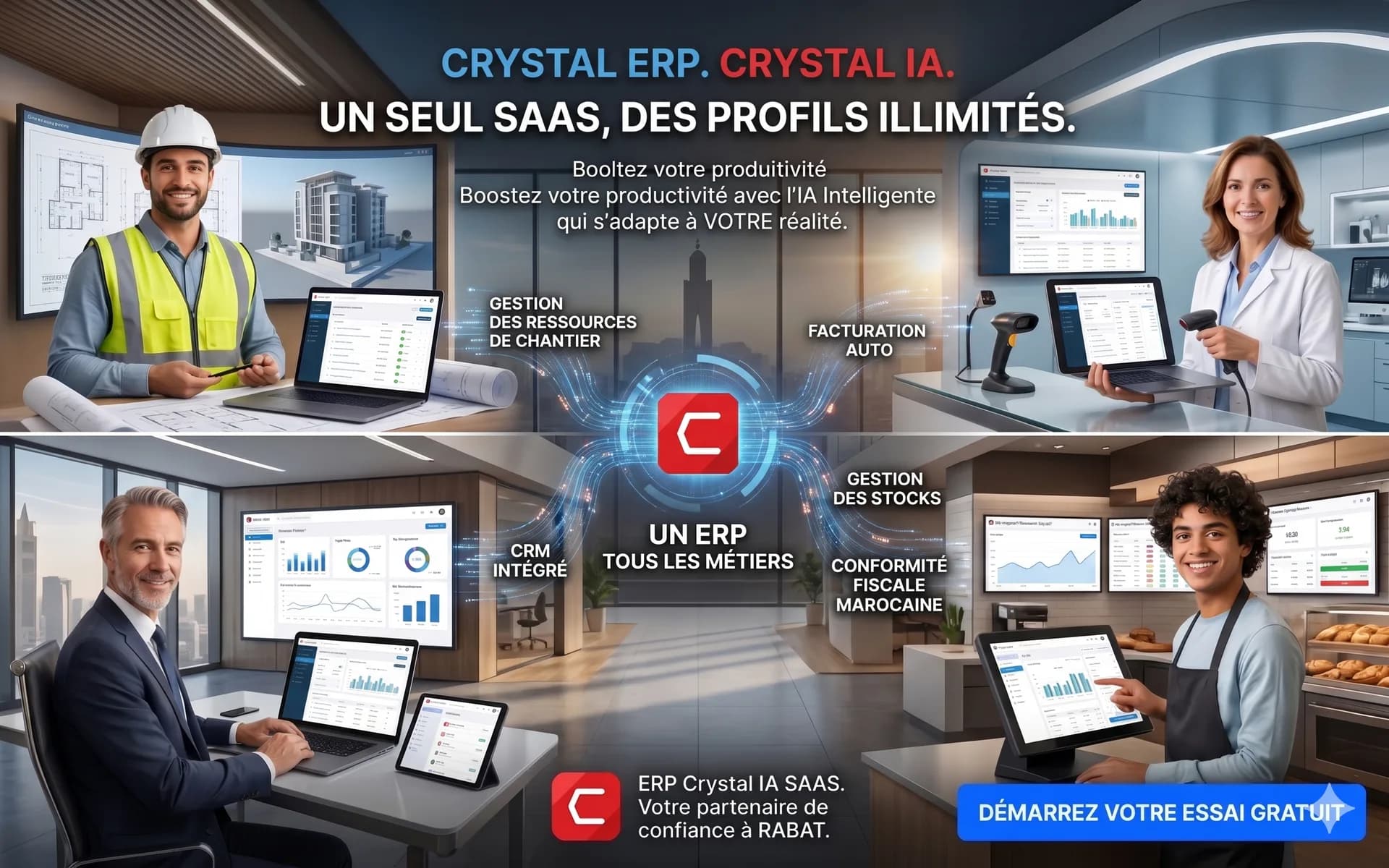
Morocco's restaurant sector is booming, driven by rising tourism, rapid urbanisation and steady growth in out-of-home consumption. From fine-dining restaurants in Casablanca to traditional cafés in Marrakech and corporate catering services, every establishment faces the same management challenges: controlling perishable raw-material inventories, fast and error-free payment processing, issuing compliant invoices for professional customers in line with the DGI's requirements, and tracking profitability in real time. Restaurant management software in Morocco addresses these issues by integrating a touchscreen point of sale, kitchen inventory, invoicing and performance indicators in a single tool. Without such a solution, restaurateurs juggle a standalone till, an inventory spreadsheet, manual invoicing and an accounting system that is impossible to keep up to date — a fragmentation that generates undetected ingredient losses, unreconciled cash discrepancies and very limited operational visibility. Crystal ERP (erp.crystalit.ma), developed by CRYSTAL IT in Rabat with over 20 years of experience in management software for Moroccan businesses, offers a POS and management module fully integrated with a complete ERP — from payment processing to accounting close, covering kitchen inventory tracking and invoicing with the mandatory tax details. This guide details what restaurant management software must cover for the Moroccan market in 2026, and how to choose the right solution.
The specific challenges facing Moroccan restaurateurs in 2026
Restaurants are operationally intensive businesses: a mid-sized establishment processes dozens to hundreds of orders per service, manages fast-moving stocks of perishable raw materials, faces unpredictable demand spikes and must maintain consistent quality with teams that are often stretched thin. Without dedicated software, coordination between the front of house, kitchen and till relies on manual processes that multiply errors and slow down service.
In 2026, two factors are amplifying these challenges. First, the DGI's e-invoicing reform provides that invoices between businesses become structured invoices (the standards cited are UBL 2.1 and UN/CEFACT CII), subject to the prior validation announced for the DGI's electronic invoicing platform; under the announced timetable, SMEs come into scope in 2027-2028 and very small businesses after 2028. In time, a simple receipt printed by the till will no longer suffice for B2B sales. To check the timeline and thresholds applicable to your establishment, consult the DGI's official portal and our dedicated article (Electronic invoicing in Morocco in 2026). Second, margin pressure is intensifying: rising food commodity prices make tracking ingredient costs an absolute priority for staying profitable.
- Perishable inventory management: food ingredients have short shelf lives; a mid-service stockout or wasted surplus directly erodes margins.
- Fragmented tools: POS, kitchen stock, supplier purchases and accounting managed separately → triple data entry, undetected losses.
- DGI compliance for B2B customers: restaurants billing companies will have to issue structured invoices compliant with the DGI reform.
- Difficult piloting: without a real-time dashboard, impossible to know the average spend, ingredient cost per dish or weekly margin.
- Multi-staff management: servers, cooks, manager — the software must be simple to use for the team and comprehensive for the owner.
POS and till: smooth service and reliable payment processing
The till is the first point of contact between the restaurant and its customers. In food service, it must meet specific requirements: fast order-taking at table or counter, automatic order printing in the kitchen and at the bar, floor plan management (table assignment, occupancy time, service progress), multi-tender payment (cash, bank card, mobile payment, meal vouchers, bank transfer for professional clients) and end-of-day reconciliation. A POS integrated with an ERP synchronises every payment with the accounting system and inventory: as soon as an order is confirmed, the corresponding ingredients are automatically deducted from kitchen stock, with no manual re-entry.
Service management also covers complex situations: table transfers, split orders, complimentary items, discount promotions, reservation management and set menu handling. Advanced functions cover takeaway orders, home delivery with platform integration, and instant menu updates with availability and price changes in seconds. Crystal ERP (Point of Sale Software in Morocco) incorporates these functions in a point-of-sale module designed for Moroccan retailers and food service establishments.
- Intuitive touchscreen POS: order-taking in seconds, with automatic order printing in the kitchen and bar.
- Floor plan management: real-time view of table status (free, occupied, awaiting bill), server assignment and service progress tracking.
- Multi-tender payments: cash, bank card, mobile payment, meal vouchers, professional bank transfer — all centralised in the till.
- Automatic end-of-day close: reconciliation of payments by tender type, cash summary and automatic accounting transfer.
- Menu and price management: instant update of available dishes, set menus and daily specials with correctly apportioned VAT.
Kitchen inventory management and ingredient cost control
Kitchen inventory is one of the most powerful levers for managing margins in food service. Food ingredients are perishable, expensive and sensitive to market price fluctuations. Rigorous management requires maintaining a perpetual inventory updated at every supplier delivery and every kitchen use, setting minimum stock levels with automatic low-stock alerts, and valuing each recipe at the actual ingredient cost to know precisely what it costs to produce each dish.
The concept of a recipe or technical sheet is central: it lists the ingredients and quantities needed to produce one portion. When integrated into the software, it automatically calculates the ingredient cost for each dish based on current purchase prices, deducts usage from stock with each sale, and detects variances by comparing theoretical consumption (calculated from sales) with actual consumption (measured at physical stocktake). This variance reveals over-sized portions, waste or abnormal losses. Supplier purchase management completes this picture: purchase orders, goods receipt with quantity checks, automatic stock and supplier accounting updates, as detailed in our purchasing guide (Purchase management software in Morocco).
- Perpetual inventory: every ingredient's stock level is updated in real time at each receipt and each sale, with no separate manual entry.
- Recipes / technical sheets: ingredient cost automatically calculated for each dish, with instant update when purchase prices change.
- Low-stock alerts: minimum reorder levels set per ingredient; the alert fires before the kitchen runs out.
- Use-by and best-before tracking: expiry date monitoring to reduce waste and comply with food safety obligations.
- Theoretical vs actual comparison: detection of variances between calculated consumption (from sales) and measured consumption (stocktake) to identify loss sources.
Invoicing and DGI compliance: receipts, B2B invoices and restaurant VAT
Not all restaurants are equally affected by the DGI's e-invoicing reform. Counter or table sales to individual customers (B2C) continue with a receipt or till printout. However, restaurants that bill companies — staff restaurants, B2B caterers, hotels billing professional groups, tea rooms issuing invoices for business meetings — fall within the reform's scope: their B2B invoices will have to be issued in structured format (UBL 2.1 or CII) and go through the prior validation announced for the DGI's electronic invoicing platform. The announced timetable depends on company size (large companies in 2026 for their transactions with the State, SMEs and mid-sized companies in 2027-2028, very small businesses after 2028); the precise dates are to be set by decree and checked on the DGI's official portal (tax.gov.ma).
An integrated restaurant management solution generates receipts and invoices from the same confirmed order: a printed receipt for individual customers, an invoice with ICE and VAT breakdown for professional customers, exportable in UBL 2.1 format. Restaurant VAT management — with its different rates depending on the nature of products (food, alcoholic beverages, tobacco, services) — is automated, eliminating manual apportionment errors. For further guidance on compliance, see our guide to choosing invoicing software (Invoicing software in Morocco: preparing for the DGI reform) and the article on the UBL format (UBL 2.1 format for electronic invoicing in Morocco: complete guide).
- B2C receipts and tickets: automatic generation from the till with the required legal information (VAT, order number, date).
- Structured B2B invoices: standard UBL 2.1 export and readiness check (ICE, mandatory details) for professional customers, directly from the confirmed order.
- Multi-VAT management: automatic apportionment of applicable VAT rates by product type, in line with Moroccan tax rules.
- Digital invoice archiving: legal retention of all invoices issued in Crystal ERP, accessible in the event of a DGI audit.
- Payment centralisation: receipts (cash, card, bank transfer) are reconciled with invoices and automatically posted to the accounting module.
Profitability management: key indicators for Moroccan restaurateurs
A restaurant's profitability is decided in the details: which dish generates the best margin? Which service generates the most covers? Which supplier offers the best value for money on ingredients? These questions can only be answered reliably if sales, inventory and purchasing data are centralised in an integrated system that calculates indicators automatically. A restaurateur flying blind — without a dashboard, without ingredient cost tracking, without sales history — makes decisions on the menu, pricing and purchasing without measurable grounds.
Crystal ERP (erp.crystalit.ma) centralises this data in a management dashboard accessible in real time: revenue by service and by period, average spend per server and customer category, ingredient cost per dish and per family, gross margin rate, supplier price trends. This visibility transforms the daily management of the restaurant: instead of discovering at month-end that margins have eroded, the owner acts during the week — by adjusting portion sizes, renegotiating with a supplier or removing an unprofitable dish from the menu. For a deeper look at management tools, see our guide on dashboards (Business dashboard in Morocco: managing your company in real time).
- Average spend and covers: real-time tracking of the average ticket per service, per day and per period, to adjust offers and opening hours.
- Ingredient cost per dish: automatic calculation of the cost-to-selling-price ratio to identify unprofitable dishes and optimise the menu.
- Sales analysis by category: which dishes sell best and at which time of day — actionable data for menu adjustments and stock management.
- Supplier purchase tracking: purchase price trends per ingredient to renegotiate contracts at the right time and spot cost overruns.
- Real-time cash flow: visibility of cash generated by operations, outstanding supplier payables and professional customer receivables awaiting settlement.
Managing a restaurant in Morocco in 2026 requires far more than a till and a spreadsheet: DGI compliance for professional customers, ingredient cost control on perishable goods with fluctuating prices, real-time kitchen inventory management and per-dish profitability tracking are challenges that exceed the capabilities of unintegrated tools. Restaurant management software connected to a full ERP transforms these constraints into performance levers: no unexpected kitchen stockouts, no unreconciled cash discrepancies, B2B invoices with the mandatory tax details and daily margin indicators. Crystal ERP (erp.crystalit.ma), developed by CRYSTAL IT in Rabat with over 20 years of experience in management software for Moroccan businesses, covers this entire scope in an integrated SaaS solution — from the POS and till (Point of Sale Software in Morocco) to B2B invoicing (Invoicing software in Morocco: preparing for the DGI reform), covering supplier purchase management (Purchase management software in Morocco) and management dashboards (Business dashboard in Morocco: managing your company in real time). Contact the CRYSTAL IT team for a Crystal ERP demonstration tailored to your food service establishment.
Have a project or a question? Let's talk with a CRYSTAL IT expert.
Request a demo