For many Moroccan SMEs, purchasing remains one of the least-equipped functions in management. Yet every dirham spent with a supplier has a direct impact on margin, cash flow and the capacity to fulfil customer orders. Who orders what, at what price, from which supplier, and when must delivery arrive? Without a dedicated tool, these questions have no clear answer, and purchasing management is reduced to a series of isolated decisions, often made too late. A purchase management solution changes the equation: it centralises supplier orders, receipts, prices and lead times, and links them to stock management and accounting. This article explains why the purchasing function deserves a proper tool, and how Moroccan SMEs can optimise it with integrated management.
Why purchasing management is an underestimated lever for Moroccan SMEs
In an SME, management attention naturally gravitates towards sales and customers. Purchasing, by contrast, is often seen as an operational constraint: order what is needed, pay the invoices, move on. This narrow view lets considerable gains slip away. Well-managed purchasing allows better terms to be negotiated, stock-outs to be avoided, emergency orders — always more expensive — to be limited, and supplier payment terms to be controlled to preserve cash flow.
In many sectors, the purchasing line represents between 40 % and 70 % of revenue. A 5 % reduction in this cost often has more impact on profitability than an equivalent increase in sales. Yet without visibility on what is being purchased, from whom and at what price, any negotiation remains guesswork. A supplier purchase management solution provides exactly this visibility: a history per supplier, price comparison, lead-time tracking, volume analysis. It is a profitability lever that has too long been neglected in Moroccan SMEs.
The limits of purchasing management without a dedicated tool
Without dedicated software, purchasing management generally relies on an assemblage of Word purchase orders, email follow-ups and manually maintained spreadsheets. Each order is handled independently: the original purchase order must be tracked down to check whether the delivery is complete, and the information must then be re-entered in the accounting software to record the expense. These repeated manual steps open the door to errors, omissions and duplicate payments.
The problem worsens as the number of suppliers and references grows. Without a dashboard, it is impossible to know, at the time of placing an order, whether the same product has already been ordered from another supplier, whether the price is consistent with the historical record, or whether the supplier's promised lead time is reliable. These gaps have direct consequences: duplicate orders, unanticipated stock-outs, poorly reconciled supplier invoices, and cash-flow pressure from poorly planned payments.
- Purchase orders created manually, with no history or price comparison.
- No alert in the event of a partial or delayed delivery.
- Supplier invoices reconciled by hand, a source of errors and omissions.
- Impossible to measure supplier performance in terms of lead times, quality and prices.
- Stock perpetually out of step with outstanding supplier orders.
What a good purchase management solution should cover
A purchase management solution does not simply record purchase orders. It must cover the entire procurement cycle, from the purchase request to receipt and the supplier invoice, including supplier selection and evaluation. This complete coverage is what makes it possible to eliminate double data entry and give the purchasing manager real visibility over the entire spend.
Here are the essential functions to require from a solution suited to Moroccan SMEs:
- Purchase requests and orders: creation, tracking and automatic conversion into receipt then supplier invoice, with no re-entry.
- Supplier management: supplier directory with price, lead-time and performance history.
- Receipts and delivery checking: recording of partial or complete receipts and tracking of discrepancies against the order.
- Supplier invoice reconciliation: validation of received invoices against purchase orders and receipts, to avoid errors and duplicate payments.
- Alerts and follow-ups: notifications for late orders and automated supplier reminders.
- Purchasing dashboards: volume per supplier, average purchase price, average lead times and cost trends.
Purchasing, stock and accounting: the integrated chain that eliminates double entry
One of the most common pitfalls is treating purchasing as a function separate from stock and accounting. Yet these three areas form an inseparable chain: a placed order must feed stock on receipt, and the corresponding supplier invoice must automatically generate the accounting entry. When these functions live in separate tools, all this information must be re-entered, creating discrepancies and errors that can never be entirely eliminated.
The value of integrated management lies precisely in this continuity. When a supplier purchase order is entered once in the system, it automatically becomes a receipt at the time of delivery, updates the available stock, and generates the supplier invoice that feeds the accounts with no manual intervention. The manager thus has, in real time, reliable stock, an up-to-date cash position and accounts that faithfully reflect actual operations. This integration is the prerequisite for effective supply chain management in a Moroccan SME.
How to choose your purchase management software in Morocco
The market offers a wide range of solutions, from purchasing modules integrated in an ERP to specialist tools. For a Moroccan SME, the choice should be guided by one central criterion: integration. A standalone purchasing solution, disconnected from stock and accounting, merely shifts the double-entry problem rather than solving it. The right question is therefore not 'what is the best purchasing software?' but 'how does purchasing integrate with the rest of my management?'
Beyond integration, check the following points before committing:
- Native integration with stock, sales and accounting: a single entry, a single system.
- SaaS mode, to access purchasing data from anywhere and benefit from continuous updates.
- Multi-supplier management and price comparison, for more effective negotiation.
- The ability to handle partial receipts and invoices with discrepancies, unavoidable in practice.
- Readiness for mandatory e-invoicing, which will also cover supplier invoices under the DGI reform.
- Proximity and longevity of the publisher: an interlocutor who understands the Moroccan market and supports deployment.
Crystal ERP: purchasing integrated with your entire management in real time
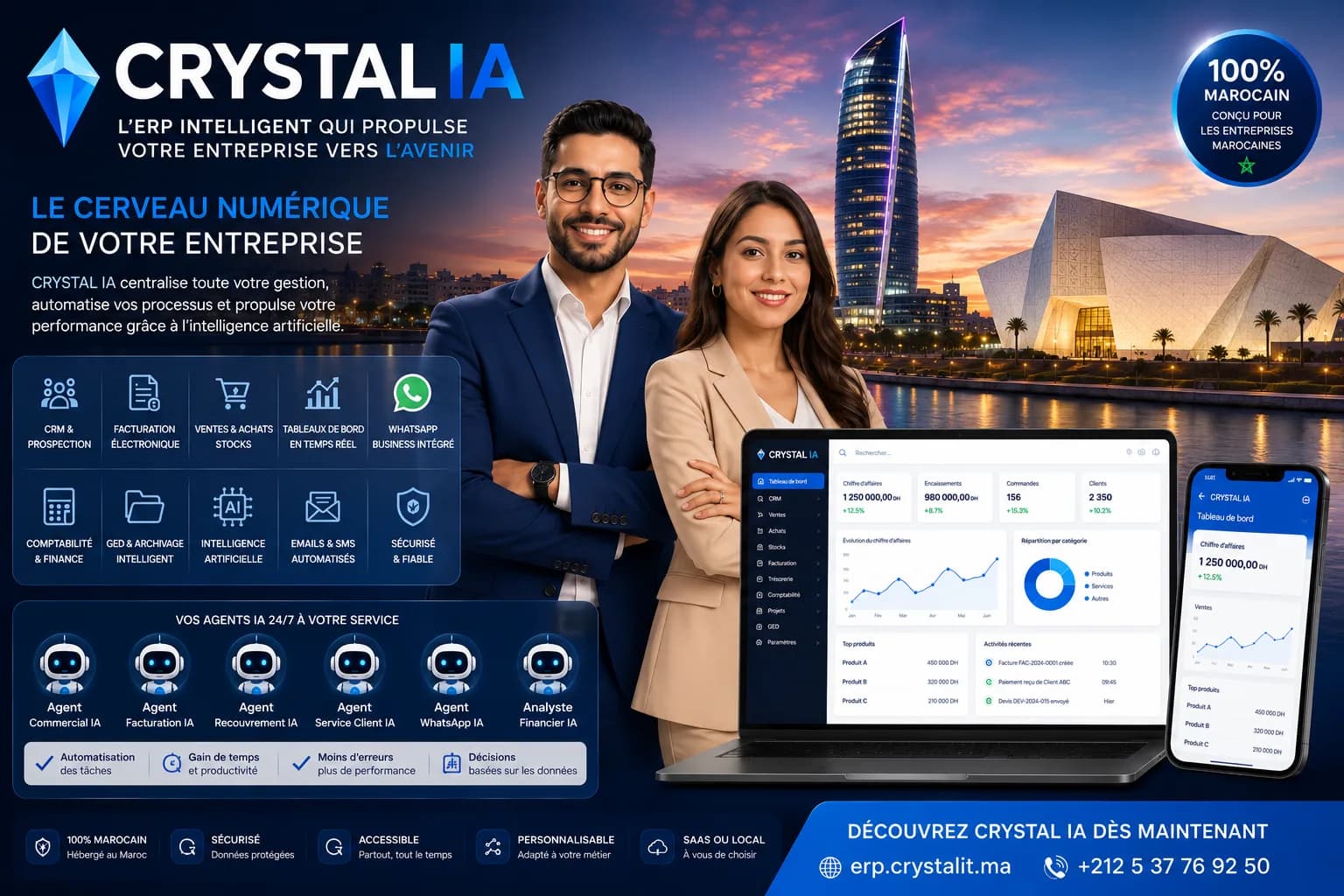
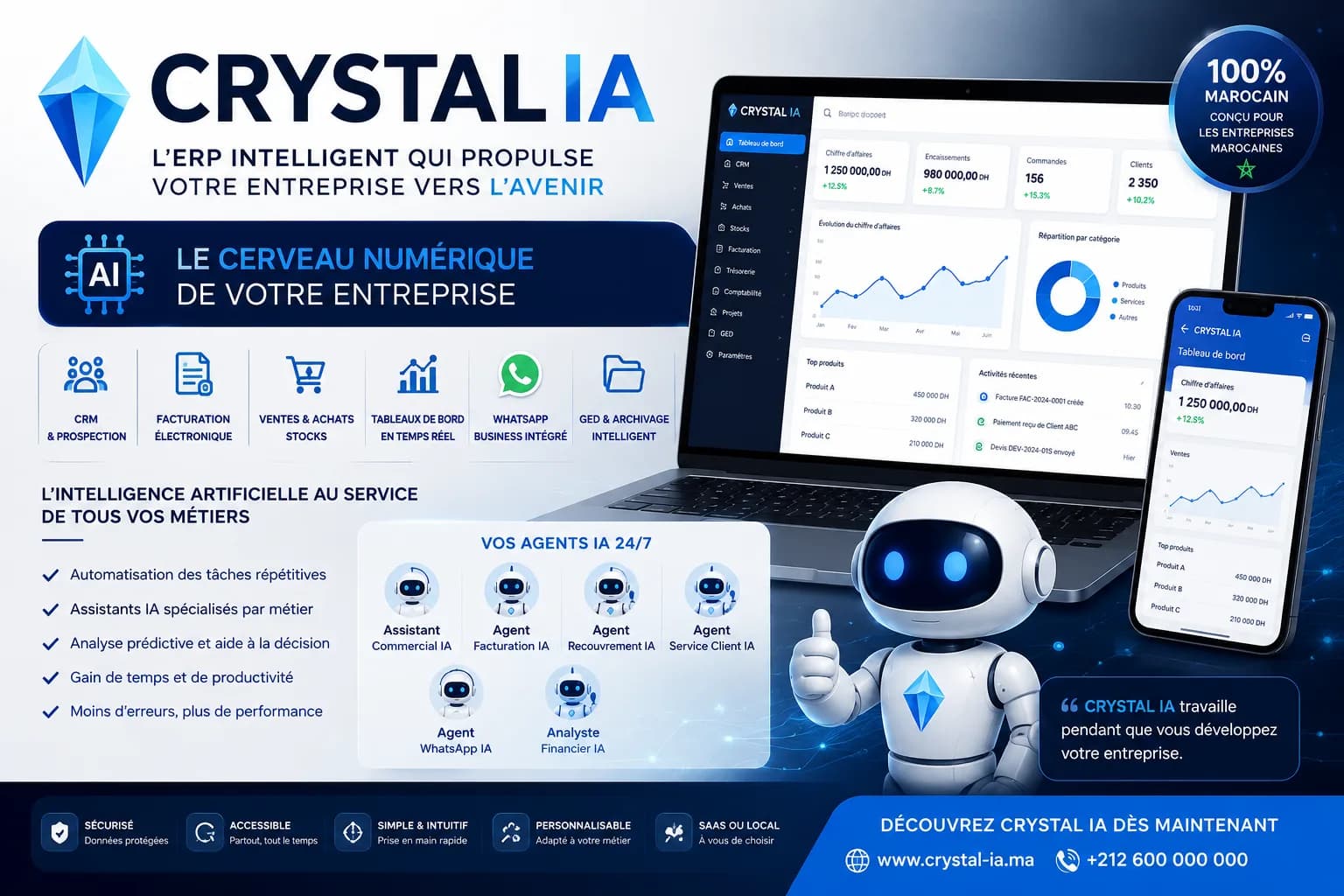
In Crystal ERP, the SaaS ERP published by CRYSTAL IT, supplier purchasing management is not a separate module: it is one of the pillars of the system, connected in real time to stock, sales and accounting. Supplier orders, receipts and invoices flow in a single stream: a receipt automatically updates stock, and the supplier invoice generated from that receipt feeds the accounts with no manual intervention. The purchasing manager has a complete history per supplier, a view of outstanding orders and alerts on late deliveries.
Powered by Crystal IA, CRYSTAL IT's artificial intelligence engine, Crystal ERP also provides a Chat AI assistant directly accessible in the tool. The purchasing manager can query their data — which suppliers have the best average lead time, what is the average purchase price of a given product over the last twelve months — and receive answers based on the company's real data, without building a report. Published in Rabat by a company with over 20 years of experience, Crystal ERP is supported by a local team available six days a week.
Managing purchasing well is not only about avoiding stock-outs and duplicate payments: it is about transforming a passive cost line into a genuine profitability lever. For a Moroccan SME, this means a tool that integrates supplier orders with stock, accounting and sales in a single flow, with no re-entry. Crystal ERP, powered by Crystal IA, is designed with this in mind: purchasing is the first link in a chain that runs from the supplier purchase order to the company's management dashboards. To see concretely how Crystal ERP would optimise your purchasing management, request a personalised demonstration from the CRYSTAL IT teams in Rabat: we will show you the solution on your own use cases, with no obligation.
The CRYSTAL IT solution on this topic
Have a project or a question? Let's talk with a CRYSTAL IT expert.
Request a demo