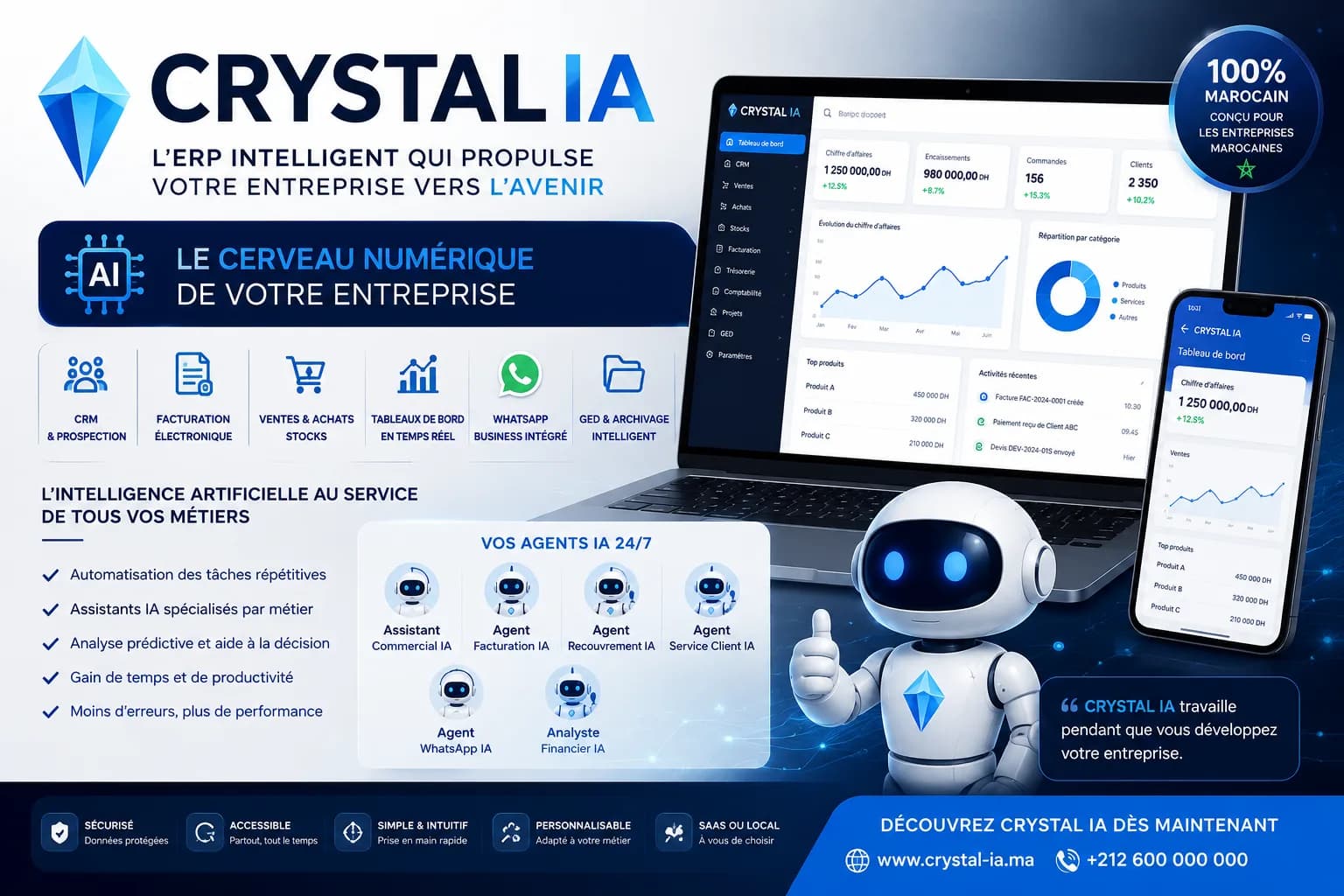
The Moroccan real estate sector plays a structural role in the national economy. Property developers — whether they build residential units, offices or land developments — face highly complex management: each real estate project is a standalone entity with its own units, buyers, phased fund-call schedules linked to construction progress, dedicated analytical accounts and its own subcontractor chain. Managing several projects simultaneously using spreadsheets or generic tools quickly creates gaps: units with uncertain status, delayed fund calls, cash flow that's hard to forecast over 18 or 24 months, and analytical accounting that cannot be consolidated without double entry. Crystal ERP (erp.crystalit.ma), developed by CRYSTAL IT in Rabat with over 20 years of experience serving Moroccan businesses, offers integrated management tailored to the real estate sector: project and unit tracking, off-plan sales management (VEFA), fund-call planning, project-level analytical accounting and real-time dashboards. This guide examines the management challenges facing Moroccan property developers and how an integrated ERP can solve them.
Management Challenges for Property Developers in Morocco
The Moroccan real estate market is characterised by complex development cycles. A real estate project is not managed like a conventional business: from marketing launch to purchase agreements, phased fund calls tied to construction progress, unit handovers and after-sales support, developers handle dozens or even hundreds of files simultaneously. On top of commercial complexity comes demanding financial management: funds collected are advances linked to construction commitments, costs are spread across multiple subcontractors, and accounting must be analytical per project to satisfy tax requirements and the eligibility criteria of partner banks financing construction. For a developer running several projects in Casablanca, Rabat, Marrakech and Tangiers, the absence of a central tool produces siloed management: each project in a separate Excel file, each accountant on their own ledger.
The DGI electronic invoicing reform (Electronic invoicing in Morocco in 2026) adds an additional regulatory constraint: structured electronic invoices are to become progressively mandatory for B2B and public-sector transactions, with an announced prior validation by the DGI's electronic invoicing platform, whose technical specification has not yet been published. Fund calls invoiced to professional buyers (companies and institutional investors) could fall within this scope, depending on the texts still to be published: it is wise to anticipate them. Software unable to produce structured invoices therefore becomes a regulatory risk on top of an operational obstacle. The precise timetable is to be set by decree: to verify the obligations specific to your situation, consult the official DGI portal.
- Multi-project management: each project has its own units, buyers, schedules and accounts — without a central tool, management has no unified real-time view.
- Progress-linked fund calls: issuing calls on time, tracking collections per unit and following up delays requires dedicated software rather than full-time staff.
- Complex analytical accounting: construction costs, supervision fees and marketing expenses — each item must be allocated to the correct project without double entry.
- Forward-looking cash flow: the developer must forecast income (fund calls) and outgoings (subcontractor settlements) 12–24 months out — impossible without an integrated cash-flow schedule.
- Tax compliance: B2B invoices must progressively adopt structured electronic format — up-to-date software is a prerequisite for compliance.
Unit and Project Tracking: the Backbone of Good Software
The first challenge for real estate management software is the unit register. Every project is divided into units — apartments, villas, commercial premises, parking spaces — each with its own attributes: floor area, storey, orientation, sale price and status (available, reserved, under contract, with title deed, or handed over). Without this centralised register, sales teams work from Excel lists that diverge quickly, and a unit already reserved is often shown to another prospective buyer. An integrated solution keeps this register live: the moment a unit changes status, the information is immediately available to the sales team and management without any manual delay.
Beyond unit status, the software must manage the file associated with each unit: buyer details, supporting documents, financing method (own funds, bank loan or participatory finance), the sale agreement or title deed, and a full correspondence history. This unified document base prevents lost files and makes it easier to respond to buyer queries. It also streamlines relations with notaries and partner banks by centralising the information required to release tranches. Crystal ERP (erp.crystalit.ma) structures this register natively, with a view showing in one glance which units are available, reserved, in the notarisation process or handed over — no need to consolidate multiple files.
- Real-time project breakdown: each unit displayed with its status, price, floor area and buyer — instant visibility for sales staff and management.
- Unified buyer file: agreement, title deed, correspondence and financing all in one place, accessible to sales, legal and accounting teams.
- Multi-project view: a developer running five projects can see all statuses on a single screen — no context-switching between files.
- Availability-to-reservation workflow: a unit goes from available to reserved to under contract within the same tool, with full traceability of every change.
- Integrated invoicing: sales documents generated directly from the unit file, with the mandatory invoice details, without re-entry (Invoicing software in Morocco: preparing for DGI electronic invoicing).
Off-Plan Sales (VEFA) and Fund-Call Management
The vente en l'état futur d'achèvement (VEFA — off-plan sale) is the dominant model for Moroccan residential real estate. In this model, the developer collects funds progressively as construction advances: typically a deposit at signing, then tranches at defined construction milestones (foundations, rough structure, completion, handover). Managing these fund calls manually — one Excel file per project, hundreds of buyers — quickly becomes unmanageable: a forgotten call represents a cash shortfall, a poorly timed call undermines buyer trust.
A real estate ERP must automate this schedule: define the call plan per project (percentage of sale price × construction milestone), generate calls on the target date for all units in the relevant status, track collections and flag overdue calls for follow-up. This automation also enables precise cash-flow forecasting: by combining the anticipated call schedule with the subcontractor payment schedule, the developer gets a 12- to 24-month forward view updated automatically as the project progresses. Crystal ERP integrates this VEFA module with accounting: each call collected generates the corresponding accounting entry, each subcontractor invoice is posted against the analytical project budget — no double entry between the commercial and financial modules.
- Automated call plan: milestones defined once per project, calls generated automatically for all buyers on the right date.
- Collections tracking: each call monitored with expected date, collection date, gap and automated reminder for overdue amounts.
- Forward cash flow: combination of anticipated calls and subcontractor payments in an integrated 18-month schedule (Cash Flow Management for Moroccan SMEs).
- VEFA ↔ accounting link: each collected call automatically creates the accounting entry in the dedicated analytical account.
- Customer statements: each buyer can receive a clear statement of amounts paid, amounts due and remaining schedule.
Analytical Accounting and Cash Flow by Project
Analytical accounting is a legal requirement for property developers in Morocco, not an option: costs must be allocated by project for corporate tax purposes and to meet the conditions set by partner banks financing construction. In practice, this means every purchase, subcontractor invoice, fee and general expense must be coded to the right project. Without integrated software, the accountant handles this manually — a time-consuming, error-prone process that makes it hard to get a clear financial picture of each project.
A real estate ERP solves this at source: every document (purchase order, invoice, payment, fund call) is created within a project context, and the analytical allocation is automatic. The developer can then see at any time the margin per project, the remaining budget versus initial budget, and the overall position across all projects in real time. This granularity also simplifies the annual statutory audit and the reports required by banks for construction financing. Crystal ERP (erp.crystalit.ma) integrates general accounting (Accounting software in Morocco), analytical accounting and real-time dashboards (Business dashboard in Morocco: managing your company in real time) in a single tool — no reconciliation required between separate systems.
- Automatic project allocation: every invoice and expense coded to the right analytical account at source — no manual re-entry.
- Real-time project margin: revenue (fund calls collected) vs costs (subcontractors, fees, works) per project, updated live.
- Budget vs actual: initial project budget tracked against actual expenditure, with alerts on overruns before they become critical.
- Consolidated dashboard: multi-project view for the financial director — total revenue, total costs and aggregate margin in one screen.
- Bank-ready reports: project analytical statements exportable in the formats required by construction-financing banks.
How to Choose Real Estate Management Software for Your Moroccan Property Company
The real estate management software market includes generic tools, construction sector ERP systems and solutions specifically designed for Moroccan property developers. A few criteria help to quickly separate the options (How to choose an ERP in Morocco: criteria, cost and mistakes to avoid): does the software natively handle the VEFA model and progress-linked fund calls? Does it include integrated analytical accounting per project with no separate accounting system required? Is it SaaS — accessible from any device without local installation — to allow sales and site teams to work in the field? Does it comply with DGI requirements for electronic invoicing, which will apply progressively to B2B transactions? Does the vendor have proven experience in the Moroccan market, with references in real estate and construction?
CRYSTAL IT, based in Rabat with over 20 years of experience serving Moroccan businesses, has developed Crystal ERP (erp.crystalit.ma) as an integrated SaaS solution covering all these dimensions: unit and project management, VEFA, analytical accounting, cash flow and invoicing. The solution is modular: a developer can start with the commercial and project module, then activate accounting and then treasury as their needs evolve. Support is provided by a local team familiar with Moroccan tax constraints — a significant advantage for smooth deployment and regulatory compliance.
- Native VEFA model: fund-call plan linked to construction milestones, with automatic generation and collections tracking — a prerequisite for any Moroccan developer.
- Integrated accounting: no separate accounting software required — general and analytical accounting built into the same ERP as the commercial modules.
- SaaS and mobile: accessible from site offices, sales offices and head office without VPN or local installation.
- Preparing for electronic invoicing: invoices, including fund calls, checked (ICE, mandatory details) and exportable in standard UBL 2.1 format; transmission to the DGI platform will be added once its specification is published (Electronic invoicing in Morocco in 2026).
- Local support: a Rabat-based team with knowledge of Moroccan tax and regulatory constraints — decisive for fast and compliant deployment.
Managing a property developer in Morocco goes well beyond simple accounting: it requires project-level analytical tracking, a VEFA module for progressive fund calls, integrated cash-flow forecasting and a live view across all projects. Crystal ERP, developed by CRYSTAL IT in Rabat with over 20 years of experience serving Moroccan businesses, offers an integrated SaaS solution covering all these dimensions. Whether you are a small developer managing two or three projects or a major player with a multi-city portfolio, the software adapts to your scale and handles the complexity specific to Moroccan real estate. To find out more about Crystal ERP's real estate modules, visit erp.crystalit.ma or contact the CRYSTAL IT team directly at +212 5 37 76 92 50.
Have a project or a question? Let's talk with a CRYSTAL IT expert.
Request a demo