In many Moroccan SMEs, accounting still follows a pattern inherited from another era: a bundle of documents sent to the accountant or fiduciaire each month, weeks of waiting before seeing the real financial picture, and an exhausting annual closing that takes several days to complete. Meanwhile, the manager steers the business blind — not knowing whether the company is genuinely profitable, whether cash will hold until the next revenue cycle, or even which clients still owe money. Yet accounting is not a burden to be endured: properly organised and supported by the right tool, it becomes the company's financial dashboard. This article explains what accounting software adapted to Moroccan SMEs should cover, why integrating it with commercial management is a game changer, and how to identify the right solution in a market that offers everything.
Why manual accounting holds your SME back
In many Moroccan SMEs, accounting amounts to an Excel file sent monthly to the fiduciaire along with a bundle of supporting documents, followed by weeks of waiting to learn the company's actual financial position. This approach creates a constant lag between operations and their accounting translation, which penalises decision-making. The manager steers with figures that are several weeks — sometimes a full quarter — out of date.
Manual entry of accounting records is not only slow; it is error-prone. A forgotten invoice, incorrectly coded VAT, a cost booked to the wrong category: each of these discrepancies complicates month-end reconciliation and delays the closing of accounts. For an SME owner without in-depth accounting training, dependence on a single external resource — the accountant or fiduciaire — also creates an operational risk: if that person is unavailable, the tracking stops.
What good accounting software should cover
A genuine accounting software solution does not merely record journal entries. It must support the company across the entire accounting and tax cycle, from the daily journal to periodic declarations and through to generating the required financial statements. This comprehensive coverage is what lightens the data-entry workload and maintains a reliable financial picture without waiting for a monthly closing.
Here are the essential functions to require from accounting software adapted to the Moroccan market:
- Moroccan chart of accounts (PCGE): configuration in line with the Plan Comptable Général des Entreprises for rigorous bookkeeping.
- VAT management: automatic calculation at the applicable rates, production of periodic declarations (monthly or quarterly).
- Bank reconciliation: import of bank statements and automatic matching to identify discrepancies quickly.
- Financial statements: generation of the balance sheet, income statement and cash-flow position in a few clicks.
- Fixed asset management: tracking of depreciation and automatic calculation of allowances.
- Tax return file (liasse fiscale): production of the documents required by the DGI — an annual obligation that digitalisation simplifies considerably.
Accounting and commercial management: the integration that eliminates double entry
Accounting is not an isolated activity: it is the financial counterpart of every commercial operation. A sale generates a receivable and a revenue entry; a purchase generates an expense and a supplier payable; a payment received clears the receivable. When accounting lives in a separate tool from commercial management, all these operations must be entered twice — once in the invoicing tool and once in the accounting software. This double entry is a permanent source of errors and timing differences.
Integrating commercial management with accounting solves this problem at the root. In an integrated system, an invoice issued from commercial management automatically generates the corresponding accounting entry; receiving a supplier order updates the expense and liability accounts; a payment received clears the client receivable with no additional manual step. The accountant or manager has access at any time to up-to-date accounts, without re-keying or tedious reconciliation. This level of continuity is what transforms accounting from an administrative burden into a genuine financial dashboard.
The electronic invoicing reform: an opportunity to modernise your accounting
The Direction Générale des Impôts (DGI) is preparing to roll out electronic invoicing in stages. According to announcements reported in the press in June 2026, large companies' transactions with the public sector lead the way in 2026, followed by SMEs and mid-sized companies in 2027-2028, then very small businesses after 2028; the precise timeline is to be set by a decree, not published to date (Electronic invoicing timeline in Morocco). The announced principle is that invoices are issued in a structured format and validated in advance by the tax authority's platform, on technical terms yet to be published. The reform is often perceived as a technical constraint, but it is in fact an opportunity to modernise the entire accounting process at the same time.
A company that issues structured electronic invoices directly from its management software no longer needs to re-enter that data into its accounting software: the flow is direct and reconciliation is automatic. For SMEs that equip themselves now, preparing for electronic invoicing and the accounting productivity gain go hand in hand. Those that wait, on the other hand, will have to tackle both projects urgently once the deadlines are set, under the pressure of regulatory deadlines that do not adapt to anyone's schedule.
How to choose your accounting software in Morocco
The market offers a wide range of solutions, from pure accounting software to integrated ERPs, from cloud-based applications to software installed on a workstation. For a Moroccan SME, the choice must be based on concrete criteria, setting aside marketing arguments and focusing on what matters day to day.
Points to examine before committing:
- Compliance with the Moroccan framework: PCGE chart of accounts, local VAT rates, DGI tax return file.
- Integration with commercial management: to eliminate double entry and keep accounts permanently up to date.
- SaaS mode: accessible anywhere, with no server to buy or updates to manage — essential in a period of continuing regulatory change.
- Readiness for electronic invoicing: does the vendor follow the DGI's publications, including the platform specification still awaited, and update the product accordingly?
- Local support: a responsive contact in your time zone who understands the realities of Moroccan businesses.
- Vendor durability: track record, references in comparable organisations, and capacity to evolve with the regulatory environment.
Crystal ERP: accounting integrated into your entire management system
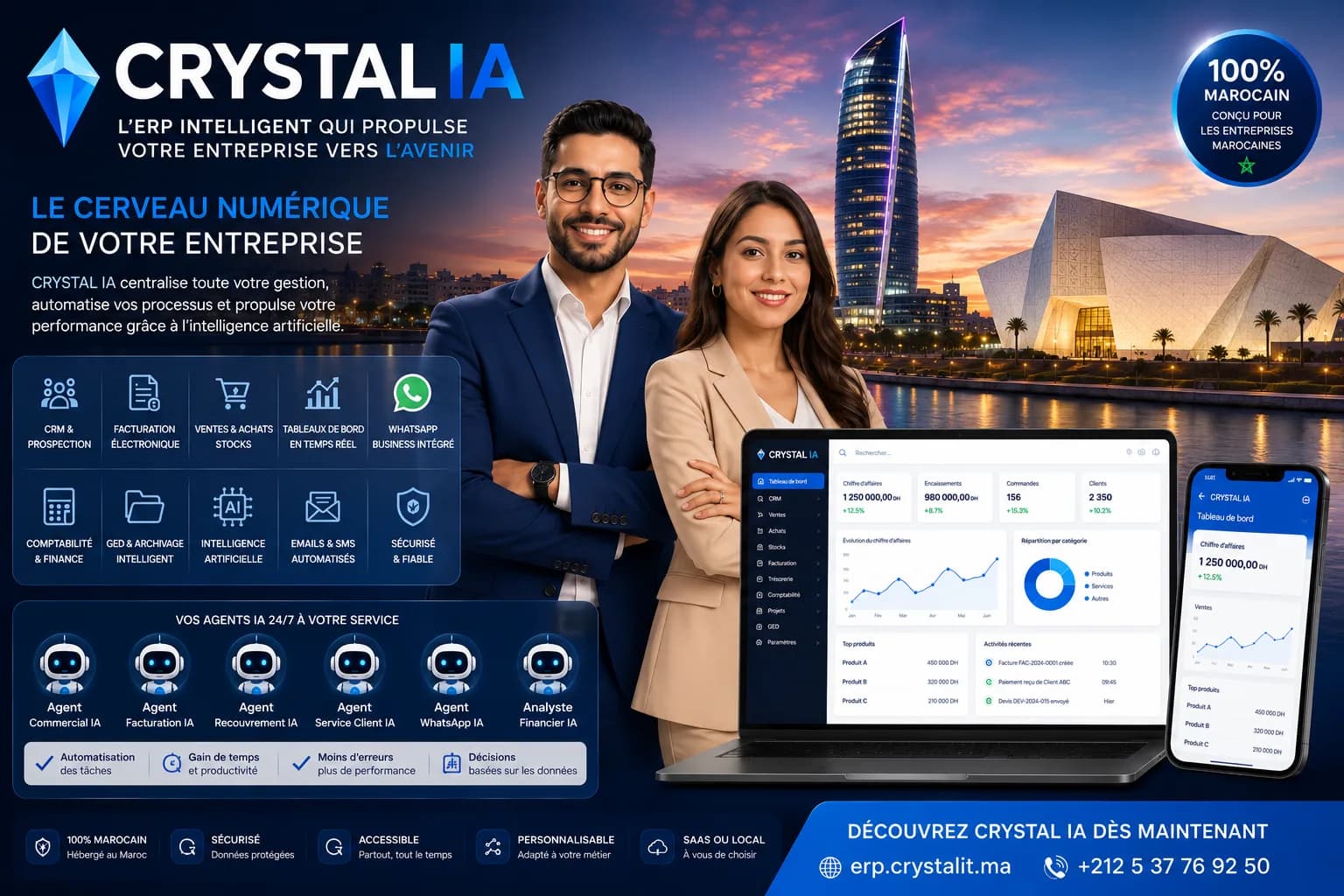
Crystal ERP, the SaaS ERP published by CRYSTAL IT in Rabat, treats accounting not as a separate module but as the natural culmination of the commercial cycle. Quotes, orders, deliveries and invoices issued through Crystal ERP automatically feed the accounts without re-entry, and supplier purchasing, stock management and CRM are linked in the same flow. The manager has a permanently up-to-date financial picture — no waiting for a monthly closing, no document to send to the fiduciaire.
Accessible in SaaS mode and powered by the Crystal IA chat assistant, Crystal ERP lets teams query their management data in natural language and produce financial statements without deep technical expertise. Behind the product stands a Moroccan vendor with over 20 years of experience and support available six days a week — the combination of an integrated solution and close-at-hand guidance that makes the difference for an SME that wants to master its accounting, not be overwhelmed by it.
Accounting is not a burden to be endured: properly equipped, it becomes a real-time financial dashboard that illuminates the manager's decisions. For a Moroccan SME, the priority is to break free from double entry and delayed closings by choosing a solution that integrates accounting and commercial management in a single flow. Crystal ERP, powered by Crystal IA, is built with this in mind: accounts updated at every moment, connected to sales, purchasing, stock and invoicing, accessible in SaaS mode from any browser and maintained at the pace of the DGI's requirements. To see concretely what Crystal ERP would change in your financial management, request a personalised demonstration from the CRYSTAL IT teams in Rabat: we will show you the solution on your own use cases, with no obligation.
The CRYSTAL IT solution on this topic
Have a project or a question? Let's talk with a CRYSTAL IT expert.
Request a demo