Invoicing is an operation every company knows — and one that many, in Morocco, still handle with Word templates, spreadsheets or a standalone point-of-sale tool. That era is coming to an end. The Directorate General of Taxes (DGI) is progressively rolling out mandatory electronic invoicing from 2026, on the so-called 'clearance' model where each invoice must be validated by the administration before being sent to the customer. For companies, this is not a mere technical formality: it is a change of method that needs to be prepared. This article reviews the reform, what it concretely implies, and how to choose invoicing software that brings you into compliance without pain.
Electronic invoicing in Morocco: what are we talking about?
Electronic invoicing does not mean sending a PDF by email. It means issuing invoices in a structured format, readable by computer systems, and validated by the DGI platform before being sent to the customer. The plain PDF, precisely, is explicitly excluded: the invoice must be produced in a standardised format (such as UBL or CII) and accompanied by an electronic signature guaranteeing its integrity.
Morocco has adopted the 'clearance' (prior validation) model, comparable to that of countries such as Mexico, Turkey or Saudi Arabia. In concrete terms, the invoice passes through the tax administration's platform, which checks it and assigns it an identifier, before it is considered valid. The State's aim is twofold: to fight VAT fraud and to make tax collection more reliable.
The reform timeline: who is concerned, and when?
The reform applies in stages, starting with the largest organisations before extending to smaller ones. The announced timeline provides for a progressive ramp-up, which should be confirmed with the DGI or your chartered accountant, as the precise terms may evolve.
The broad lines commonly cited are the following:
- From 2026: obligation for large companies.
- During 2026: extension to medium-sized companies.
- From 2027: generalisation to SMEs and very small businesses.
- Penalties planned for non-compliance: a fine per non-compliant invoice and, ultimately, a risk to the right to deduct VAT.
Why a simple invoicing program will no longer be enough
Many companies think it will be enough to keep issuing their invoices as before. But compliance is not about the layout of a document: it requires producing a structured file, signing it electronically, transmitting it to the DGI platform and handling the validation response. A Word template or a spreadsheet can do none of this.
That is why the reform is also an opportunity: rather than cobbling together minimal compliance, companies have everything to gain by equipping themselves with a tool that natively integrates invoicing into their management. An invoice is never an isolated act: it follows from a quote, an order, a delivery, and it feeds payment tracking and accounting. Handling invoicing separately means condemning yourself to double entry; integrating it into business management means winning on both fronts — compliance and productivity.
The criteria of compliant invoicing software in Morocco
Before choosing, check that the solution is genuinely designed for the Moroccan context and for the coming reform. An invoicing 'facade' is not enough: what matters is tax compliance and the ability to evolve.
The points to examine first:
- Compliance with Moroccan VAT and mandatory legal mentions.
- The ability to produce invoices in a structured format and to evolve towards transmission to the DGI platform.
- Integration with the rest of management: quotes, orders, inventory, payments and accounting.
- SaaS mode, which guarantees automatic updates in step with regulatory changes.
- A local vendor able to support the compliance process and respond quickly.
Anticipate rather than endure: how to get started now
The mistake would be to wait for the deadline. Companies that get started early approach the reform calmly, whereas those who leave it to the last minute risk bottlenecks and errors. The right approach is to map your current invoicing, identify the breaks (off-system invoices, double entry, manual payment tracking) and choose a tool that removes them while preparing for compliance.
An integrated solution such as an ERP offers a clear advantage here: invoicing is already connected to the complete sales cycle, and the vendor evolves the product as the DGI's requirements change. The company does not have to reinvent its organisation at each new stage of the timeline: it relies on a system that updates itself.
Crystal ERP: invoicing integrated into your entire management
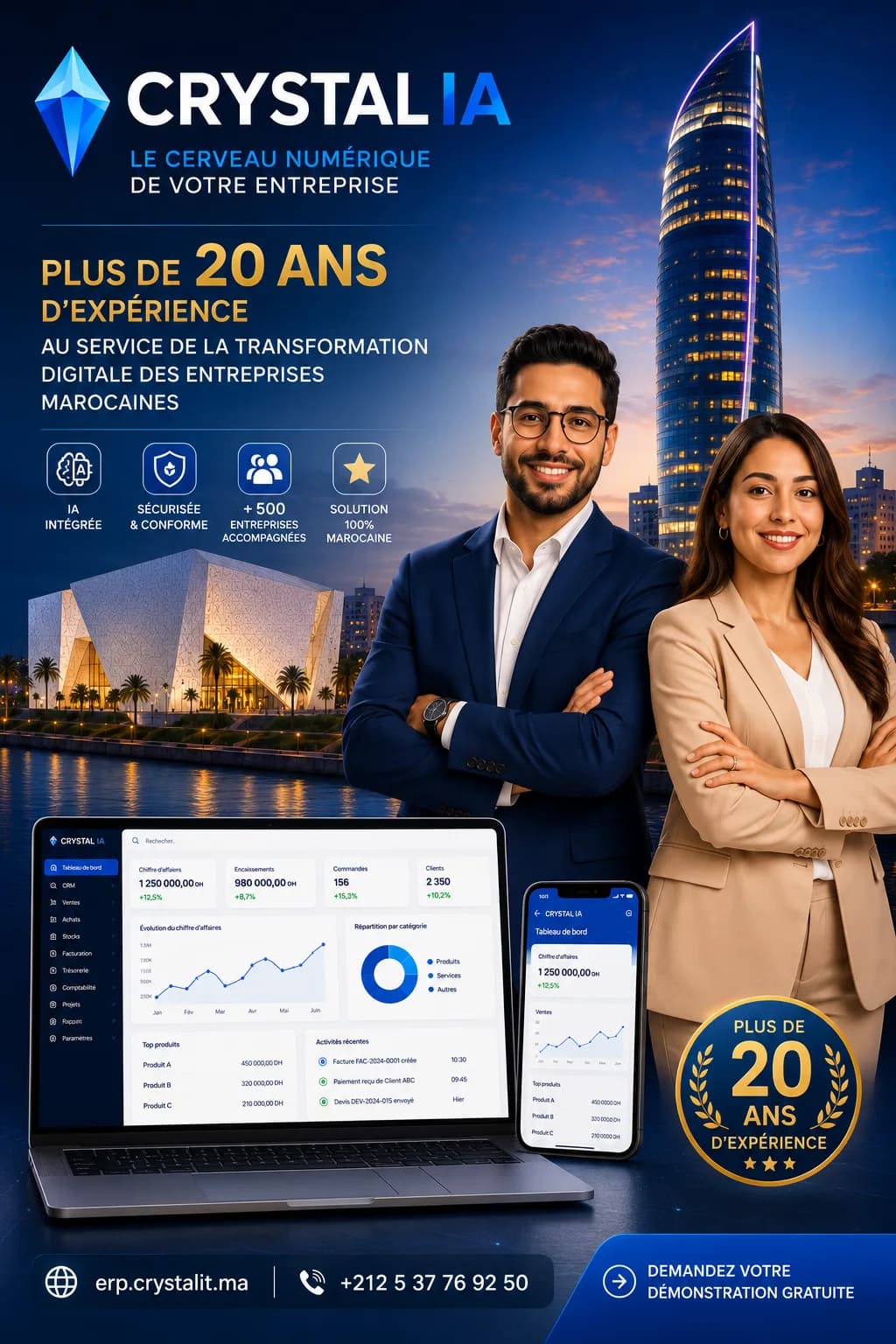
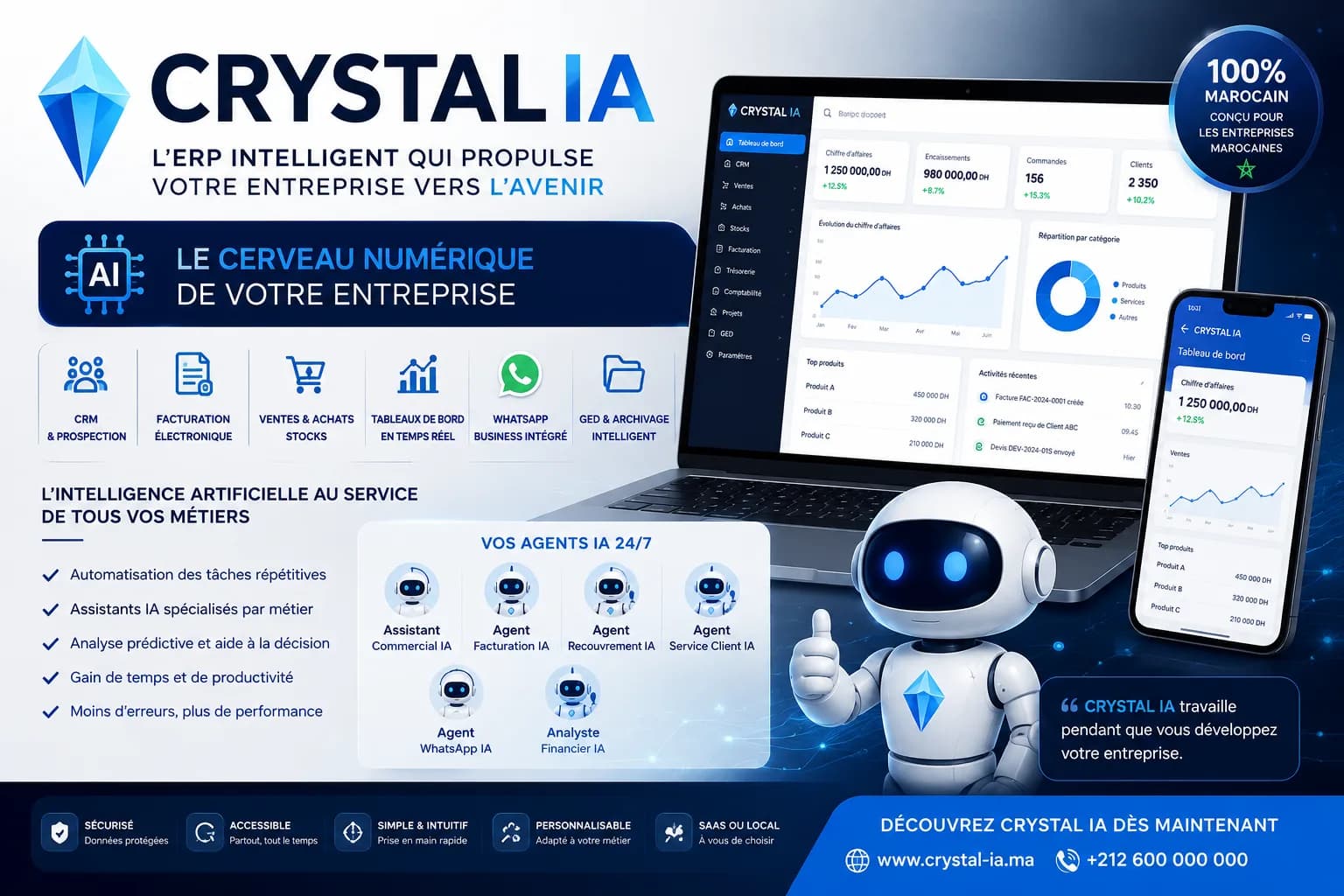
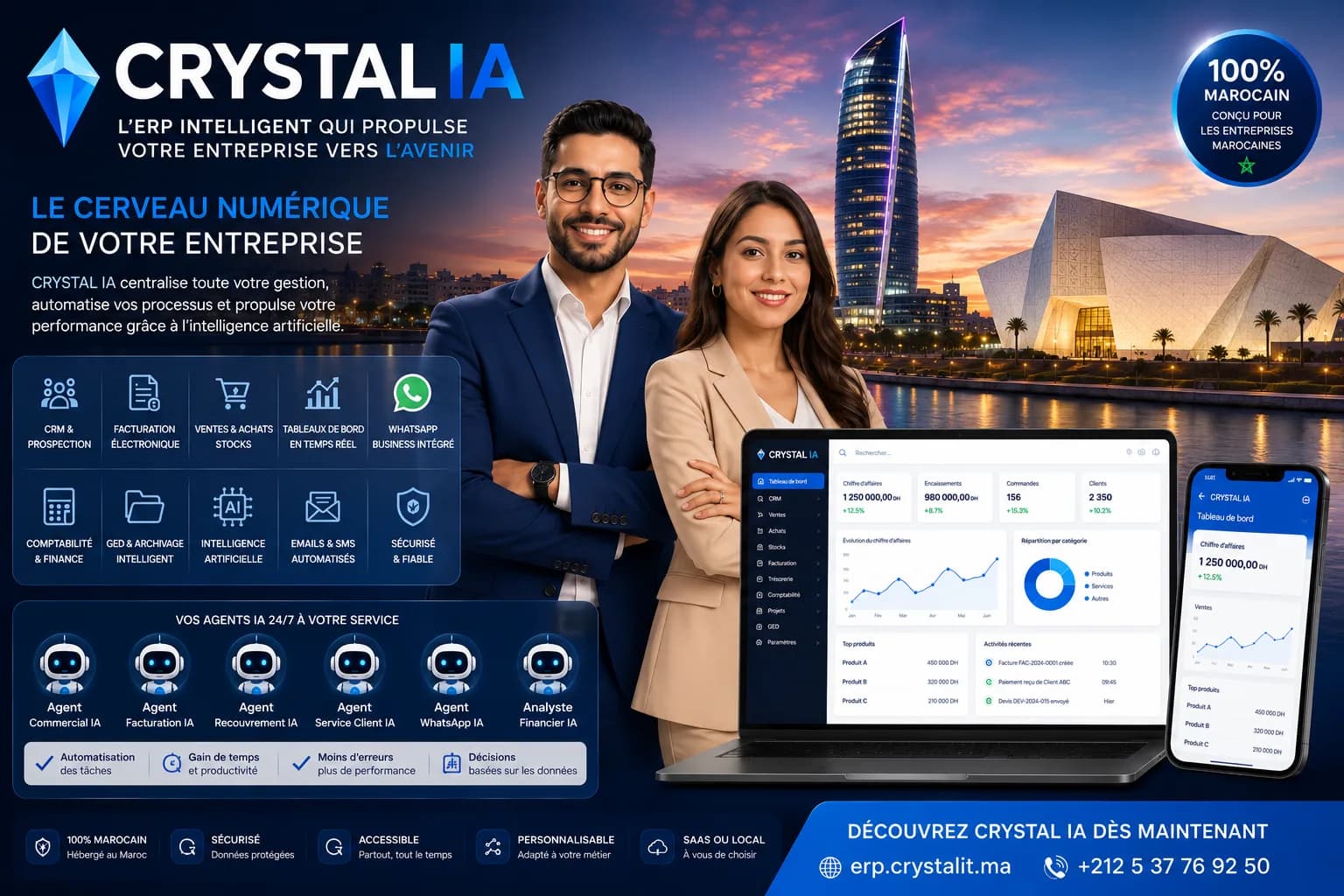
Crystal ERP, the Moroccan SaaS ERP developed by CRYSTAL IT, treats invoicing not as an isolated function but as the natural outcome of the sales cycle: quotes, orders and deliveries turn into invoices with no re-entry, and each invoice automatically feeds payment tracking and accounting. Inventory, purchasing and CRM management are connected to the same flow, for a unified, real-time view.
Developed in Rabat by a company with more than 20 years of experience, Crystal ERP is available in SaaS mode and benefits from continuous updates — a key point at a time when regulation is evolving. Rather than enduring the transition to electronic invoicing, companies equipped with an integrated tool maintained by a local vendor approach it as simply one more step.
Mandatory electronic invoicing is not a threat, but a milestone to cross — and it is better to do so early, with the right tool. For Moroccan companies, the stakes go beyond simply issuing invoices: it is about adopting management where invoicing is integrated, structured and ready to communicate with the DGI platform. Crystal ERP, powered by Crystal IA, places invoicing at the heart of all-in-one management and evolves in step with the reform. To take stock of your situation and anticipate the deadline calmly, request a personalised demonstration from the CRYSTAL IT teams: we will study your concrete case together, with no obligation. (For the precise tax terms, please refer to the DGI or your chartered accountant.)
Have a project or a question? Let's talk with a CRYSTAL IT expert.
Request a demo