Following up on unsigned quotes is one of the most profitable yet least systematic commercial practices in Moroccan SMEs. Every sent quote represents a real opportunity: a prospect has expressed a need, taken the time to request an offer, and is waiting for a response to their deliberation. Yet the majority of these quotes receive no follow-up — buried in daily activity, forgotten after the prospect's first silence, or simply abandoned for lack of a tracking tool. For an SME owner in Morocco, the stakes are immediate: improving the conversion rate without prospecting more or increasing acquisition costs. Crystal ERP (erp.crystalit.ma), developed by CRYSTAL IT in Rabat with over 20 years of experience serving Moroccan SMEs, integrates automated quote tracking, configurable follow-up alerts and a commercial pipeline that makes every unsigned quote visible in real time. This guide explains why follow-up is decisive, how to structure an effective process, and how Crystal ERP automates this discipline without adding to the sales team's workload.
Unforced Quotes: An Invisible Revenue Gap for Moroccan SMEs
In most Moroccan SMEs, a quote sent without a response sits pending indefinitely. The sales rep moves on to the next deal, the prospect does not make contact spontaneously, and the opportunity disappears without anyone really knowing whether it was lost or simply waiting for a follow-up. B2B sales cycles show that most purchasing decisions do not happen at the moment of first contact — the prospect needs time, comparisons and sometimes internal validation. A quote that is not followed up leaves the field clear for a competitor who does make contact at the right time.
To measure this revenue gap concretely, a manager can start with a simple calculation. If their SME sends 30 quotes per month with a current 30% conversion rate, 21 quotes go nowhere. If a systematic follow-up converts an additional 15% — a conservative estimate — that is 3 to 4 extra orders per month without an additional prospect or extra marketing spend. Among all the practices that improve commercial portfolio performance, our guide on commercial management software (Business management software in Morocco: the complete guide for SMEs) explains how these ratios improve with the right tools.
- Untracked pending quotes: in an SME without a tracking tool, the list of unsigned quotes simply does not exist — you do not know what you are losing.
- Long decision cycle: in Moroccan B2B, a purchase decision often involves multiple internal approvals — a quote may take several weeks to mature.
- More reactive competitor: a competitor who follows up two days before you can win a deal you would have closed.
- Conversion without acquisition cost: following up with an already-engaged prospect costs far less than acquiring a new one.
- No data on losses: without tracking, you cannot identify why you lose deals or at which stage opportunities evaporate.
Why Moroccan SMEs Do Not Follow Up on Their Quotes
The reasons why Moroccan SMEs do not systematically follow up on their quotes are not a lack of commercial drive but the absence of a tool. In an SME where quotes are created in Excel or Word, sent by email and saved in a folder, there is no alert system to flag that a quote sent ten days ago still has no response. The sales rep must remember to follow up by themselves — a task that inevitably yields to the urgencies of the moment. The result: only the most motivating deals or follow-ups prompted by prospects who call back spontaneously are handled.
A second obstacle is the lack of consolidated visibility on the quote pipeline. In many Moroccan SMEs, each sales rep manages their quotes in their own digital space — personal email inbox, local folder, individual Excel sheet. The manager has no consolidated view of the total outstanding quotes, their age, their amount and their likelihood of conversion. Without this overview, it is impossible to prioritise follow-ups on high-potential deals or to detect loss patterns. This gap is what a commercial dashboard (Commercial dashboard in Morocco) and a CRM (CRM software in Morocco: managing client relationships and growing…) fill by centralising all opportunities in a single interface.
- No automatic alert: without a tracking tool, the sales rep must remember follow-ups alone — and forgetting is inevitable.
- Quotes scattered by rep: each rep manages their files in their own space, with no consolidated view for the manager.
- No priority on large deals: without visibility, follow-up on small deals takes as much time as on large ones.
- Fear of intruding: many sales reps hesitate to follow up without a buying signal — hesitation that a formalised process dissolves.
- No diagnosis of losses: without tracking, you cannot tell whether quotes were lost for lack of follow-up or for another reason (price, competition, evolved need).
Structuring an Effective Follow-Up Process: Timing, Messages and Priorities
An effective follow-up process rests on three simple decisions: when to follow up, through which channel, and with what message. On timing, the experience of Moroccan SME commercial teams shows that the first follow-up should occur between D+3 and D+5 after sending the quote, when the document is still in the prospect's mind and their deliberation is active. A second follow-up at D+10 or D+14 is warranted if the first goes unanswered, accompanied by an open question about the progress of the decision. A third follow-up at D+21 or D+30 can be useful for high-value quotes, with a different angle — a technical clarification, an availability highlight, or a proposal for a telephone call.
On the content of follow-ups, the trap to avoid is the pressure follow-up that generates rejection: 'Have you received our quote?', repeated three times without added value, will be perceived as harassment. An effective follow-up brings something new — a clarification on delivery time, an adjustment to better match the need, a relevant customer reference. For teams managing a high volume of quotes, our guide on commercial quotation software (Commercial Quoting Software in Morocco) explains how to standardise quote creation and tracking to make follow-up easier.
- First follow-up at D+3/D+5: ideal timing when the prospect's thinking is still fresh.
- Second follow-up at D+10/D+14: open question on progress, no pressure — 'Where are you in your thinking?'
- Value-added follow-up: each follow-up brings new information (delivery time, technical clarification, adjustment) to avoid being perceived as harassment.
- Prioritise by amount and age: the highest-value and oldest quotes deserve a personalised follow-up, not a generic automated email.
- Log every follow-up in the CRM: each contact is recorded with the date, channel and response received — to know exactly where each file stands.
Crystal ERP: Automatic Quote Tracking and Follow-Up Alerts
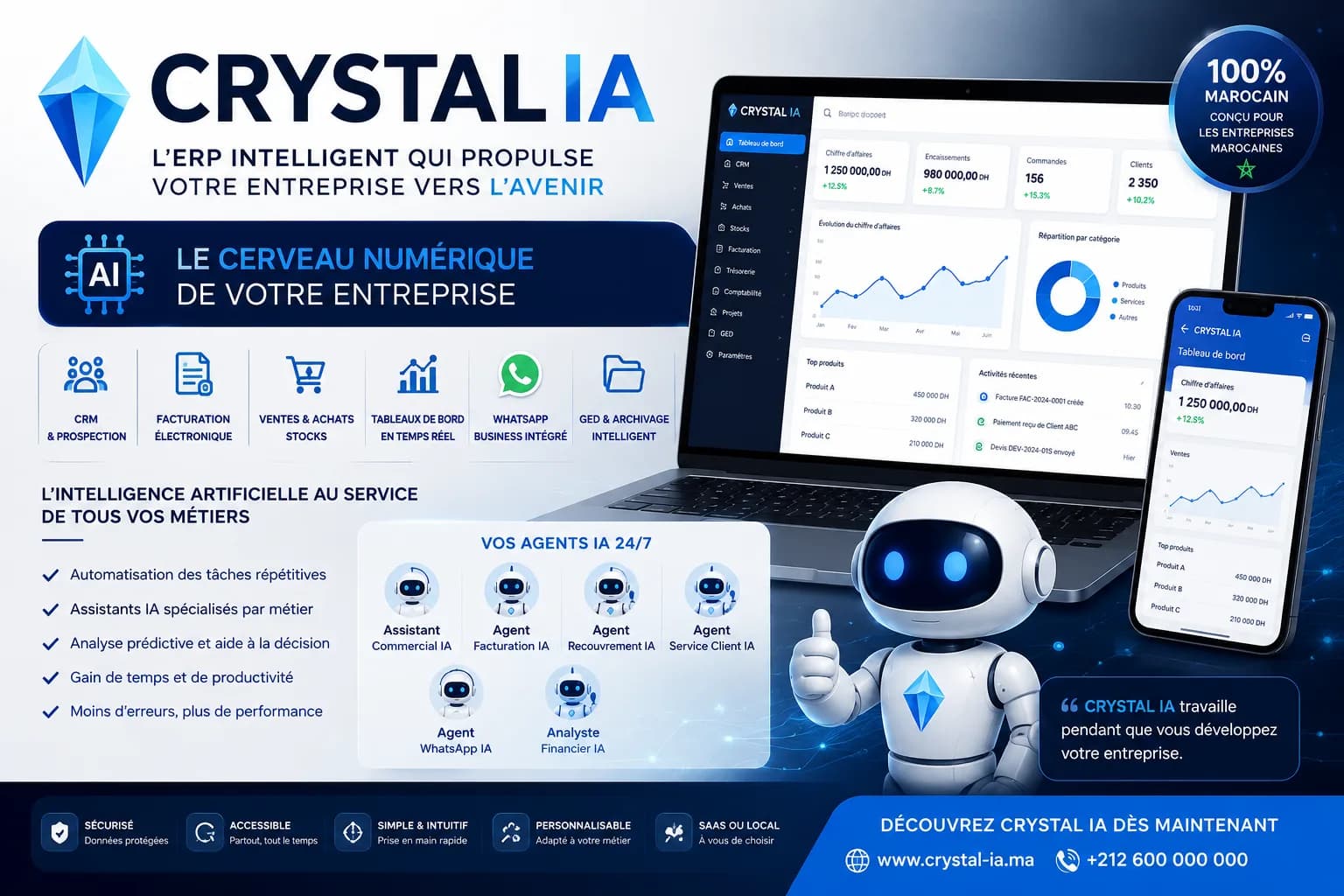
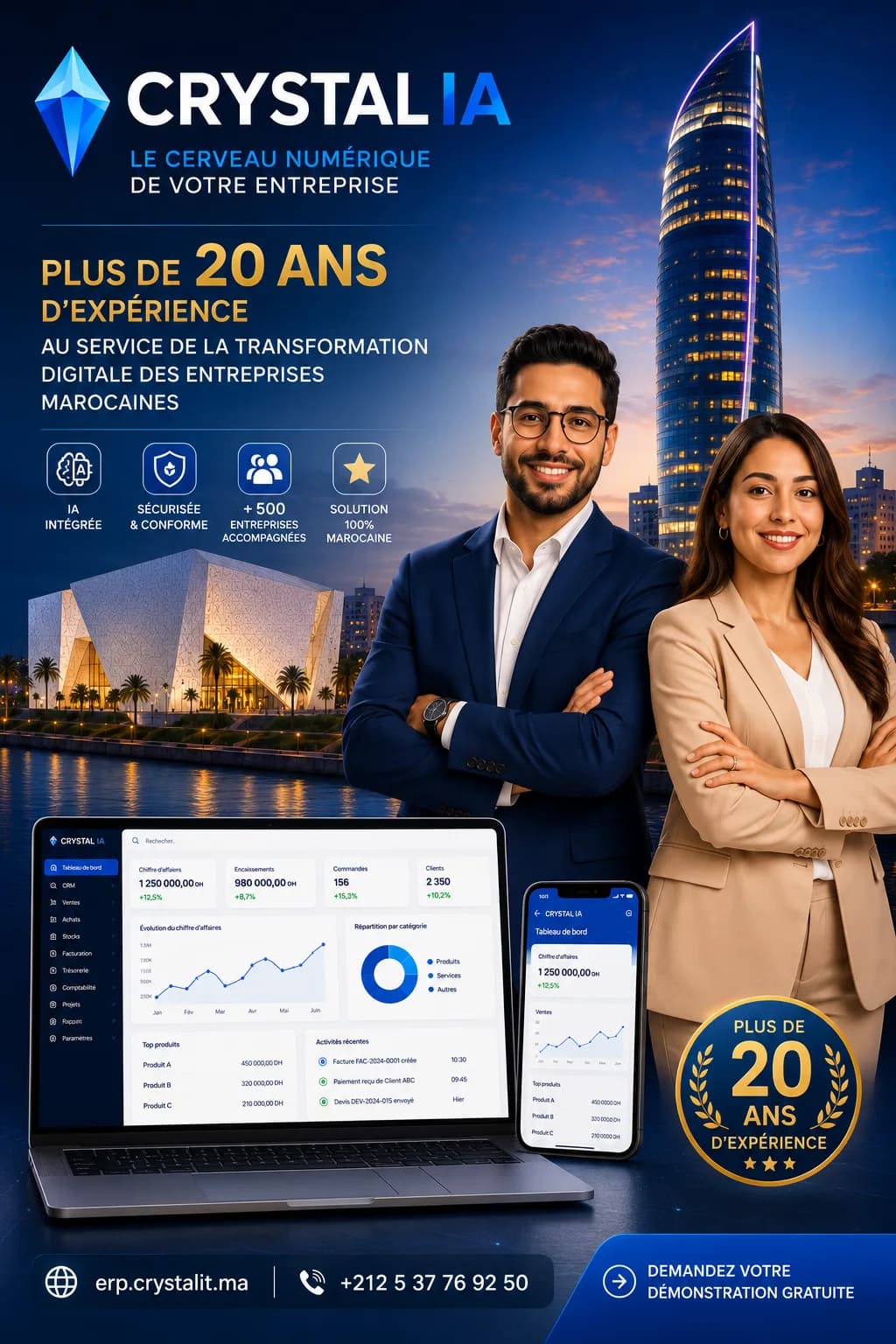
Crystal ERP (erp.crystalit.ma) integrates quote tracking directly in its commercial management module, with no additional tool required. Every quote issued from Crystal ERP is visible in real time in the manager's commercial pipeline: issue date, amount, responsible rep, status (sent, followed up, in negotiation, won, lost) and time elapsed since sending. Configurable alerts deliver an automatic notification — in the interface or by email — when a quote has received no response beyond a set delay. The relevant rep and their manager are alerted simultaneously, ensuring the information does not get lost in either person's daily flow.
Beyond individual tracking, Crystal ERP lets the manager steer the entire team's quote portfolio. The pipeline view — described in our commercial dashboard guide (Commercial dashboard in Morocco) — displays all outstanding quotes with their cumulative value by stage, the historical conversion rate per rep, and deals that have exceeded the average decision delay with no activity recorded. Crystal ERP also integrates a CRM module (CRM software in Morocco: managing client relationships and growing…) that logs every interaction with the prospect — email, call, visit — so the rep can prepare their follow-up with the full context of the file.
- Automatic alert on inactive quotes: configurable notification when a quote exceeds a delay without response — for the rep and for the manager.
- Real-time quote pipeline: all team quotes visible by stage, with cumulative value and time since sending.
- Interaction history per prospect: every email, call or visit is logged in the CRM — follow-ups are prepared with full context.
- Conversion rate per rep: Crystal ERP measures in real time the transformation rate per rep and per product family.
- Quote-order-invoice integration: when a quote is won, it is converted to an order in one click, then to a delivery and an invoice — no re-entry.
Measuring and Improving Conversion Rate Through Commercial Management
Quote follow-up is only effective when it is grounded in data. Without measurement, you can multiply follow-ups and still not progress if the real problem is a price gap, a poorly calibrated deadline or an incomplete offer. The overall conversion rate is the first metric to monitor: how many quotes issued are transformed into orders over a given period. But the conversion rate broken down by rep, product family and customer segment is far richer: a low rate for a specific rep may indicate a technical mastery issue; a low rate on a product family may signal a competitive price gap in that segment.
The second indicator is the average transformation delay: how many days elapse between sending the quote and signing it. A lengthening delay often signals that market buying conditions have evolved — prospects take longer to decide, compare more, or need more internal validation. Crystal ERP calculates these delays automatically and displays them in the commercial dashboard, allowing the manager to detect a trend before it impacts revenue. For SMEs looking to go further in animating their sales force, our guide on sales force software (Sales Force Automation Software in Morocco) presents the tools available to manage field representatives.
- Overall conversion rate: percentage of quotes converted to orders — the baseline indicator to monitor week by week.
- Conversion rate by rep: identify gaps within the team to support or train underperforming profiles.
- Average transformation delay: measures the time between quote sending and order — a lengthening delay is an early warning signal.
- Measured impact of follow-up: compare conversion rates of followed-up versus non-followed-up quotes to quantify the effect of follow-up discipline.
- Loss reason analysis: every lost quote is qualified (price, delay, competitor, unmet need) — to improve the offer at the source.
Following up on unsigned quotes is one of the most accessible growth levers for a Moroccan SME: without an additional prospect, without extra marketing spend, simply by activating already-open opportunities with discipline and method. The prerequisite is a tool that makes pending quotes visible, alerts the right sales rep at the right moment, and measures the impact of every action on the conversion rate. Crystal ERP (erp.crystalit.ma), developed by CRYSTAL IT in Rabat with over 20 years of experience serving Moroccan SMEs, natively integrates this tracking in its commercial management and CRM module: configurable alerts on inactive quotes, real-time pipeline for the manager, complete interaction history with each prospect, and automatic measurement of conversion rates by rep and product family. For SMEs wishing to structure their commercial approach end to end — from prospecting to collections, through quotation and follow-up — Crystal ERP provides an integrated environment that eliminates oversights, automates alerts and makes the commercial team's performance measurable and steerable. Access the platform at erp.crystalit.ma or contact the CRYSTAL IT teams in Rabat to discover how Crystal ERP can improve your SME's commercial conversion rate.
Have a project or a question? Let's talk with a CRYSTAL IT expert.
Request a demo