In Morocco, many SMEs and very small businesses still run their commercial activity with a patchwork of disconnected tools: a spreadsheet for quotes, a standalone point-of-sale system, invoices in Word and a notebook for tracking payments. As long as the company is small, it holds together. But as the volume of orders, products and customers grows, these tools start to contradict one another, double data entry multiplies, and the manager loses visibility over the business. Business management software answers precisely this need: centralising the entire sales cycle, from quote to payment, in a single tool. This guide explains what business management software really is, what it should cover, and how to choose one suited to the Moroccan market.
What is business management software?
Business management software is a tool that handles a company's entire sales cycle: drawing up quotes, turning them into orders, deliveries, invoicing, payment tracking, and managing the associated customers and products. Its purpose is simple: to make information flow from one step to the next without re-entering it, and to give the manager a single, up-to-date view of the business.
It should not be confused with a simple invoicing program, which only covers one step, nor with accounting software, which records financial entries downstream. Business management sits at the heart of daily operations: it drives what is sold, to whom, at what price and with what stock. When it is integrated with purchasing, inventory and accounting, it becomes an ERP (Enterprise Resource Planning system), of which business management is the central module.
The limits of scattered tools: Excel, point of sale and paper
A spreadsheet creates the illusion of being enough for a long time. But it cannot link a quote to an order, decrement stock when an invoice is issued, or flag a customer who exceeds their credit limit. Each operation becomes a re-entry, and each re-entry is a source of error: a forgotten price, a misreported discount, a wrong quantity. As the business grows, the time spent reconciling files exceeds the time saved.
The real cost of this fragmentation is rarely measured, but it is very real: invoices issued late, unanticipated stock-outs, unpaid bills detected too late, and above all an inability to answer simple questions quickly — what is my revenue this month, which products sell best, which customers owe me money? Business management software removes this friction by making single data entry the rule.
What good business management software should cover
A solution worthy of the name does not stop at issuing invoices. It must cover the complete chain of the sales cycle and connect it to the related functions that depend on it. It is this continuity that creates value, far more than any single feature taken in isolation.
In practice, the essential building blocks to require are the following:
- Quotes and orders: creation, tracking and automatic conversion of a quote into an order and then an invoice, with no re-entry.
- Invoicing: compliant issuance of invoices and credit notes, with tracking of due dates and payments.
- Inventory management: real-time tracking of inbound and outbound movements, reorder alerts, stock valuation.
- Supplier purchasing: purchase orders, receipts and a direct link with stock and cash flow.
- Customers and CRM: complete customer record, sales history, outstanding balances and follow-ups.
- Dashboards: revenue, margins, most profitable products and customers, in real time.
Business management, invoicing and accounting: how they fit together
These three areas are often confused, when in fact they form a chain. Business management drives activity (what is sold and purchased); invoicing is its documentary and financial outcome; accounting records and reports the whole on a legal basis. When these functions live in separate tools, information is entered three times and falls out of sync.
The benefit of an integrated solution is to eliminate these breaks: an invoice issued from business management automatically feeds payment tracking and flows into accounting. It is also what prepares the company for electronic invoicing, which the DGI is rolling out progressively in Morocco from 2026: a system that already produces structured, traceable invoices will be far easier to bring into compliance than a patchwork of Word and Excel files.
How to choose: the criteria that matter in Morocco
Beyond the list of features, the choice comes down to fundamental criteria, particularly important in the Moroccan context. Is the solution designed for local rules (VAT, legal mentions, future electronic invoicing)? Does the vendor understand the realities of Moroccan SMEs? Is support reachable quickly, in your language and time zone?
Before committing, examine the following points:
- Adaptation to the Moroccan market: VAT, invoice format, readiness for the DGI's electronic invoicing.
- SaaS (cloud) mode: accessible everywhere from a browser, with no server to buy or maintain.
- Integrated coverage: quotes, invoicing, inventory, purchasing, sales, accounting and CRM in a single tool.
- The vendor's proximity and longevity: its track record, number of installations, knowledge of the business.
- Support availability and onboarding assistance, decisive for successful adoption.
Crystal ERP: all-in-one business management, powered by AI
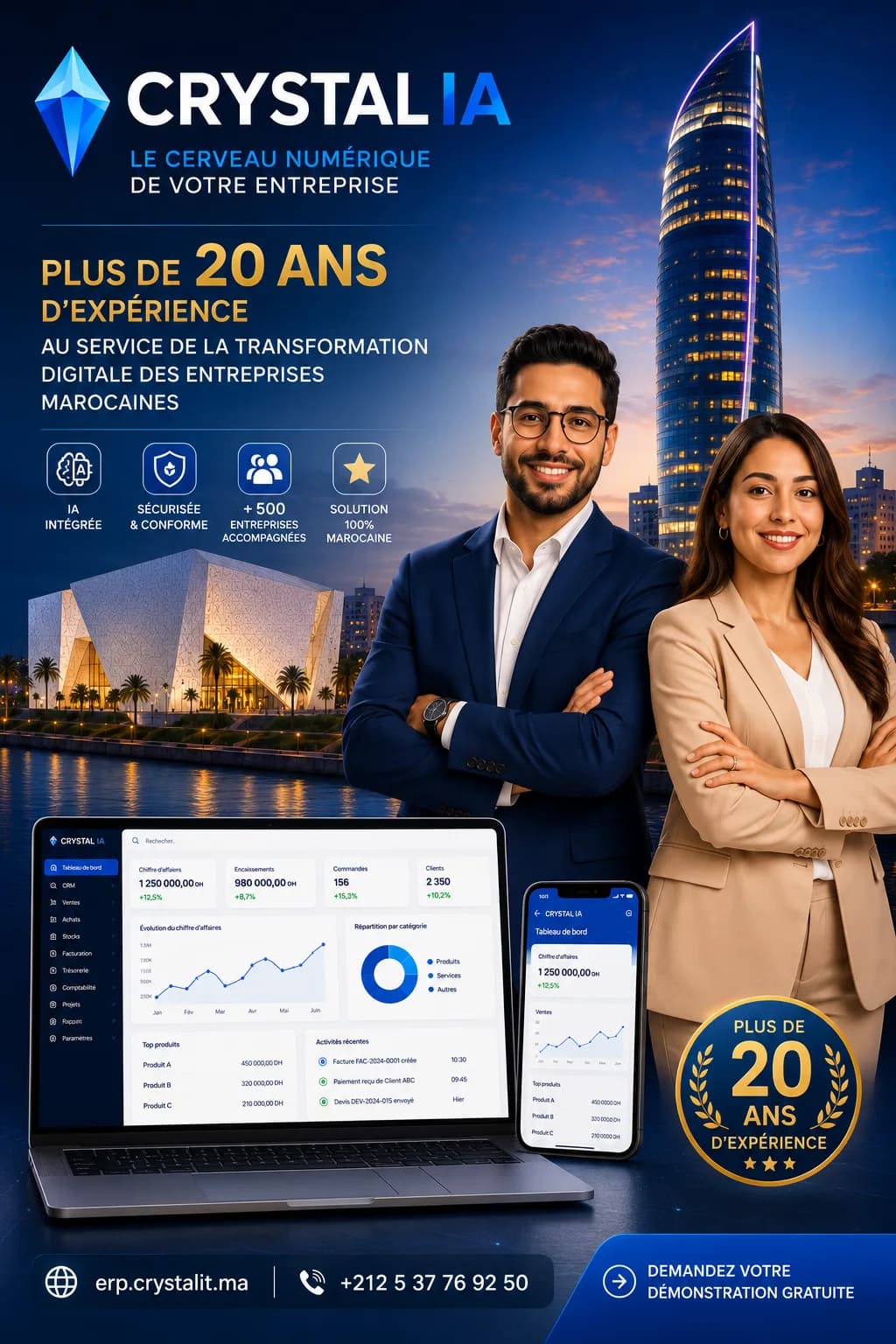
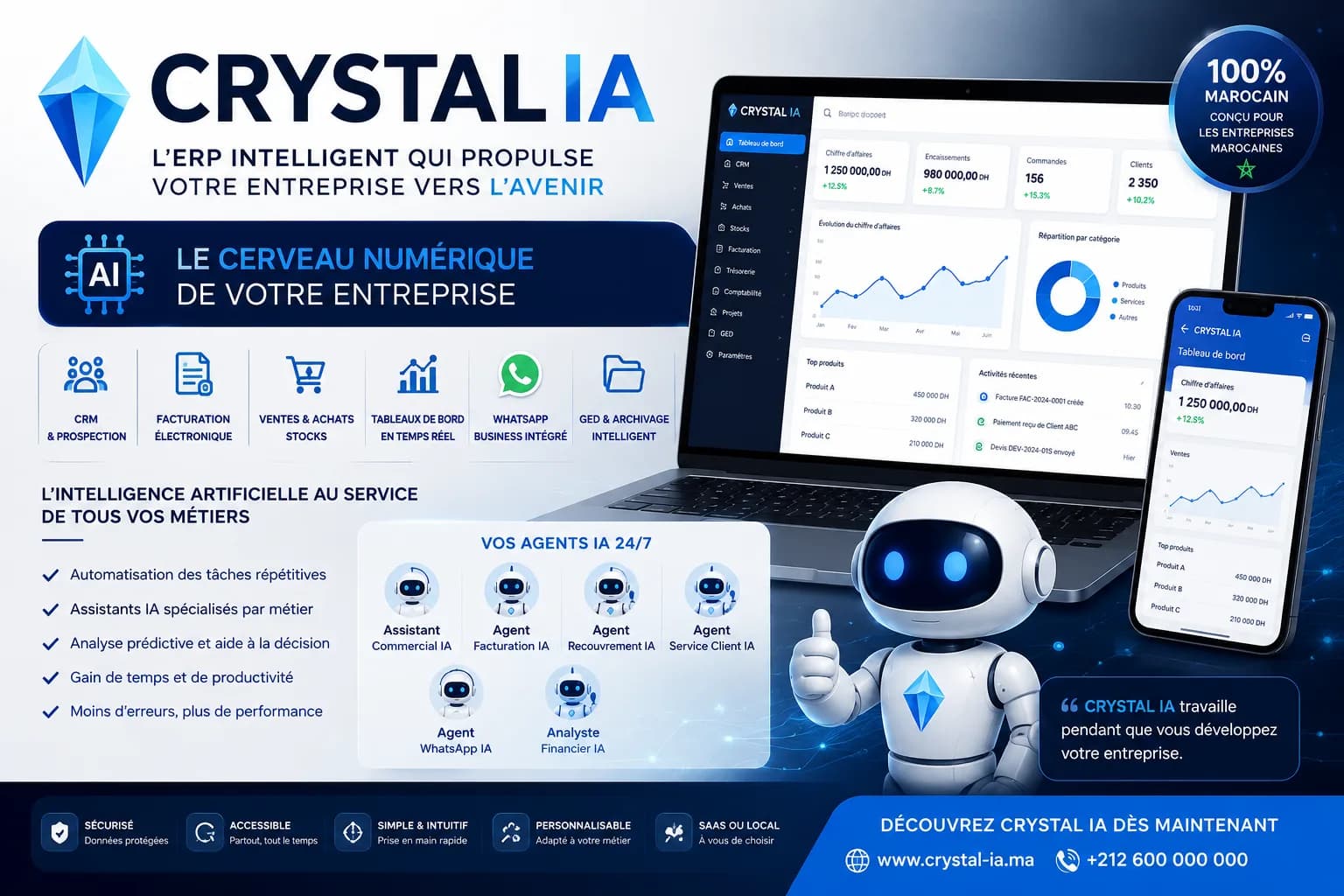
On the Moroccan market, Crystal ERP is the all-in-one business management software developed by CRYSTAL IT. It covers the entire cycle — quotes, orders, deliveries and invoices — connected to inventory and product management, supplier purchasing, sales, accounting and CRM. Information is entered once and flows automatically, which removes double entry and gives the manager a unified, real-time view.
Crystal ERP adds a decisive asset: a built-in AI Chat assistant, powered by Crystal IA. Rather than navigating menus or building reports, users query their management in natural language and get answers grounded in their real data. Everything is available in SaaS mode, everywhere and in real time. Behind the product is a Rabat-based vendor with more than 20 years of experience and close local support — the combination that makes the difference for a Moroccan SME.
Choosing business management software is not about buying yet another tool: it is about deciding to run your company from a single, reliable source of information rather than scattered files. For a Moroccan SME, the right instinct is to favour an integrated solution, in SaaS mode, suited to local rules and backed by a solid vendor — all the more so as mandatory electronic invoicing approaches. Crystal ERP, powered by Crystal IA, meets these conditions. To see concretely what it would change in your daily operations, request a personalised demonstration from the CRYSTAL IT teams in Rabat: you will discover the solution on your own use cases, with no obligation.
Have a project or a question? Let's talk with a CRYSTAL IT expert.
Request a demo