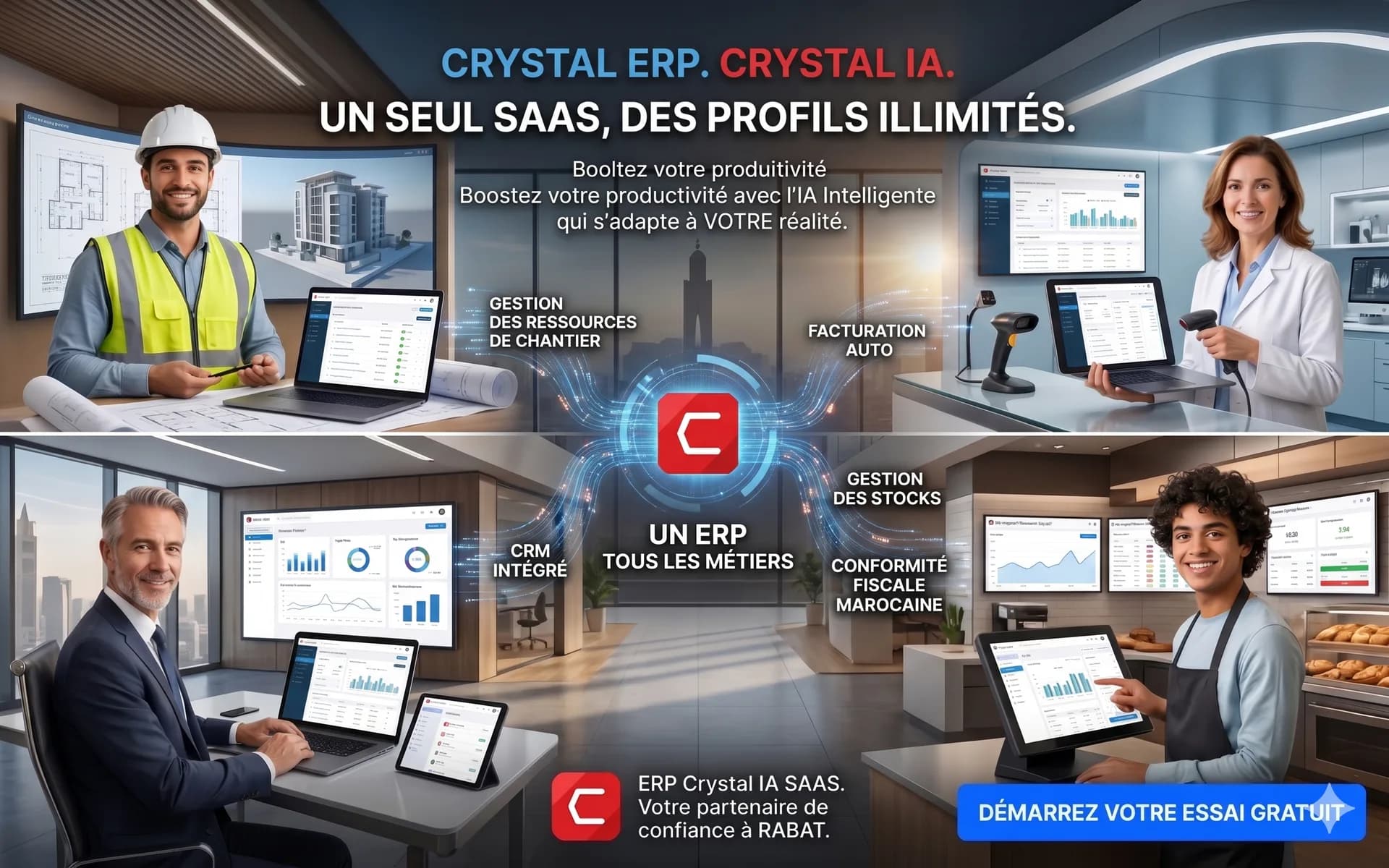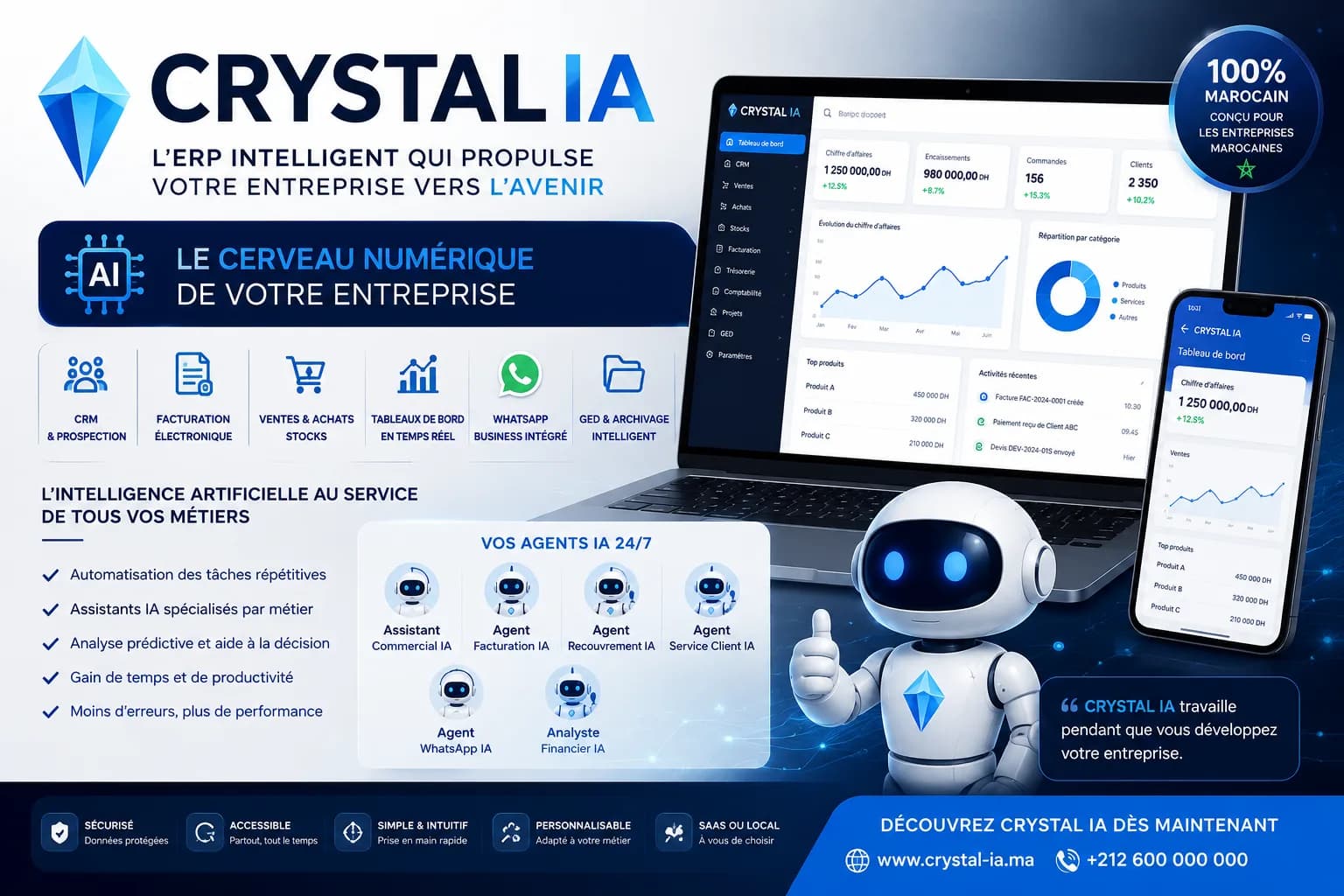
Medical cabinet management software in Morocco addresses a growing need among healthcare professionals who, amid the rollout of Mandatory Health Insurance (AMO) and new administrative requirements, have less and less time for administrative tasks and more and more regulatory obligations to fulfil. A general practitioner or specialist clinic, a private hospital with multiple practitioners, a rehabilitation centre or a midwifery practice in Rabat, Casablanca or Fès all share the same operational challenges: overloaded schedules managed on paper, patient files scattered between binders and Word documents, laborious AMO/CNOPS third-party billing prone to errors, and medical supply stock managed by guesswork. These friction points are not inevitable: suitable management software connects scheduling, patient records, billing and stocks in a coherent flow that reduces administrative burden and improves patient follow-up quality. Crystal ERP (erp.crystalit.ma), developed by CRYSTAL IT in Rabat with over 20 years of experience serving Moroccan businesses, offers a modular platform adaptable to healthcare structures — from individual practices to multi-practitioner clinics — centralising all management flows in a single system. This guide reviews the key features of medical cabinet management software suited to the Moroccan context.
The Administrative and Financial Challenges of Moroccan Healthcare Structures
Medical cabinets and clinics in Morocco face an accumulation of challenges that worsen as the practice grows. The first concerns appointment management: without dedicated software, patients call, the receptionist notes down appointments in a paper diary, last-minute cancellations are not tracked, time slots remain under-occupied and patients forget their appointments with no automatic reminder. In a busy practice, this translates into poorly structured days, excessive waiting times and lost revenue from unfilled slots.
The second challenge, often heavier, is medical billing. With the rollout of AMO (Mandatory Health Insurance) and supplementary schemes like CNOPS (for civil servants), healthcare structures must master third-party payment: the patient pays only part of the act, and the structure must submit reimbursement requests to the coverage body in precise formats. This manual management of third-party billing files is time-consuming and inevitably leads to coding errors, incomplete files and refused or forgotten reimbursements, generating invisible financial losses.
- Unmanaged scheduling: poorly optimised time slots, uncovered absences, patients forgetting with no reminder — up to 20% of slots wasted in an under-equipped practice.
- Scattered patient files: between paper notebooks, hastily scanned prescriptions and loose lab results, longitudinal patient tracking becomes impossible.
- Laborious third-party billing: manual management of AMO/CNOPS files generates errors, missed follow-ups and uncollected receivables that pile up with no visibility.
- Untracked supply stock: last-minute orders, unanticipated shortages, waste or expiry of untraceable products.
- Growing administrative burden: the more the practice grows, the greater the proportion of non-medical time — a problem software must solve, not amplify.
Online Medical Scheduling and Electronic Patient Records: the Management Foundations
Medical cabinet management software begins with two fundamental building blocks: the electronic scheduling system and the patient record. The scheduler allows available slots to be viewed at a glance, appointments to be recorded in seconds, duration to be automatically allocated by consultation type (standard consultation, follow-up, first visit, treatment), and automatic reminders to be sent to patients by SMS or email before their appointment. This feature significantly reduces no-shows and improves time-slot occupancy. For multi-practitioner structures, scheduling must be multi-resource: each doctor has their own timetable, visible to the receptionist and team members according to assigned rights.
The electronic patient record (EPR) centralises all medical and administrative information: identity and healthcare coverage data (AMO number, affiliated body), consultation history with diagnoses and acts performed, prescriptions, lab and imaging results, allergies and medical history. The issue is not just organisation: it is quality of care. A doctor who accesses a patient's complete history in two clicks — current treatments, contraindications, latest lab results — makes better clinical decisions and avoids preventable errors. The link between the patient record and billing is equally important: acts performed during a consultation automatically populate the corresponding invoice, without re-entry and without risk of omission.
- Multi-practitioner scheduler: each doctor has their own individual timetable visible to the receptionist, with management of unavailabilities, leave and intercalated emergencies.
- Automatic patient reminders: SMS or email sent 24 or 48 hours before the appointment to reduce no-shows — no technical skills required, immediate impact.
- Centralised patient record: identity, healthcare coverage, act history, prescriptions and results in a single profile accessible in one click before the consultation.
- Act traceability: every consultation, treatment or technical act is recorded with the date, the practitioner and the corresponding billing code to facilitate invoicing.
- Role-based secure access: the doctor, receptionist and nurse each access data according to their rights — medical records remain confidential.
Medical Billing and AMO/CNOPS Third-Party Payment: Automate to Stop Losses
Billing is the most critical management link for Moroccan medical cabinets and clinics, and the least well mastered. In a practice working with third-party payment through CNOPS or AMO bodies, each medical act generates an administrative obligation: recording the act with the correct billing code, calculating the body's share and the patient's remaining share, preparing the reimbursement file in the required format, and tracking its processing until actual payment is received. Management software automates this circuit: it automatically calculates the patient/body breakdown according to the applicable coverage rate, prepares billing statements in standard formats and tracks the status of each file.
For patients paying directly, the software manages multi-mode collections: cash, cheque, transfer and Mobile Money. With the DGI's electronic invoicing reform progressively reaching Moroccan businesses, it is also important to choose software capable of issuing invoices in compliant formats for B2B transactions — see our dedicated article (Electronic invoicing in Morocco in 2026) to understand the obligations currently in force.
- Automatic AMO/patient breakdown: for each act performed, the software automatically calculates the body's share and the patient's share according to the applicable coverage rate.
- Third-party file tracking dashboard: view of files sent, received, rejected or under review — automatic follow-up reminders for files without response.
- Patient receipts and payment acknowledgements: instant issue of a formal receipt with act details, amount paid and amount remaining from the body.
- Receivables management: alerts on aged debts (third-party or direct patients), with follow-up tracking and traceability of every contact.
- Financial dashboard: revenue by practitioner, act type and paying body — clear visibility of the structure's financial performance.
Pharmaceutical and Medical Supply Stock Management
Stock management is a frequently overlooked aspect of Moroccan medical practices, but its consequences are concrete: a shortage of syringes or dressings mid-consultation disrupts activity; medications bought in excess approach expiry and are discarded. An integrated stock management module allows this to be managed proactively: each consumable used during a consultation is deducted from stock in real time, automatic reorder alerts are triggered when the level reaches the minimum threshold, and consumption history enables future needs to be forecast accurately.
For structures holding medications (clinics, care centres), stock management becomes a legal and financial imperative. The software must manage batch numbers and expiry dates, flag products approaching expiry before they become unusable, and produce inventories for internal control. For further best practices on stock management, see our dedicated guide (Inventory management software in Morocco). Easy Print (easyprint.crystalit.ma), available for free, also enables printing of supplier payment cheques directly from the management software.
- Real-time stock tracking: every consumable used during a consultation is automatically deducted from stock without additional manual entry.
- Reorder alerts: automatic notification when an item falls below its minimum threshold — no more surprise shortages during a busy day.
- Expiry date management: preventive alert on products approaching expiry to avoid waste and ensure care safety.
- Stock valuation in accounts: medication and supply stock is valued in accounting at weighted average cost — consistency guaranteed between physical and accounting stock.
- Simplified inventory: stock status at a given date for internal controls, audits and year-ends — generated in one click without manual counting.
Crystal ERP: A Modular Management Platform for Moroccan Healthcare Structures
Crystal ERP (erp.crystalit.ma), developed by CRYSTAL IT in Rabat with over 20 years of experience serving Moroccan businesses, is a modular SaaS ERP adaptable to the administrative and financial management needs of healthcare structures. Its modules — scheduling and appointment management, patient records, multi-body billing, stock management, accounting and treasury — are articulated in a coherent flow where each piece of information entered once automatically feeds all dashboards. For an individual medical practice, deployment can begin with scheduling and billing, then extend to patient records and stock management as the structure grows. For a multi-practitioner clinic, Crystal ERP centralises timetables, records, per-practitioner billing and analytical accounting by activity.
The native integration between billing and accounting is particularly useful for clinics employing staff who must simultaneously manage payroll, CNSS social charges and analytical accounting by department. Crystal ERP covers these dimensions in a single system: human resources and payroll module (HR Management Software in Morocco: the Complete Guide for SMEs), integrated accounting (Accounting software in Morocco) and real-time treasury (Cash Flow Management for Moroccan SMEs). For structures looking to understand how to choose the right ERP, see our guide (How to choose an ERP in Morocco: criteria, cost and mistakes to avoid).
- Scalable modular platform: start with scheduling and billing, then add stock, HR and accounting modules as your structure grows.
- Multi-user access with differentiated rights: the doctor, receptionist and nurse each access data relevant to their role — medical record confidentiality is maintained.
- Analytical accounting by practitioner or department: for multi-practitioner clinics, revenue and costs are broken down by practitioner or specialty.
- SaaS accessible from all devices: computer, tablet and smartphone — no server infrastructure to maintain, automatic updates included.
- CRYSTAL IT support in Rabat: configuration, team training and ongoing support from a local team familiar with the specificities of the Moroccan context.
Digitalising the management of a medical cabinet or clinic in Morocco means reclaiming medical time lost to administrative tasks, reducing billing errors that generate financial losses, and improving patient follow-up quality through a centralised, accessible record. Crystal ERP (erp.crystalit.ma), developed by CRYSTAL IT in Rabat with over 20 years of experience, offers a modular platform adaptable to all sizes of healthcare structures — from individual practices to multi-practitioner clinics — with scheduling, patient records, third-party billing, stock and accounting modules integrated in a coherent flow. Contact the CRYSTAL IT team for a Crystal ERP demonstration tailored to your type of healthcare structure and management requirements.
Have a project or a question? Let's talk with a CRYSTAL IT expert.
Request a demo