For a company that buys, stores and resells products, stock is both its main asset and one of its primary sources of risk. Too much stock ties up cash and sometimes ends in losses; too little, and it means stock-outs, lost sales, disappointed customers. In Morocco, many shops and distribution SMEs still track their stock on spreadsheets or from memory, with painful annual inventories and constant gaps between theoretical and actual figures. Inventory management software radically changes this: it makes stock visible, reliable and steered in real time. This article explains how.
Why spreadsheet-based stock management quickly hits its limits
A spreadsheet does not know movements in real time: they must be entered by hand, which no one does systematically in the heat of activity. As a result, the gap between displayed stock and actual stock widens day after day. You order what you already have, you sell what you no longer have, and the annual inventory becomes a chore that reveals the scale of the gaps without explaining their origin.
This approximation has a direct cost. A stock-out on a product that sells well means lost revenue and a customer who will go elsewhere. Overstock, conversely, ties up money and exposes you to obsolescence or expiry. Without a dedicated tool, the company flies blind, unable to know which products turn over quickly and which sit dormant on the shelves.
What inventory management software brings
Inventory management software records every movement — inbound, outbound, transfer — and continuously maintains a reliable picture of available quantities. It is not only about counting: it is about steering, drawing on accurate data accessible at any time.
The concrete benefits are the following:
- Real-time tracking of quantities, by product, by warehouse or by location.
- Reorder alerts as soon as a product falls below its minimum threshold.
- Stock valuation to know the value tied up at any moment.
- Traceability of movements: who took out what, when and for which order.
- Simplified inventories and identified gaps, instead of one anxiety-inducing annual count.
Stock does not live alone: its link with purchasing and sales
The classic mistake is to treat stock as an isolated module. Yet stock is never more than a point of passage between purchasing and sales: it decreases when you invoice, increases when you receive a supplier order. If these flows live in separate tools, stock is necessarily wrong, because it does not reflect the operations that move it.
That is why inventory management makes full sense within integrated business management. When an invoice is issued, stock is automatically decremented; when a supplier receipt is entered, it is incremented. The company no longer has to synchronise anything: stock is accurate because it is fed by real operations, not re-entered after the fact.
Choosing your inventory management software in Morocco
When choosing, beware of standalone stock tools that will then force you into double entry with your invoicing and purchasing. Integration is the number one criterion. Then come accessibility and the vendor's solidity.
The points to examine:
- Native integration with sales, purchasing and invoicing, for stock that is always accurate.
- SaaS mode, to consult and update stock from any point of sale or warehouse.
- Multi-warehouse management if your activity requires it.
- Dashboards: product turnover, stock value, dormant items.
- A local vendor able to support the configuration and the migration of your product catalogue.
Crystal ERP: inventory management connected to your entire activity
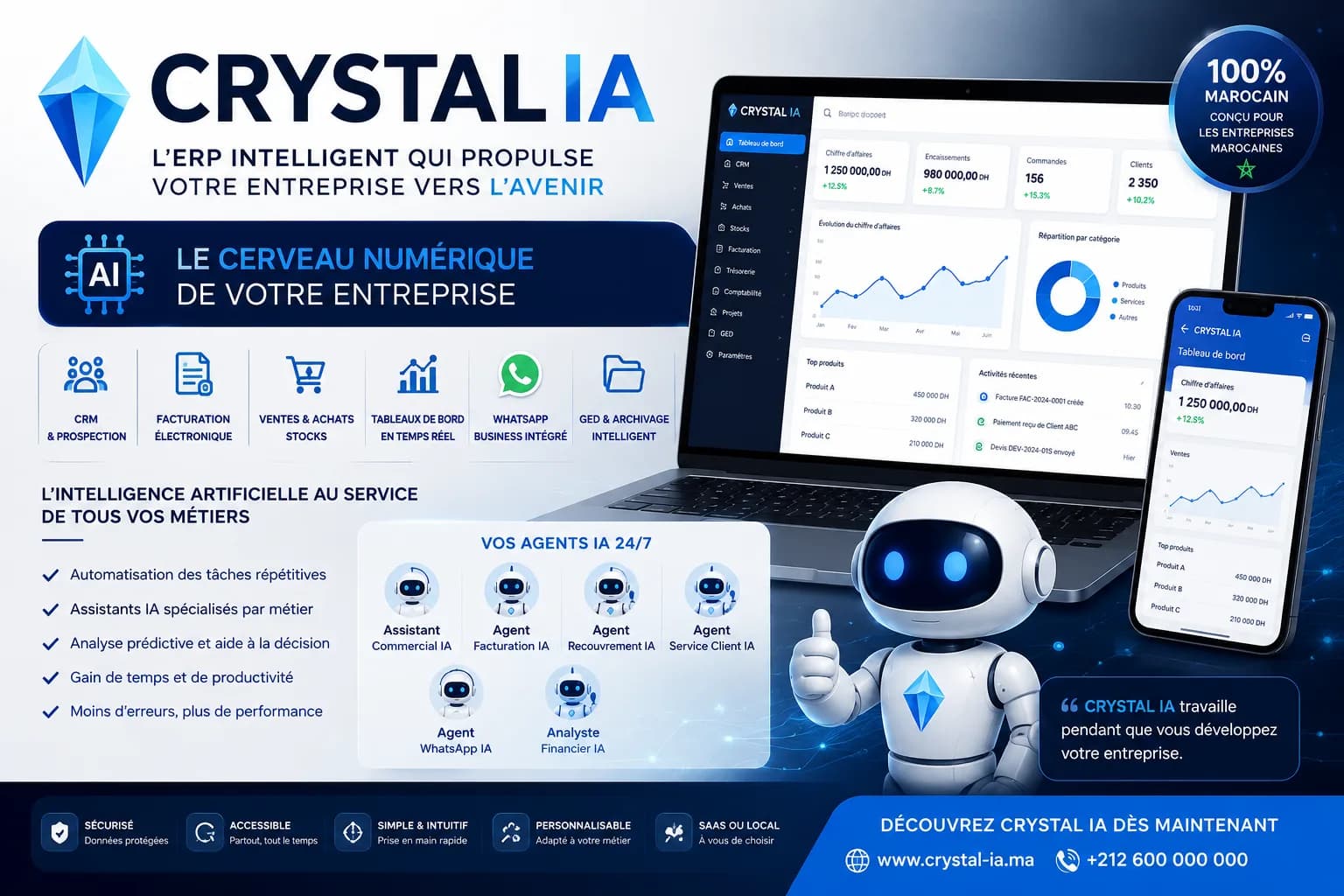
In Crystal ERP, the SaaS ERP developed by CRYSTAL IT, inventory and product management is not an island: it is connected to supplier purchasing upstream and the sales cycle downstream. Every invoice, every receipt updates stock automatically, guaranteeing a reliable picture with no re-entry. The manager knows in real time what they have, what it is worth and what they need to reorder.
Accessible everywhere in SaaS mode and powered by the Crystal IA Chat assistant, Crystal ERP lets you query your stock as easily as asking a question. Developed in Rabat by a company with more than 20 years of experience, it comes with close support to succeed with the initial configuration — often the step that determines the lasting reliability of stock.
Mastering your stock is not only about avoiding stock-outs and overstock: it is about freeing up cash, making inventories reliable and making better purchasing decisions. For a Moroccan company, the key is not to treat stock separately, but to integrate it into unified business management where sales, purchasing and invoicing update it in real time. This is precisely what Crystal ERP, powered by Crystal IA, offers. To see how it would make your inventories reliable on your own products, request a personalised demonstration from the CRYSTAL IT teams in Rabat, with no obligation.
Have a project or a question? Let's talk with a CRYSTAL IT expert.
Request a demo