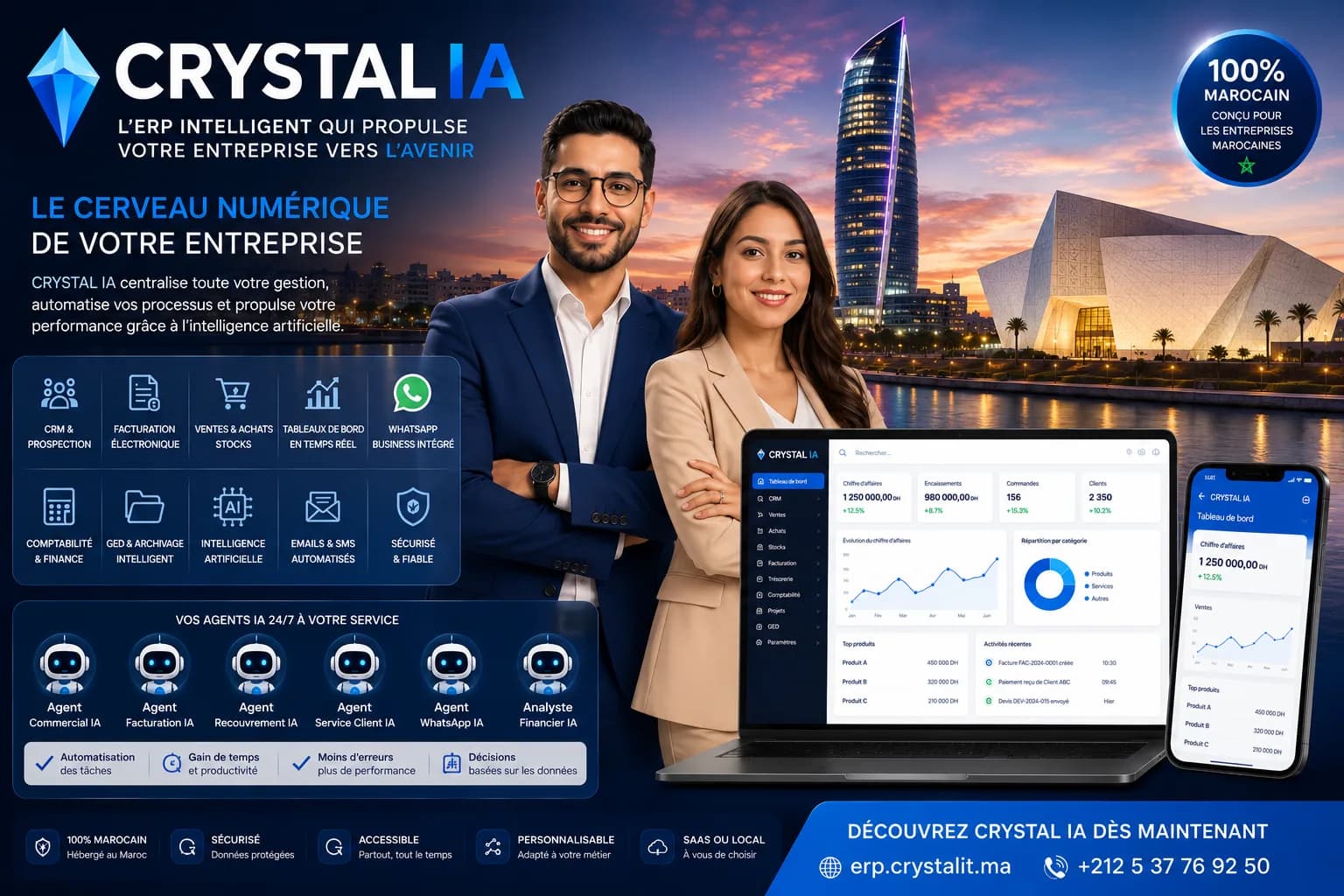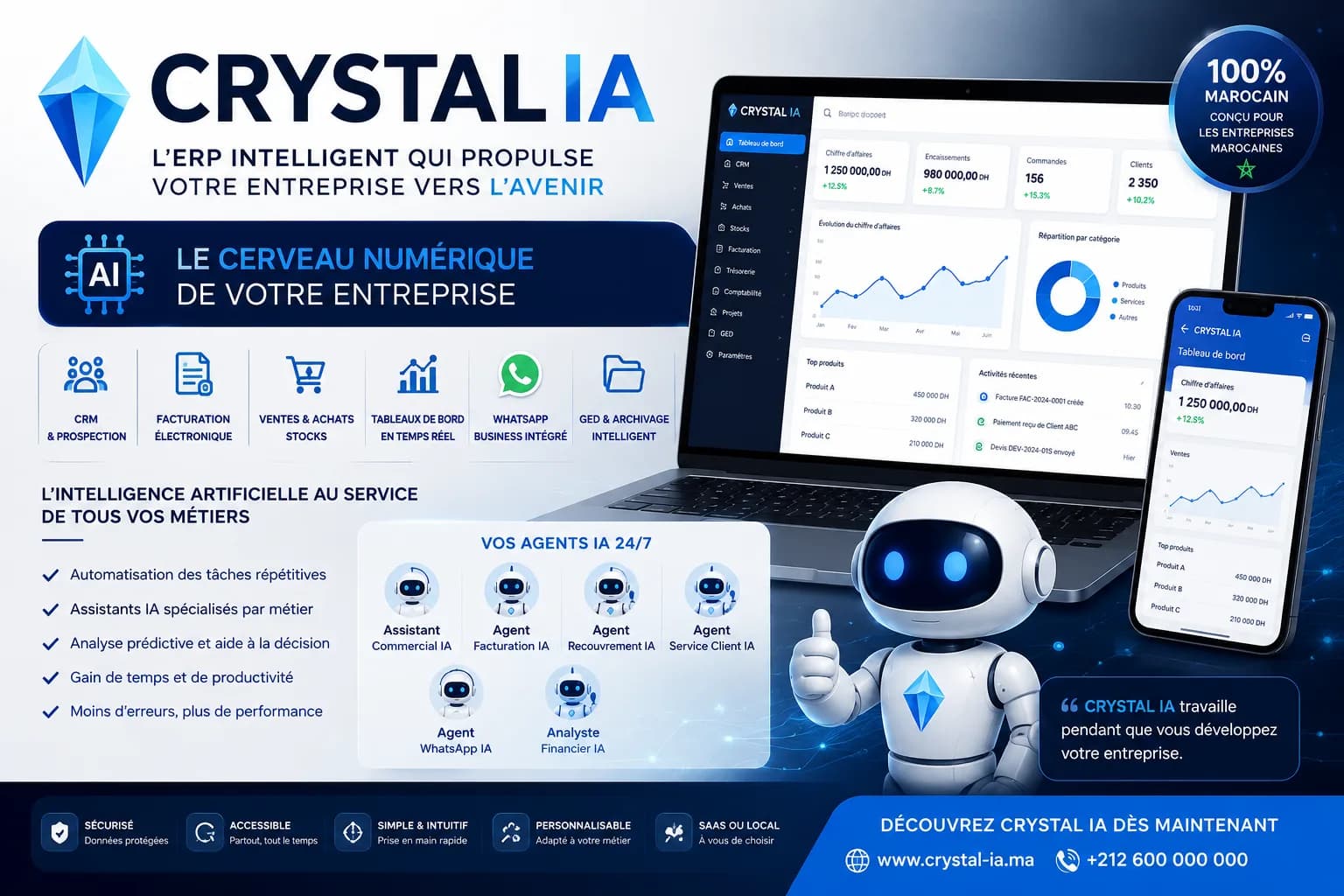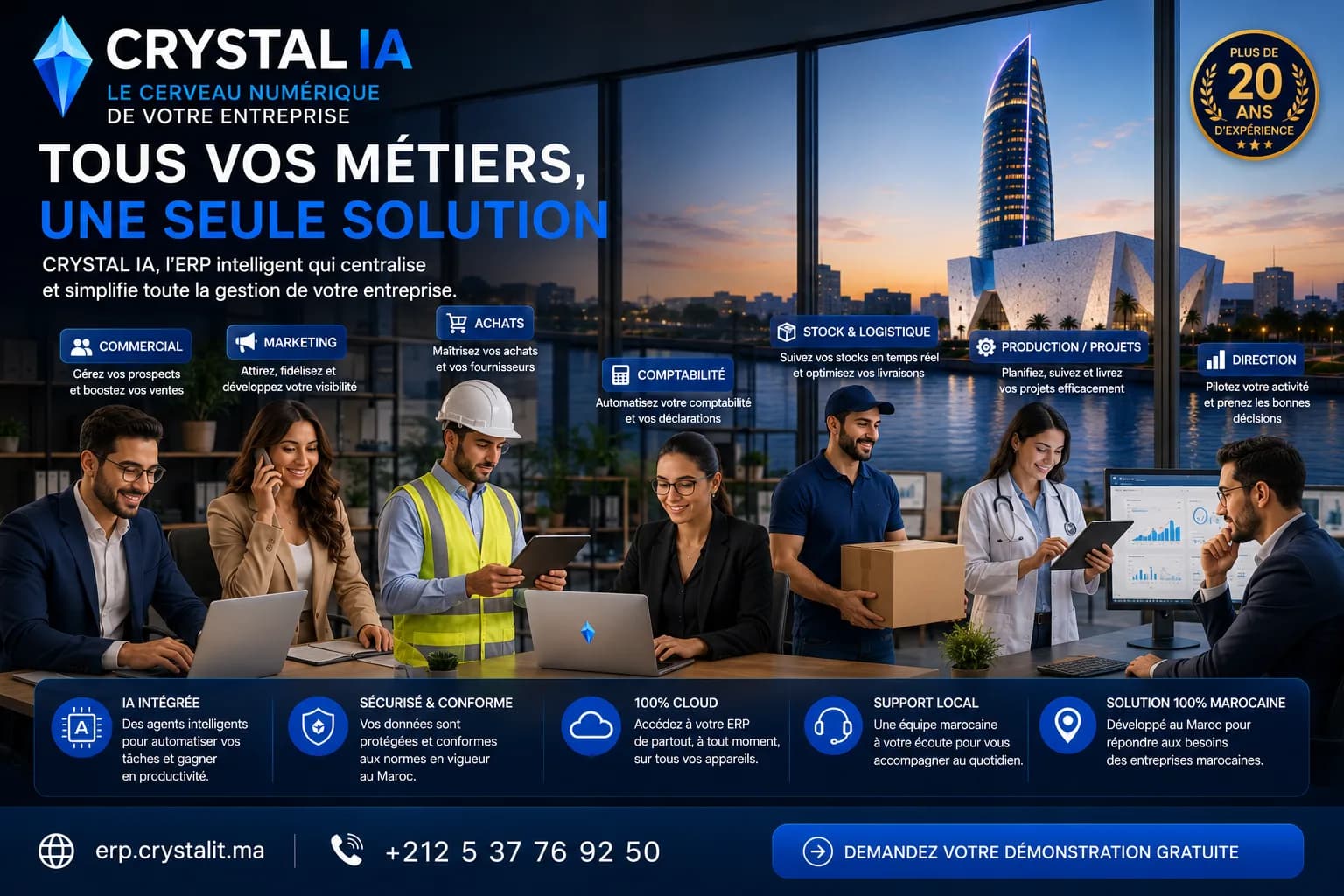
Hotel management software in Morocco has become a strategic tool for hotels, riads, tourist residences and guesthouses seeking to professionalise their operations and meet the growing expectations of an increasingly connected clientele. Morocco's tourism sector, driven by rising international arrivals, a diversifying accommodation offering and the ambitious projects linked to the 2030 World Cup, requires property managers to simultaneously handle multi-channel reservations (OTAs, phone, walk-ins), real-time room management, stay billing with the breakdown of tourist tax, hotel VAT and ancillary services, and compliance with the tax obligations of the Direction Générale des Impôts (DGI). Without the right tool, this complexity translates into overbookings, misallocated rooms, incorrect invoices and opaque cash management that undermines profitability. Crystal ERP (erp.crystalit.ma), developed by CRYSTAL IT in Rabat with more than 20 years of experience serving Moroccan businesses, offers a hotel management module integrated within the full ERP — from reservation intake to accounting close — enabling establishments of all sizes to run their operations from a single platform. This guide details what hotel management software must cover for the Moroccan context and how to choose the right solution in 2026.
The specific challenges of hotel management in the Moroccan context
A hospitality establishment, even a modest one, manages several intertwined activity flows that must be coordinated in real time. Reservations arrive through multiple channels — OTA portals (Booking, Airbnb, Expedia), direct phone calls, emails, walk-in visits — and must be centralised in a single planning system to prevent overbookings (double bookings), which are a source of client disputes and costly relocation fees. Without a suitable management tool, this centralisation is handled manually in notebooks or spreadsheets, with the constant risk of duplicate entries or missed updates when a cancellation occurs.
Moroccan tax regulations add a further layer of complexity: hospitality establishments are subject to VAT according to their classification, to the tourist tax collected on behalf of local authorities, and to the obligation to issue compliant invoices for stays by professional clients (businesses, public bodies, travel agencies). The electronic invoicing reform announced by the DGI (Electronic invoicing in Morocco in 2026), whose progressive roll-out begins in 2026 with B2G transactions by large companies, will strengthen this requirement: invoices will have to be issued in a structured format (UBL 2.1 and UN/CEFACT CII are the standards cited) and validated beforehand by the DGI's e-invoicing platform, whose technical specifications have not yet been published. The precise timetable is to be set by decree; it is essential to verify it on the official DGI portal (tax.gov.ma).
- Overbookings (double bookings): without a centralised planning system, two reservations land on the same room for the same period — a source of client disputes and relocation costs.
- Uncontrolled dynamic pricing: rates vary by season, room type and booking channel — without a tool, pricing grids are often misapplied.
- Manual housekeeping management: assigning rooms for cleaning, tracking each room's status (clean, occupied, out of order) managed verbally or on a whiteboard.
- Ancillary service billing: restaurant, bar, spa, excursions, airport transfers — without a connection to the central system, these items are often omitted or invoiced separately.
- Complex tax compliance: hotel VAT, tourist tax, B2B invoicing with ICE and IF for professional clients — manual management exposes the establishment to errors and costly adjustments.
PMS (Property Management System): the core of hotel management software
The PMS (Property Management System) is the central module of any hotel management solution. It combines reservation scheduling, room management, check-in and check-out, rate management and communication with distribution channels. The room planning chart is the reception team's daily dashboard: a visual calendar displaying each room's status for every night (reserved, occupied, vacant, blocked for maintenance), allowing reservations to be moved or modified by drag and drop, and flagging potential conflicts in real time. A good PMS also manages full reservation records including all client details, recorded preferences (upper-floor room, king-size bed, garden view), guaranteed payment methods and associated correspondence.
Connection with distribution channels (channel manager) is a key feature for establishments selling through OTAs. It synchronises availabilities and rates between the PMS and Booking, Airbnb, Expedia and Agoda portals in real time: as soon as a room is sold on one channel, it disappears from availabilities on all the others. This synchronisation eliminates overbookings and frees up front office time. Crystal ERP (erp.crystalit.ma) integrates PMS functions within its hospitality module, connected to accounting, invoicing and cash management for a unified management flow. For an overview of the complete billing cycle, see our guide (Invoicing software in Morocco: preparing for DGI electronic invoicing).
- Real-time visual planning: room calendar with dynamic status (vacant, occupied, dirty, out of order), modifiable in a few clicks by the reception team.
- Complete reservation record: client details, room preferences, guaranteed payment method, previous stay history and internal notes.
- Rate and promotion management: rate grid by season, room type, length of stay and rate plan (room only, breakfast included, half board) — automatically applied at the time of booking.
- Fast check-in and check-out: room assignment, key handover, activation of ordered services, closing of client folio in a few minutes.
- Channel manager synchronisation: availability and rates updated in real time on all connected OTA portals — zero overbooking, zero manual updates.
Housekeeping, maintenance and operational management of the property
Housekeeping management is a challenge often underestimated in basic hotel software. Yet the assignment of rooms for cleaning, tracking their progress (being cleaned, clean and ready for allocation, requiring inspection) and scheduling of housekeeping staff are activities that directly determine the smoothness of arrivals and guest satisfaction. An effective hotel management solution offers a dedicated housekeeping interface: list of rooms to prepare for the day, status updated in real time (via a tablet or smartphone by the housekeeping team), and an alert to the reception desk as soon as a room is ready.
Maintenance management is complementary: a room reported as defective (air conditioning breakdown, plumbing issue, faulty lock) must be blocked in the planning to prevent any new allocation until it is remediated. In Crystal ERP (erp.crystalit.ma), the hospitality module integrates a maintenance log with intervention tracking, remediation timelines and alerts to the responsible manager. This traceability is also useful during inspections by the Ministry of Tourism. For establishments managing a significant equipment portfolio (pool, spa, kitchen, shuttle vehicles), Crystal ERP's preventive maintenance management (Maintenance Management Software (CMMS) in Morocco) complements this capability.
- Dynamic housekeeping list: rooms to prepare in priority order (imminent arrivals first), status updated from a tablet by housekeeping staff.
- Real-time room status: dirty → being cleaned → clean → inspected — instantly visible at reception to optimise room assignment during check-ins.
- Automatic maintenance blocking: a room flagged as defective is automatically excluded from availabilities until resolved, with an alert to the technical manager.
- Intervention log: every incident is recorded with the date reported, the person responsible, the nature of the fault and the resolution date — consultable history for preventive maintenance.
- Linen management: tracking of linen stocks (sheets, towels) by room and rotation, with automatic reorder trigger based on thresholds.
Stay billing: room folio, ancillary services and DGI compliance
Billing is the critical moment of every stay: it consolidates all client charges (room, meals, bar, spa, laundry, phone, excursions) and must be presented clearly, accurately and in compliance with Moroccan tax obligations. In an integrated hotel management solution, the room folio opens automatically when the reservation is created and is updated in real time with every charge posted to the room. Extras ordered at the restaurant or spa are posted directly to the folio via the point-of-sale system or by notification from the relevant team — no manual re-entry and no risk of omission.
For stays by professional clients (businesses, travel agencies, public bodies, events), the invoice must include the client's ICE and IF numbers, the breakdown of hotel VAT by rate, and the tourist tax. With the electronic invoicing reform announced by the DGI, these invoices will progressively have to be issued in a structured format and validated beforehand by its e-invoicing platform, on a timetable and with technical specifications yet to be published. Crystal ERP (erp.crystalit.ma) manages this distinction automatically at check-out: if the client is a professional identified by their ICE, the system checks the invoice's mandatory particulars and can export it in standard UBL 2.1 format; transmission to the DGI platform will be added once its specification is published. For technical details on the format, see our guide (UBL 2.1 format for electronic invoicing in Morocco: complete guide) and our article on choosing invoicing software (Invoicing software in Morocco: preparing for the DGI reform).
- Automatic room folio: every service consumed (room, restaurant, bar, spa) is posted to the folio in real time — no manual re-entry at reception.
- Multi-currency billing: local currency (MAD) or foreign currency (EUR, USD) according to the client's nationality and payment method — automatic conversion at the current rate.
- Integrated tourist tax: calculated and displayed automatically on the folio according to the property's classification and length of stay, separate from hotel VAT.
- Structured B2B invoice: automatic detection of the client's professional status, checks on ICE, IF and VAT breakdown, export in standard UBL 2.1 format.
- Multiple payment methods: cash, bank card, bank transfer, traveller's cheque, agency booking voucher — mixed payment management for stays with an advance deposit.
Hotel profitability management: RevPAR, occupancy rate and reporting
Running a hotel is grounded in a set of specific key performance indicators that every property director must master. The occupancy rate (OR) measures the percentage of rooms occupied out of total available rooms: 80% occupancy in peak season is a solid result for a well-positioned hotel, but 40% across a full year may signal a commercialisation or pricing issue. RevPAR (Revenue Per Available Room) combines occupancy rate with average daily rate (ADR) to provide a single measure of commercial performance: RevPAR = Occupancy Rate × ADR. A hotel can have high occupancy at a low rate, or a high ADR at low occupancy — RevPAR reconciles both dimensions.
Crystal ERP (erp.crystalit.ma) provides a hotel dashboard with these indicators calculated automatically in real time: occupancy rate by day, week and month, RevPAR and ADR compared to the same period in the prior year, revenue breakdown by room type and booking channel, no-show rate, average length of stay and nationality mix. These data enable the property director to steer pricing policy and react quickly to trends. For even more comprehensive dashboards, see our general guide on business management (Business dashboard in Morocco: managing your company in real time) and our treasury management article (Cash Flow Management for Moroccan SMEs).
- Real-time occupancy rate: occupied rooms / available rooms, displayed by day, week, month and season — year-on-year comparison to detect trends and seasonality.
- RevPAR and ADR: revenue per available room and average daily rate, calculated automatically and broken down by room type and distribution channel.
- Channel breakdown: Booking vs direct vs agencies vs corporate — to measure OTA dependency and steer direct commercialisation efforts.
- Nationality and segment analysis: leisure vs business clientele, Moroccan vs international tourists — to target marketing actions and agency partnerships.
- Extras and food & beverage tracking: share of ancillary revenue (restaurant, spa, bar) in total revenue — upselling and guest spend indicator.
Hotel management in Morocco has reached a level of complexity that goes far beyond a spreadsheet or a reservation notebook: multi-channel operations, DGI tax compliance, structured B2B invoicing, housekeeping management and profitability reporting are all dimensions that require integrated software. Crystal ERP (erp.crystalit.ma), developed by CRYSTAL IT in Rabat with more than 20 years of experience serving Moroccan businesses, centralises all of these flows in a single platform — from reservation intake to accounting close — and connects the hospitality module to invoicing (Invoicing software in Morocco: preparing for DGI electronic invoicing), accounting (Accounting software in Morocco), consumables stock management (Inventory management software in Morocco) and treasury (Cash Flow Management for Moroccan SMEs). For printing supplier payment cheques, Easy Print (easyprint.crystalit.ma) is available free of charge. Contact the CRYSTAL IT team for a demonstration of Crystal ERP tailored to the size and specific requirements of your establishment.
Have a project or a question? Let's talk with a CRYSTAL IT expert.
Request a demo