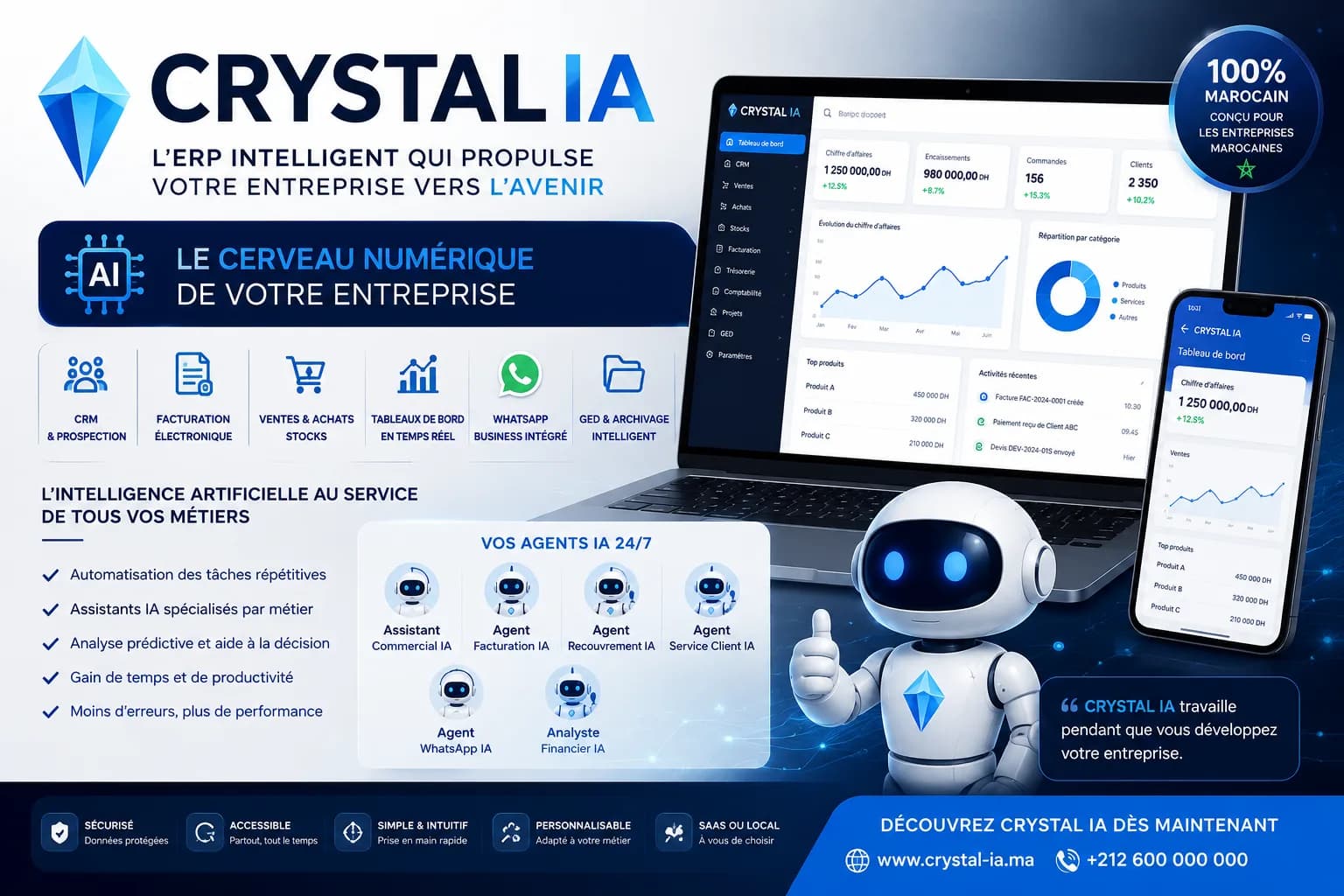
The return on investment (ROI) of an ERP for Moroccan SMEs is the first question any serious business leader asks before signing a software contract. And it is a fair question: an ERP project represents a commitment in time, budget and change management that can appear daunting against benefits that seem difficult to quantify. Yet an ERP's ROI can be calculated — rigorously and methodically — from two columns: the real costs of the project, and the measurable gains it generates in daily operations. A distribution SME in Casablanca, an accounting firm in Rabat, an industrial company in Fès or a brokerage network in Marrakech do not calculate exactly the same ROI, but they share the same broad gain categories: hours of data entry saved, errors avoided, billing cycles shortened, stocks better calibrated, management better informed. Crystal ERP (erp.crystalit.ma), developed by CRYSTAL IT in Rabat with over 20 years of experience serving Moroccan businesses, is designed for SMEs that need a complete SaaS ERP, deployable quickly, without server infrastructure or an in-house IT team. This guide explains how to structure the ROI calculation for an ERP, what cost items to anticipate, where to find quantifiable gains, and how to shorten the payback period in the Moroccan context.
Why ERP ROI is often underestimated — in both directions
Most Moroccan SMEs that hesitate to take the ERP step make two opposite calculation errors. The first is to estimate only the visible costs: the licence or monthly subscription, the initial training. The second is to count only the most obvious gains: 'we will avoid entering orders twice.' Both errors lead to the same underestimation of the real ROI: total cost is overestimated (forgetting that SaaS eliminates server infrastructure and reduces maintenance) and gains are underestimated (omitting hours recovered on accounting, purchasing, stock management and report production). The result is a decision too often based on comparing the subscription price against the cost of a part-time employee, whereas the real question is whether the ERP generates more value than everything the company currently spends managing its data in degraded mode.
A well-deployed ERP does not replace a human position: it frees up capacity on low value-added tasks — data entry, manual reconciliation, data extraction, error correction — so that the same teams can focus on activities that genuinely create value. In Moroccan SMEs, it is not uncommon for senior management to spend two to three hours per week consolidating Excel files before the management committee, for the sales team to wait two days to get stock availability on an item, or for accounting to spend the last week of the month tracking down missing invoices. These silent frictions — difficult to quantify before implementation — make up the largest part of an ERP's ROI.
- Underestimated visible costs: server infrastructure, IT maintenance, manual backups — switching to SaaS eliminates or significantly reduces them.
- Most important hidden gains: hours lost consolidating, correcting, recalculating — that nobody measures because they are spread across several departments.
- Decision postponed indefinitely: without a structured calculation, the ERP project stays 'for later', while the cost of inaction accumulates every month.
- Change management under-costed: training and adaptation time has a cost, but it is one-off — the gains are recurring, every month, for years.
Cost items for an ERP project in a Moroccan SME
Before calculating an ROI, the total cost of ownership (TCO) must be clarified over the intended period of use, typically three to five years. For a SaaS ERP such as Crystal ERP, the TCO breaks down into several categories. The monthly subscription is the most visible component: it covers application access, cloud hosting, updates and backup. Its advantage over on-premise ERP is that there is no large upfront investment or licence renewal cost: the SME pays as it uses and can adjust the number of users as it grows. For a detailed comparison of SaaS ERP and on-premise ERP costs, see our dedicated article (SaaS ERP: why Moroccan companies are moving to the cloud to run their…).
The second category is implementation and configuration cost: configuring the ERP to the company's specific processes, migrating existing data (customers, items, stocks, invoicing history), training users and validating workflows before go-live. This is a one-off but structuring cost: an implementation that is too rushed or too light generates adoption problems that lengthen the payback period. The third category is ongoing training and support cost: the ERP evolves, new features are deployed, new employees arrive. Setting a modest annual training budget maintains the level of proficiency that conditions the gains. The fourth category is the internal time invested: a project manager on the company side must drive the deployment, coordinate with the publisher and validate deliverables. This cost, often forgotten, is real even if it does not appear on an invoice.
- Monthly SaaS subscription: recurring cost proportional to the number of users, with no server investment or update costs.
- Implementation and configuration: configuring modules, migrating data, validating workflows before go-live — one-off cost to plan.
- Initial and ongoing training: getting teams up to speed and maintaining proficiency as the ERP evolves.
- Internal project management time: a project manager on the company side is indispensable — their time has a cost even off-invoice.
- IT personnel cost avoided: SaaS eliminates infrastructure management, backup, system update and on-premise licence renewal costs.
Quantifiable ERP gains: where to find the real savings
Calculating ERP gains relies on systematically identifying current inefficiencies, item by item. The first item is data entry time eliminated or reduced: a customer order entered once in the commercial software automatically generates the delivery note, stock outflow and invoice, with no re-entry. In an SME processing thirty orders a day, if each order generates twenty minutes of multiple entries across different files, the gain is ten hours a day. Multiplied by twelve months and the hourly cost of the staff concerned, this single item alone can justify the annual subscription. The second item is error reduction: a stock error, a duplicate invoice or an unreconciled payment takes time to correct, sometimes a credit note, sometimes a lost customer. An integrated ERP mechanically reduces error rates by eliminating manual transfers between tools.
The third item is reduced invoicing lead times and improved working capital requirement (WCR). In many Moroccan SMEs, the invoice is issued several days after delivery because the order is processed in sales, the delivery note in logistics, and invoicing in accounting, with no connection between these steps (Invoicing software in Morocco). Each extra day between delivery and invoicing is a day of cash flow lag. An ERP that automatically triggers invoicing at delivery validation can shorten this by two to five days — a direct WCR improvement measurable from the first quarter. The fourth item is stock optimisation: a poorly calibrated stock ties up capital needlessly (overstock) or generates lost sales (stockouts). An ERP with real-time stock management, automatic reorder triggers and ABC analysis (Inventory management software in Morocco) can reduce average stock by 15 to 25% without increasing stockout rates.
- Single entry, automatic flow: one order entered once triggers delivery, stock outflow and invoice — no re-entry in other tools.
- Error reduction: fewer manual transfers means fewer stock errors, duplicate invoices and customer disputes to handle.
- Shortened invoicing lead time: triggering the invoice at delivery validation recovers two to five days of cash flow per cycle.
- Stock optimisation: automatic replenishment and ABC analysis reduce average stock by 15 to 25% without increasing stockouts.
- Instant reporting: management has real-time indicators without spending hours consolidating Excel files (Business dashboard in Morocco: managing your company in real time).
Calculating your ERP ROI: method and key indicators
The ROI calculation method for an ERP is straightforward but requires rigorous estimation discipline. The basic formula is: ROI (%) = [(Total gains – Total costs) / Total costs] × 100. For a Moroccan SME, the exercise breaks down into several steps. First step: list all identified potential gains and quantify them in dirhams per month — data entry time saved × hourly cost, reduced billing lead time × freed capital × financing rate, stock reduction × carrying cost, errors avoided × average resolution cost. It is better to be conservative: retain 50 to 70% of estimated gains to account for the learning curve and use cases that only reach full speed after a few months.
Second step: calculate the total cost over the chosen period (24 or 36 months) — subscription × duration, implementation (one-off), initial training, estimated internal time. Third step: calculate the payback period, i.e. the month when cumulative gains exceed cumulative costs. In well-managed SaaS ERP projects for SMEs of 10 to 50 employees, this period is generally between 8 and 18 months. Fourth step: calculate the ROI over 36 months, then the net present value (NPV) if management wishes to factor in the time value of money. To refine this analysis, an accountant (Accounting software in Morocco) can help model flows over several financial years. If you are hesitating between a custom ERP and a packaged solution, our article (Custom-built ERP or off-the-shelf package: how to choose?) will help you set the right foundations before launching the ROI calculation.
- ROI formula: (cumulative gains – cumulative costs) / cumulative costs × 100 — calculated over 24 or 36 months for a realistic picture.
- Payback period: the month when cumulative gains exceed costs — generally 8 to 18 months for a well-supported 10 to 50-person SME.
- Gains to quantify: entry time saved × hourly cost, billing lag × improved WCR, stock reduced × carrying cost, errors avoided × resolution cost.
- Costs to integrate over the same period: subscription × duration, implementation, training and internal project management time.
- Be conservative in year one: apply a 50 to 70% coefficient to estimated gains while teams reach full speed.
Crystal ERP: designed to shorten ROI for Moroccan SMEs
Crystal ERP (erp.crystalit.ma) is the management software developed by CRYSTAL IT in Rabat to address precisely the challenges of Moroccan SMEs — companies that need a complete ERP but cannot afford an eighteen-month implementation or a permanent IT maintenance cost. Several design choices directly shorten the payback period. The first is the SaaS model: no server to buy, no infrastructure cost, no in-house IT team required — the monthly subscription covers everything. Updates to new features are automatic, at no additional cost. For electronic invoicing (Electronic invoicing in Morocco in 2026), Crystal ERP already checks invoice readiness (ICE, mandatory mentions, structure) and exports invoices in UBL 2.1 format; transmission to the DGI platform will be added once its specification is published. The second factor is broad functional coverage from the first subscription: commercial management (Business management software in Morocco: the complete guide for SMEs), invoicing (Invoicing software in Morocco), purchasing (Purchase management software in Morocco), stock (Inventory management software in Morocco), accounting (Accounting software in Morocco) and dashboards (Business dashboard in Morocco: managing your company in real time) — with no separate modules to integrate or interfaces to multiply.
The third ROI acceleration factor is implementation support: a team of CRYSTAL IT consultants based in Morocco, available to configure the ERP to the company's processes, migrate data and train users before go-live. This local support is an important differentiator in a context where Moroccan specificities — CGNC chart of accounts, VAT, DGI regulations, purchase order and delivery note formalisation — require local expertise. The fourth factor is modular flexibility: an SME starting with commercial management and invoicing can activate accounting, CRM (CRM software in Morocco: managing client relationships and growing…) or the HR module (HR Management Software in Morocco: the Complete Guide for SMEs) when the need becomes a priority, without reconfiguring the whole system. To choose the right starting modules, our guide (How to choose an ERP in Morocco: criteria, cost and mistakes to avoid) details the prioritisation method suited to Moroccan SMEs.
- SaaS with no infrastructure: no server, no IT team, automatic updates including DGI regulatory changes.
- Complete functional coverage: sales, invoicing, purchasing, stock, accounting and dashboards in one subscription — no separate modules to integrate.
- Local support: CRYSTAL IT consultants based in Morocco, experts in CGNC, Moroccan VAT and DGI regulations.
- Progressive modularity: start with priority modules and activate others as needs arise, without rebuilding the system.
- E-invoicing preparation: checks on the ICE and mandatory mentions, UBL 2.1 export; transmission to the DGI platform will be added once its specification is published.
The ROI of an ERP for Moroccan SMEs is not a magic number from a white paper — it is the result of a structured calculation comparing the real costs of the project against measurable gains in daily operations. SMEs that have carried out this exercise seriously regularly achieve payback periods of less than 12 months, with a three-year ROI often exceeding 200%. Crystal ERP (erp.crystalit.ma), developed by CRYSTAL IT in Rabat with over 20 years of experience serving Moroccan businesses, is designed for SMEs to reach this result quickly: SaaS deployment with no infrastructure, complete functional coverage, local support and invoices that are checked and exportable in UBL 2.1 ahead of electronic invoicing. Contact the CRYSTAL IT teams in Rabat for an audit of your current processes, a personalised ROI estimate for your ERP project, and a Crystal ERP demonstration tailored to your sector.
The CRYSTAL IT solution on this topic
Have a project or a question? Let's talk with a CRYSTAL IT expert.
Request a demo