For a long time, equipping a business with management software in Morocco meant investing in servers, expensive licences and complex installations. That model increasingly belongs to the past. Today, Moroccan SMEs are turning en masse to SaaS ERP: complete management software, hosted in the cloud, accessible from a simple browser and billed on a usage basis. In this article, we explain what is driving this shift, the concrete benefits for business leaders, and how a Moroccan ERP software such as Crystal ERP, developed by CRYSTAL IT in Rabat, supports this digital transformation of SMEs.
SaaS ERP: what exactly are we talking about?
An ERP (Enterprise Resource Planning) is software that centralises all of a company's processes in a single tool: sales, purchasing, inventory, invoicing, accounting and customer relationships. Instead of juggling Excel files, a standalone invoicing program and email exchanges, all teams work on a single, shared database.
The SaaS (Software as a Service) model changes the way this ERP is consumed. The software is no longer installed on the company's computers or servers: it is hosted in the cloud and accessible online, everywhere and in real time. The vendor handles hosting, maintenance and updates. For the company, the cloud ERP becomes a service that is used, rather than an infrastructure that is owned and must be maintained.
Why Moroccan companies are switching to cloud ERP
The move to SaaS ERP in Morocco is not a passing trend: it responds to very concrete constraints faced by SME leaders. The arguments that come up most often are the following.
These advantages explain why SaaS ERP is gradually establishing itself as the standard for business management software in Morocco, for SMEs as well as for larger organisations.
- Total accessibility: the ERP is available from a browser, at the office, on the move or at another site. Leaders can review their figures in real time, wherever they are.
- Controlled cost: no servers to buy and no infrastructure to maintain. The subscription replaces the heavy upfront investment, which puts the ERP within reach of SMEs.
- Automatic updates: the company continuously benefits from the latest features and fixes, with no migration project and no business interruption.
- Security and continuity: professional cloud hosting comes with backups and security best practices that are hard for an SME to replicate in-house.
- Fast deployment: no machine-by-machine installation; teams are up and running quickly.
A single tool to run the whole business: from quote to accounting
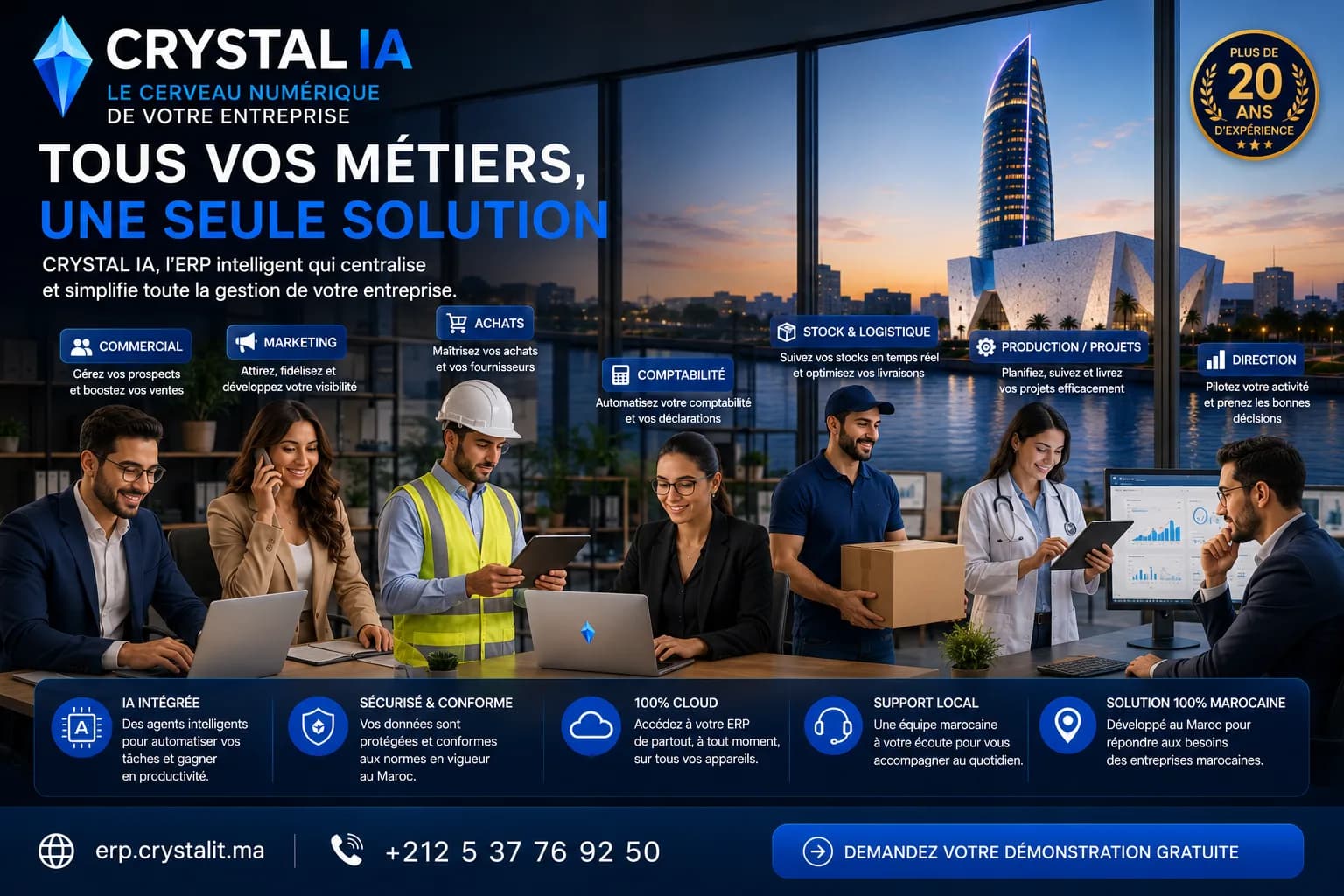
The strength of an all-in-one SaaS ERP lies in the continuity of information. Take the classic sales cycle of a Moroccan SME: a sales rep draws up a quote, the customer accepts it, the quote becomes an order, the order triggers a delivery, and then an invoice. With separate tools, each step involves re-entering data, errors and wasted time. With an integrated ERP, information flows automatically from one step to the next.
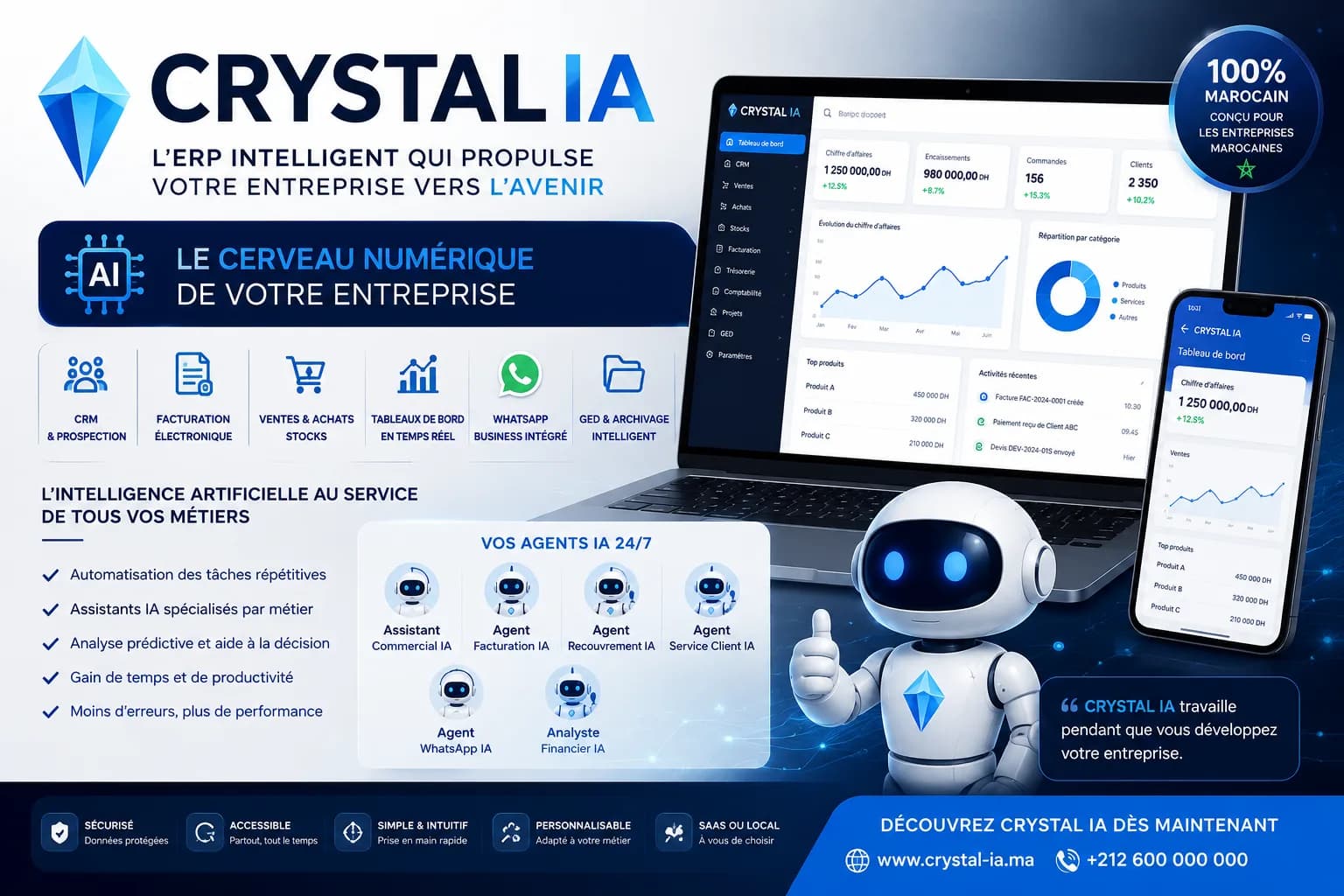
This is exactly the scope covered by Crystal ERP, the SaaS ERP developed by CRYSTAL IT: quotes, orders, deliveries and invoices follow on from one another in a single flow, connected to inventory and product management, supplier purchasing, sales and accounting. The CRM module rounds out the whole with customer portfolio tracking and a scoring feature that helps sales teams prioritise their actions. Leaders thus have a unified, real-time view of their activity, without manually consolidating scattered data.
- Complete sales cycle: quotes, orders, deliveries, invoices.
- Inventory and products tracked in real time, connected to supplier purchasing.
- Integrated sales and accounting for reliable financial steering.
- CRM with customer scoring and sales portfolio management.
Artificial intelligence, the ERP's new asset: the example of Crystal IA
The new generation of cloud ERP no longer merely records data: it helps put it to use. That is the role of Crystal IA, the artificial intelligence engine that powers the CRYSTAL IT software ecosystem and sits at the heart of Crystal ERP.
In practice, Crystal ERP embeds an IA Chat assistant directly within the management tool. Rather than navigating menus or building reports, users can query their ERP conversationally and get answers grounded in the company's real data. On the sales side, AI-powered customer scoring helps identify high-potential customers and better manage the portfolio. For an SME without an in-house data analyst, this is a simple way to put artificial intelligence at the service of everyday decision-making.
Digital transformation of SMEs: where to start?
The digital transformation of an SME is not just about buying software: it is a change in working method. A few simple principles make for a successful switch to a SaaS ERP. First, start from the company's real processes: where is time being lost today? Re-entering data between quotes and invoices, poorly tracked inventory, forgotten customer follow-ups, laborious accounting closures? This diagnosis makes it possible to prioritise which modules to deploy first.
Next, favour an all-in-one solution rather than a stack of disconnected tools: it is the integration between sales, inventory, purchasing and accounting that creates value. Finally, involve teams early and choose a vendor able to support the project over the long term. A well-chosen cloud ERP grows with the company: you start with the sales cycle and invoicing, then progressively extend to purchasing, accounting and CRM, at the organisation's own pace.
Why choose a Moroccan ERP software such as Crystal ERP
Compared with the major international suites, a Moroccan ERP software offers concrete advantages: a vendor close to its customers, who understands the realities of local businesses and supports deployment with no barrier of distance or time zone.
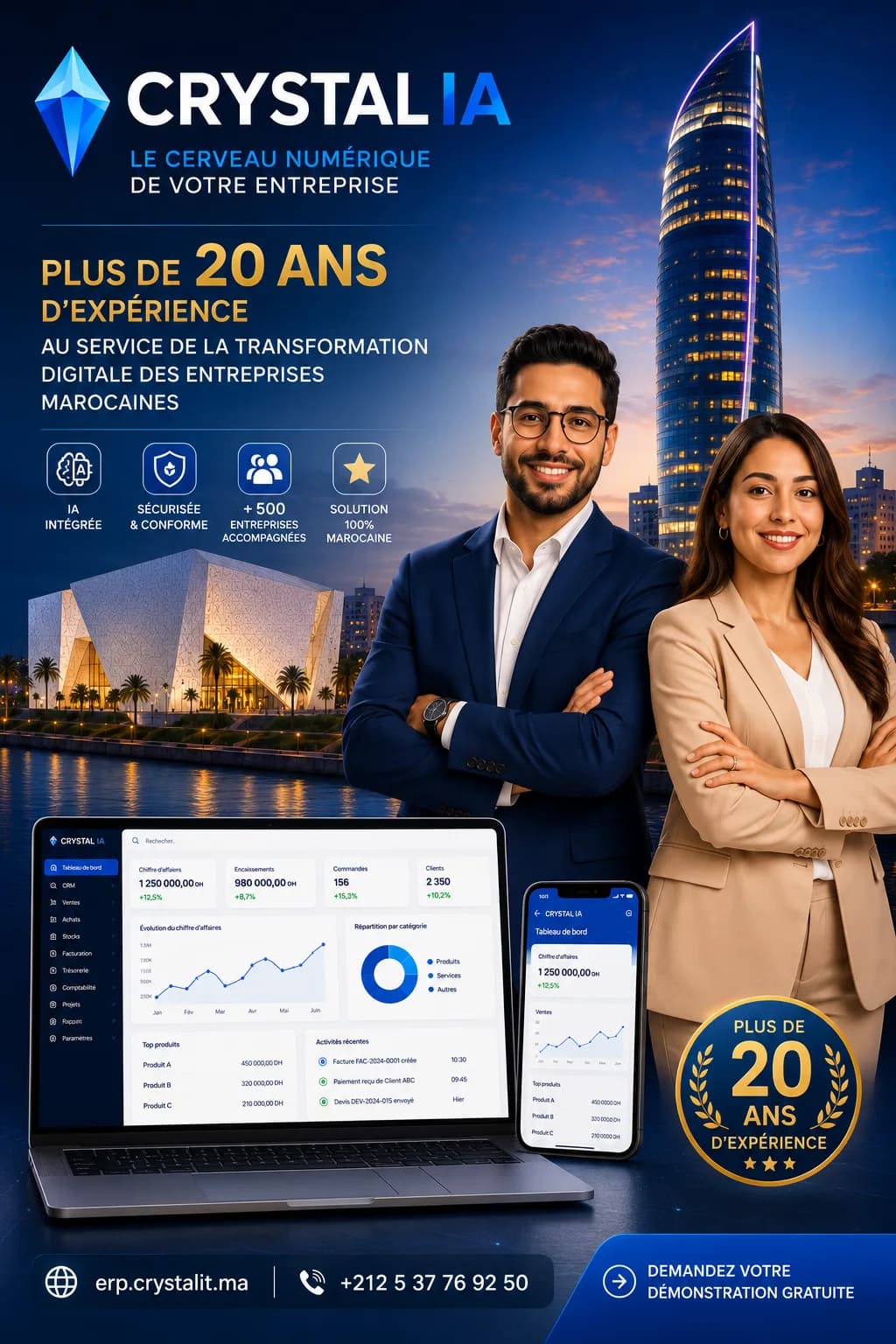
CRYSTAL IT, a SaaS software vendor based in Rabat, draws on more than 20 years of experience serving businesses. Crystal ERP is the fruit of this expertise: an all-in-one SaaS ERP, powered by Crystal IA, covering the whole of management — quotes, orders, deliveries, invoices, inventory, purchasing, sales, accounting and CRM — accessible everywhere and in real time. For a Moroccan SME, it is the combination of modern cloud technology and a strong, lasting local partner.
SaaS ERP is no longer reserved for large groups: it has become the most accessible lever for Moroccan companies that want to make their management more reliable, save time and steer their business in real time. Accessibility, controlled costs, automatic updates, security and now built-in artificial intelligence: the cloud is turning the ERP into a genuine steering assistant. With Crystal ERP, powered by Crystal IA, CRYSTAL IT puts more than 20 years of expertise at the service of the digital transformation of Moroccan SMEs. Want to see concretely what a cloud ERP can change in your company? Request a personalised demonstration of Crystal ERP from our teams in Rabat today.
Have a project or a question? Let's talk with a CRYSTAL IT expert.
Request a demo