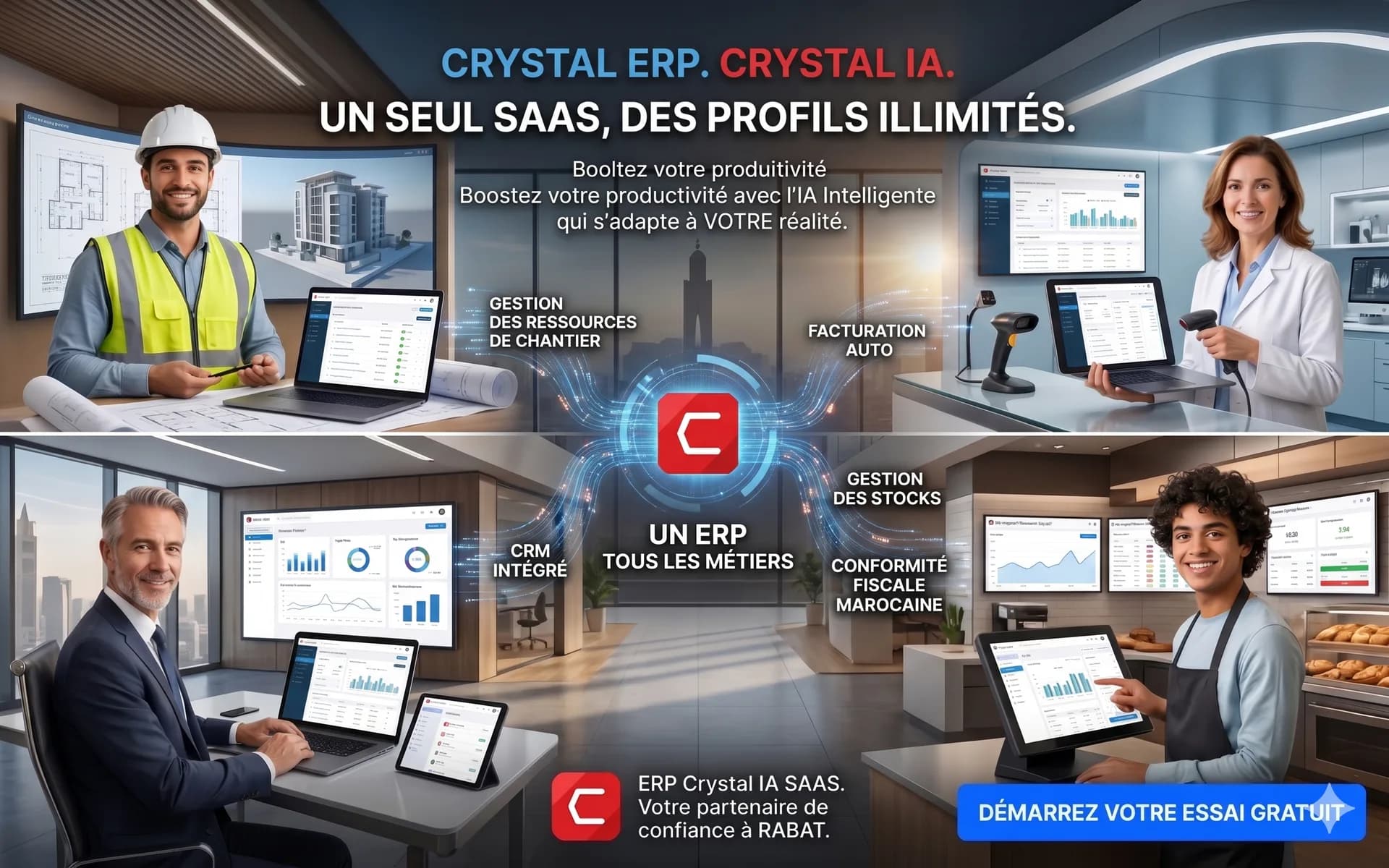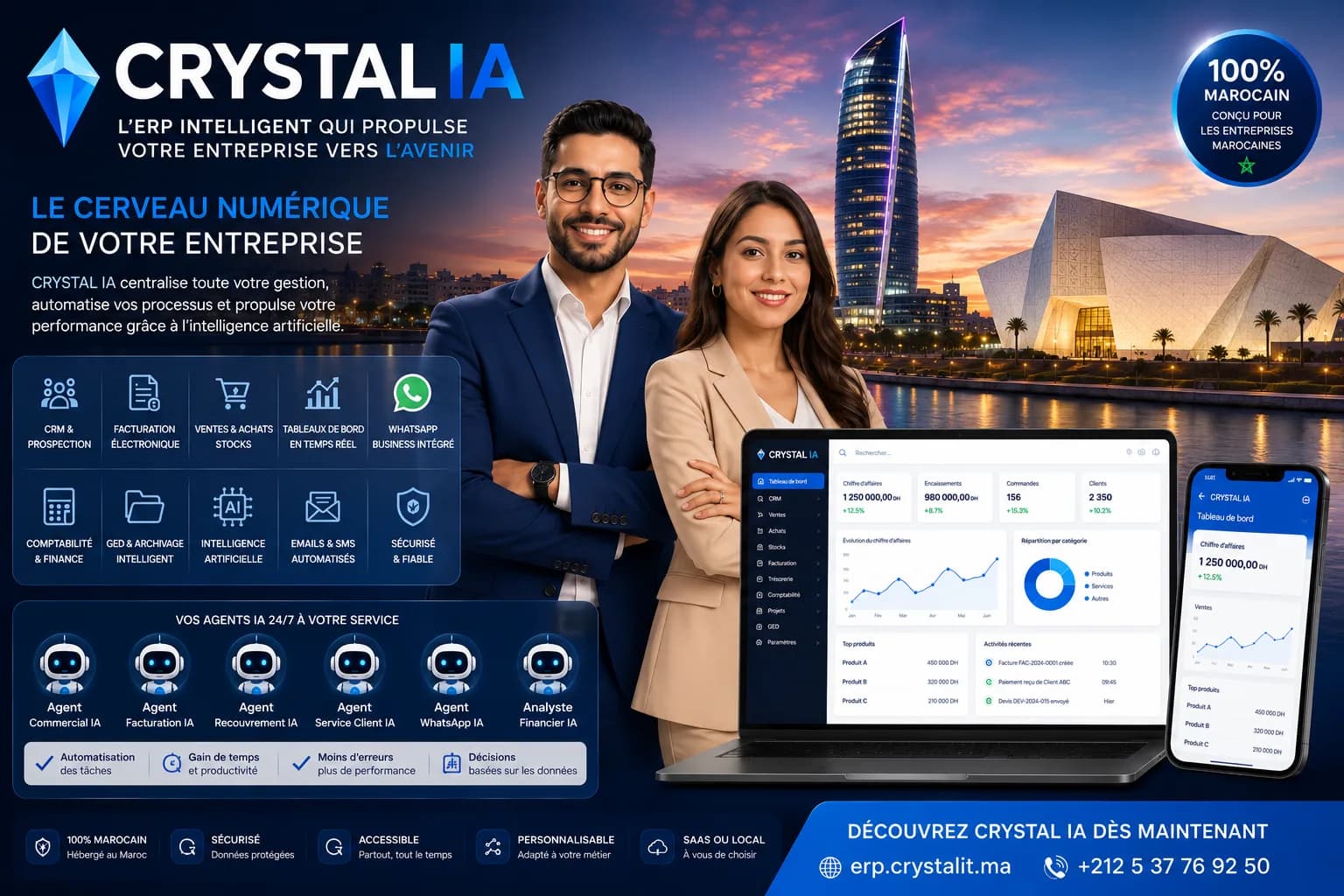
The cost of an ERP in Morocco is often the first question SME directors ask when considering a management system upgrade — and it is also the hardest to answer without a reference framework. Price ranges vary tenfold depending on the model (perpetual licence, SaaS, bespoke development), the size of the company and the functional scope selected. This guide decodes the components of the price, explains why the listed cost is never the real cost, and details how Crystal ERP (erp.crystalit.ma) offers transparent, SME-friendly pricing with no unpleasant surprises.
The factors that drive ERP cost variation in Morocco
An ERP price is not a fixed figure: it results from several interdependent variables. Understanding these variables is the first step to comparing offers on a fair basis and avoiding poorly calibrated quotes.
Company size and number of users are the primary determinants: almost all publishers set their pricing according to the number of licences or active accounts. A 10-user SME and a 100-person company do not pay the same subscription, even for an identical tool. The functional scope is equally important: an ERP covering only invoicing and purchasing costs less than a solution that also integrates HR, payroll, fleet management or analytical accounting. Each additional module increases the licence cost — but above all the implementation and training cost. For a trading SME, the core need is often business management — quotes, sales, stock, invoicing — described in our guide (Business management software in Morocco: the complete guide for SMEs).
- Number of users: each licence or active account represents a direct cost line.
- Functional scope: invoicing only, or a full ERP (stock, purchasing, HR, accounting)?
- Industry sector: a sector-specific ERP (automotive, insurance, distribution) costs more than a general-purpose one.
- Data location: cloud hosting (SaaS) or internal server (on-premise)?
- Level of customisation: a configured ERP costs less than one built bespoke.
Pricing models: perpetual licence, SaaS and bespoke development
There are three main pricing models in the Moroccan ERP market, each reflecting a very different investment logic. The perpetual licence (or on-premise) model involves a one-off purchase of the right to use the software, to which an annual maintenance contract is added (typically 15 to 20% of the licence price). This model suits large companies with an in-house IT department capable of managing deployment and updates. For most Moroccan SMEs, it generates a heavy initial investment that is difficult to amortise.
The SaaS (Software as a Service) model is now the standard for SMEs: the company pays a monthly or annual subscription per user, with no upfront infrastructure investment. Updates are automatic, hosting is managed by the publisher and scalability is immediate. This is the model of CRYSTAL IT's SaaS ERP (Crystal ERP, the Moroccan sales management and ERP software), which allows an SME to get started with a low financial commitment and adjust its subscription as it grows. Bespoke development, finally, means having an ERP built specifically for the company's processes: this is the most expensive option, with budgets typically starting at several hundred thousand dirhams, reserved for large organisations with highly atypical requirements.
- Perpetual licence (on-premise): one-off purchase + annual maintenance (15-20%) + server infrastructure. High upfront cost.
- SaaS: monthly or annual subscription per user, no internal infrastructure. Ideal for SMEs.
- Bespoke development: quoted price, generally very high, for highly specific requirements.
- Hybrid model: some publishers offer a hosted licence on their own cloud — halfway between on-premise and pure SaaS.
Total Cost of Ownership (TCO): the line items you must not overlook
The subscription or licence price is only the visible tip of the iceberg. The Total Cost of Ownership (TCO) of an ERP includes several items that are often underestimated during selection. Implementation is generally the heaviest item after the licence: module configuration, migration of existing data (customers, items, accounting history), integrations with tools already in use (email, e-commerce, banking). Depending on complexity, implementation can represent 50% to 200% of the annual licence cost.
Training is another critical line item: an ERP that is underused because staff are not trained is a wasted investment. Allow between half a day and two days of training per module per user group. Post-deployment technical support and assistance, any customisations requested during use and major updates can also generate recurring costs. Finally, indirect costs — internal time mobilised for the project, and the productivity dip during the adaptation phase — are often ignored in budget forecasts.
- Implementation and configuration: 50% to 200% of the annual licence cost depending on complexity.
- Data migration: transferring customer, item and accounting histories to the new tool.
- User training: an essential investment to maximise return on investment.
- Support and maintenance: assistance contract, major updates, one-off interventions.
- Indirect costs: internal project time, process adaptation, productivity during the transition.
SaaS vs on-premise: what budget should a Moroccan SME plan for?
For a Moroccan SME with 5 to 50 users, the SaaS model is almost always the most economical and the fastest to deploy. With no upfront infrastructure investment, no in-house IT function to manage a server and a subscription that scales with growth, SaaS offers a short decision cycle and implementation within a few weeks. By comparison, a classic on-premise deployment in this segment typically takes several months and requires in-house technical expertise that most SMEs do not have.
Financially, SaaS converts a capital expenditure (CAPEX) into an operating expense (OPEX), making budget management straightforward. Visibility is total: the company knows exactly what it spends each month, with no risk of overspend caused by major updates or server failures. For a deeper comparison between SaaS ERP and on-premise solutions, see our dedicated article (SaaS ERP: why Moroccan companies are moving to the cloud to run their…).
- SaaS: up and running in weeks, predictable subscription, updates included, no servers to manage.
- On-premise: high initial investment, lengthy deployment, in-house maintenance — suited to very large companies.
- 5-50 user SME: SaaS is almost always the most cost-effective option over three years.
- Faster ROI with SaaS: no infrastructure depreciation, rapid adoption, tangible gains from the first months.
Criteria for choosing an ERP with the best value for money
Faced with the diversity of offerings, choosing an ERP on price alone is risky: a cheap tool that is poorly suited to your sector or difficult to use will cost more in the long run than a better-calibrated solution. The criteria to evaluate alongside price are functional coverage (do the modules cover 90% of your needs without heavy customisation?), localisation (does the software handle Moroccan fiscal and regulatory obligations: VAT, CNSS, IGR, DGI e-invoicing?) and support quality (is the publisher reachable quickly in the event of a problem?).
The publisher's origin matters greatly for that last criterion: a locally based Moroccan publisher knows the specifics of the market — the Labour Code, VAT rules, CNSS obligations, the fiscal calendar — and integrates them natively into the solution, without costly manual adaptation. This is one of the key differences between Crystal ERP and a generic international solution. For a fuller discussion of selection criteria, see our complete guide (How to choose an ERP in Morocco: criteria, cost and mistakes to avoid).
- Functional coverage: does the solution cover your business processes without heavy customisation?
- Localisation: VAT, CNSS, IGR, DGI e-invoicing — the software must handle the Moroccan regulatory framework natively.
- Ease of use: a well-designed interface reduces training and adoption costs.
- Responsive support: a reachable local publisher is worth more than an offshore call centre.
- Scalability: can the software grow with your company (new modules, new users)?
Crystal ERP: transparent SaaS pricing for Moroccan SMEs
Crystal ERP (erp.crystalit.ma) is the SaaS ERP developed by CRYSTAL IT — a Moroccan publisher based in Rabat with more than 20 years of experience in management software — specifically designed to meet the needs of Moroccan SMEs without overcommitting them financially. Its SaaS pricing is built to be predictable: a monthly subscription per user, no hidden fees, no upfront licence, no infrastructure costs.
Crystal ERP implementation is deliberately streamlined: the standard configuration covers the vast majority of Moroccan SMEs (invoicing, purchasing, stock, accounting, HR) without bespoke development. CRYSTAL IT teams provide data migration support and user training within short timeframes. As a SaaS solution hosted in Morocco, Crystal ERP automatically incorporates regulatory changes (VAT, CNSS, IGR): no manual configuration required after each statutory update. On electronic invoicing, it already checks invoices for readiness (ICE, mandatory details) and exports standard UBL 2.1; transmission to the DGI platform will be added once its specification is published. Contact the CRYSTAL IT team for a quote tailored to your structure and functional scope. The modules are detailed on the product page (Crystal ERP, the Moroccan sales management and ERP software).
Evaluating the cost of an ERP in Morocco means going beyond the listed price: factoring in implementation, training, maintenance and indirect costs to get a realistic picture of TCO. For the vast majority of Moroccan SMEs, the SaaS model offers the best balance between low upfront investment, rapid deployment and budget predictability. Crystal ERP (erp.crystalit.ma) embodies this model: transparent per-user pricing, complete functional coverage for a Moroccan SME, native localisation (VAT, CNSS, IGR), readiness for DGI e-invoicing (UBL 2.1 export) and support provided by a Rabat-based publisher with more than 20 years of experience. Before signing an ERP contract, take time to compare the total cost of ownership, not just the monthly fee. See our guide to choosing the right ERP (How to choose an ERP in Morocco: criteria, cost and mistakes to avoid) and our article on the benefits of SaaS (SaaS ERP: why Moroccan companies are moving to the cloud to run their…), and contact CRYSTAL IT for a personalised estimate.
The CRYSTAL IT solution on this topic
Have a project or a question? Let's talk with a CRYSTAL IT expert.
Request a demo