Third-party payer billing is a daily reality in the vast majority of Moroccan pharmacies. As soon as a patient has medical coverage, the pharmacy advances the covered share and collects only the remaining patient co-payment at the counter. The mechanism is well known. What is less well known is the administrative burden it generates: how many third-party payer sales for a given insurer this month? What is the total amount still receivable? What portion has already been reimbursed, and what portion is still outstanding? Without a structured tool, these questions rarely have a precise answer — and poorly tracked receivables end up getting lost. Our Pharmacy module (Crystal Pharma, our pharmacy management software), developed by CRYSTAL IT in Rabat with over 20 years of experience serving Moroccan SMEs, integrates third-party payer billing at the heart of the sale: patient and insurer shares calculated automatically, the receivable recorded at the time of the transaction, internal statements per insurer and tracking of amounts receivable. This guide explains how to configure and manage third-party payer billing in a Moroccan pharmacy with Crystal Pharma, and what the software handles — as well as what it does not replace.
Third-party payer in a Moroccan pharmacy: a cash advance not to be lost
Under the third-party payer system, the pharmacy advances the share covered by the insurer: the patient pays only their co-payment at the counter, and the pharmacy must subsequently claim reimbursement from the relevant insurer. This mechanism creates a short-term receivable on every third-party payer sale — a receivable that, if not tracked, risks never being collected. In a pharmacy that processes dozens or hundreds of third-party payer sales per month, with multiple distinct insurers each having their own reimbursement procedures, tracking quickly becomes a full administrative task in its own right. Without a dedicated tool, this tracking typically relies on manually maintained spreadsheets or delivery slips — sources whose consistency deteriorates rapidly.
The stakes are not purely financial. Approximate third-party payer tracking also means difficulty in detecting partial reimbursements, identifying sales with ageing receivables, or preparing supporting documents for follow-up. The multiplicity of insurers — CNSS, CNOPS, private insurance, occupational mutual funds — adds a layer of complexity: each insurer may have different procedures, timelines and claim formats. A suitable pharmacy software must cover this entire flow: from entering the patient's coverage rate to tracking amounts receivable, including the automatic calculation of shares at every sale. For a full overview of pharmacy software features in Morocco, see our guide (Choosing pharmacy management software in Morocco).
- Third-party payer billing creates a receivable from the insurer on every sale: the pharmacy advances the covered share before being reimbursed.
- Multiple insurers can coexist in the same pharmacy, with different coverage rates depending on the patient.
- Untracked follow-up exposes the pharmacy to lost receivables, undetected partial reimbursements and missed claim deadlines.
- The volume of third-party payer sales in a Moroccan pharmacy can represent a significant share of monthly turnover.
- Each insurer has its own reimbursement procedures: distinguishing receivables by insurer is essential to preparing claims.
Setting up the patient file: insurer and coverage rate
In Crystal Pharma, third-party payer billing starts with the patient file. Each patient can be associated with a coverage insurer and a coverage rate. These two pieces of information are saved in their file and used automatically at every third-party payer sale: the software calculates the patient share and the insurer share without re-entry at each transaction. This approach prevents calculation errors at the counter, particularly during peak hours, and ensures that the rate applied correctly matches the patient's coverage conditions.
The patient file in Crystal Pharma also centralises other information useful for counter reception: past dispensing records, usual treatments, allergies and loyalty tracking. This centralisation makes it possible to retrieve a patient's situation in seconds, without having to ask for their coverage details at every visit. A patient whose coverage rate or insurer changes — for example when their employment situation changes — can have their file updated, and the new rate applies from the next sale onwards. For medication management at the counter, particularly regulatory schedule products and batch control, the article on pharmacy stock management (Pharmacy Stock Management in Morocco) completes this guide.
- Patient file with coverage insurer and rate, used automatically at every third-party payer sale.
- Updating the rate or insurer in the file: the new setting applies from the next sale onwards.
- Centralised patient information: dispensing records, usual treatments, allergies, loyalty — accessible in seconds at the counter.
- The patient file also records a credit account with a ceiling, independently of the third-party payer mechanism.
- Products promised to a patient that are out of stock are tracked in the file until their dispensing.
The third-party payer sale: automatic calculation of both shares
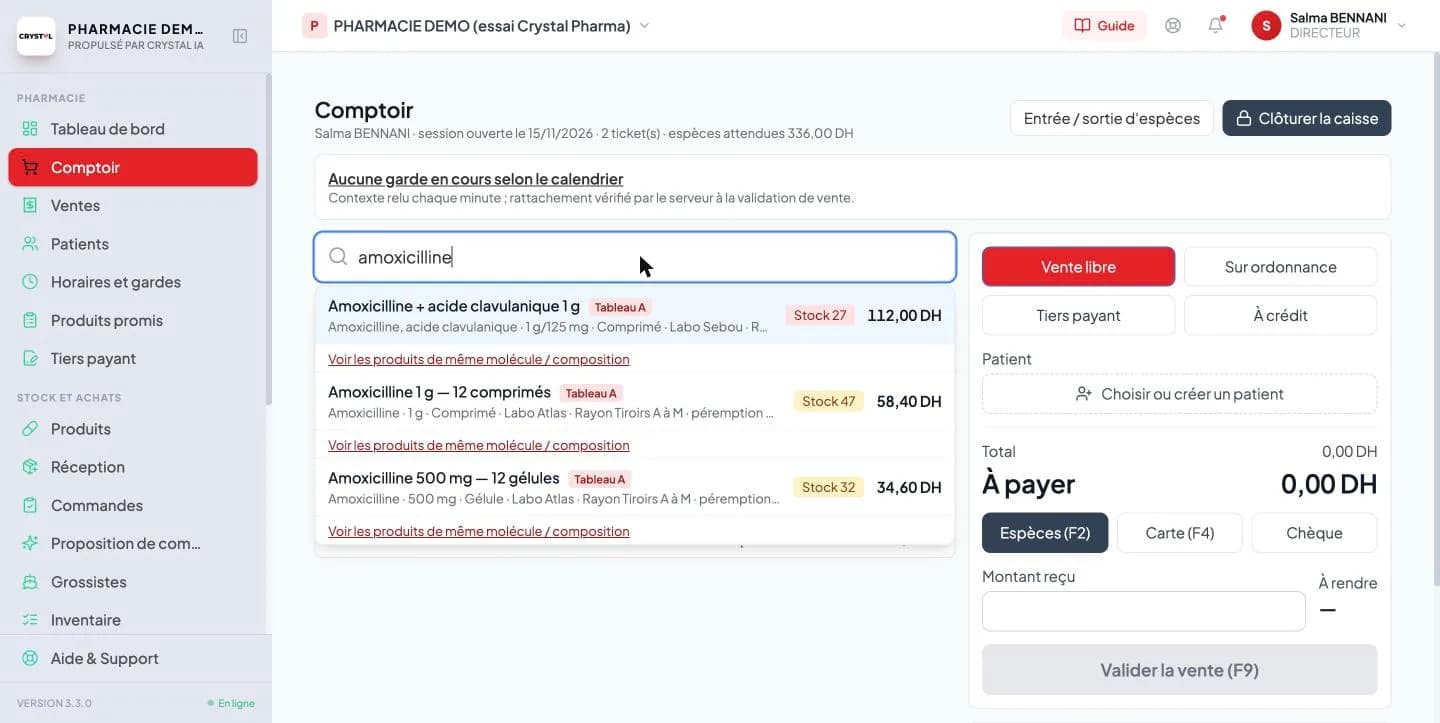
At the Crystal Pharma counter, third-party payer is one of four available sale types (free, on prescription, third-party payer, on credit). When the assistant selects the 'third-party payer' type for a patient, the software automatically calculates the patient share and the insurer share based on the coverage rate recorded in their file. The patient pays their co-payment at the counter — in cash (F2), by card (F4) or by cheque — and the insurer share is recorded as an amount receivable. The sale is confirmed with the F9 key and the receipt is printed.
A medication from schedules A, B or C sold under third-party payer billing must be linked to the prescribing doctor, in accordance with prescription dispensing rules. This requirement applies regardless of the payment method: selling a regulated medication requires entering the prescription. The 'third-party payer' sale type therefore carries a dual logic: on one hand, calculating shares for financial tracking; on the other, traceability in the prescription register. These two aspects are linked in the software, preventing oversights during complex sales — for example, a third-party payer prescription for a medication from a regulatory schedule.
- Four sale types at the counter: free, on prescription, third-party payer, on credit — selected for each transaction.
- Automatic calculation of the patient share and insurer share based on the rate recorded in the patient file.
- Patient co-payment in cash (F2), by card (F4) or by cheque; confirmed with F9 and receipt printed.
- Insurer share recorded as an amount receivable at the time of sale, with no subsequent re-entry.
- Medications from schedules A, B or C under third-party payer: entering the prescribing doctor remains mandatory regardless of payment method.
Statements and tracking of amounts receivable from insurers
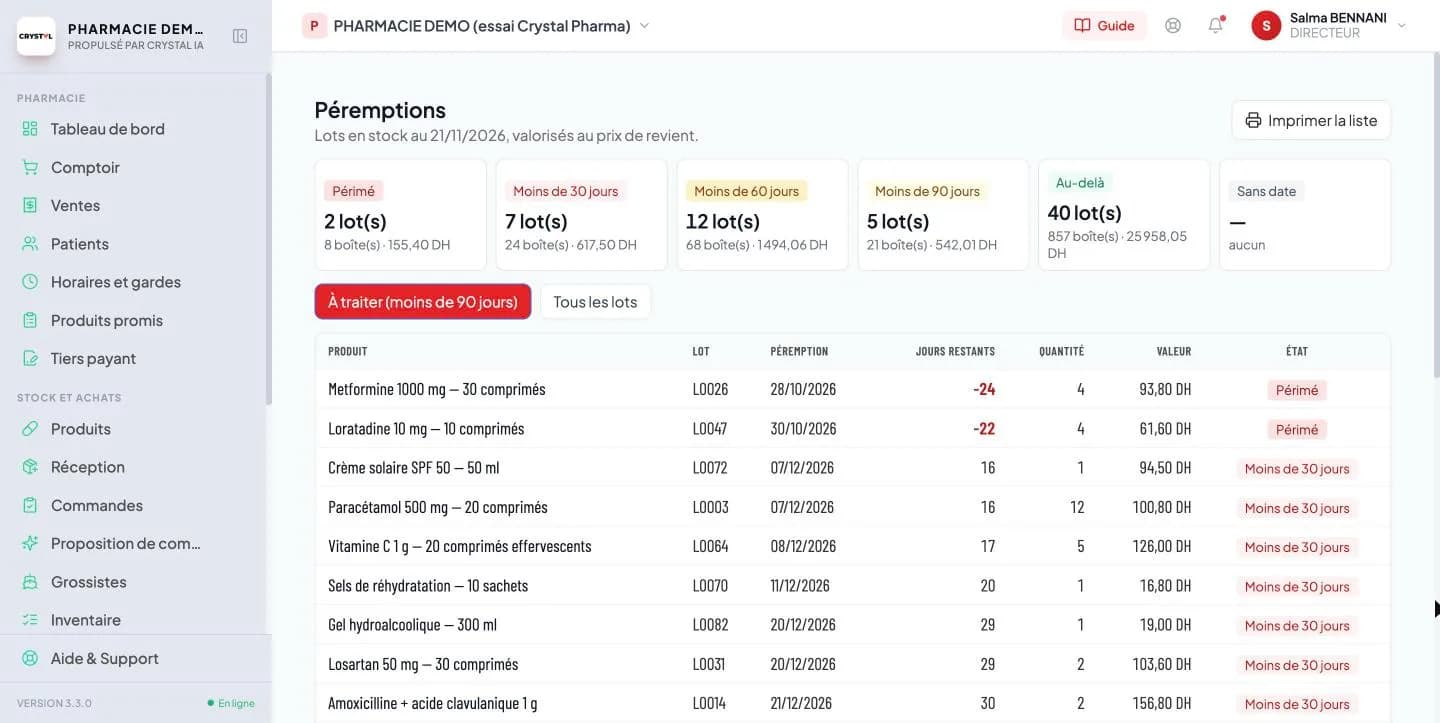
Crystal Pharma generates internal statements per insurer: every third-party payer sale is linked to the patient's insurer and feeds the tracking of amounts receivable. This tracking makes it possible to know, for each insurer, the total third-party payer sales for a period, the amounts already reimbursed and those still outstanding. This information is essential for preparing claims, calculating the pharmacy's real cash position and identifying receivables whose reimbursement is overdue.
The tracking of amounts receivable in Crystal Pharma is an internal management tool, separate from accounting entries: as with wholesaler credits, the module does not generate bookkeeping. The third-party payer summary is intended to be handed to the accountant or to feed the preparation of claims to insurers. The actual submission of reimbursement requests — filing statements, electronic procedures specific to each insurer — remains the responsibility of the head pharmacist, using the channels specific to each insurer. Crystal Pharma does not transmit health insurance claim forms electronically and has no direct connection to coverage insurers: these steps are carried out outside the software, based on the data it provides.
- Internal statements per insurer: summary of third-party payer sales, amounts receivable, reimbursements received and outstanding balance.
- Period-based tracking: identify outstanding receivables and partial reimbursements for each insurer.
- Crystal Pharma does not generate accounting entries: the third-party payer summary is to be handed to the accountant.
- No electronic transmission of health insurance claims, no direct connection to insurers: submitting claims remains the head pharmacist's responsibility.
- Exportable data for handover to the accountant or preparation of claim files.
Reports and dashboard: managing third-party payer billing over time
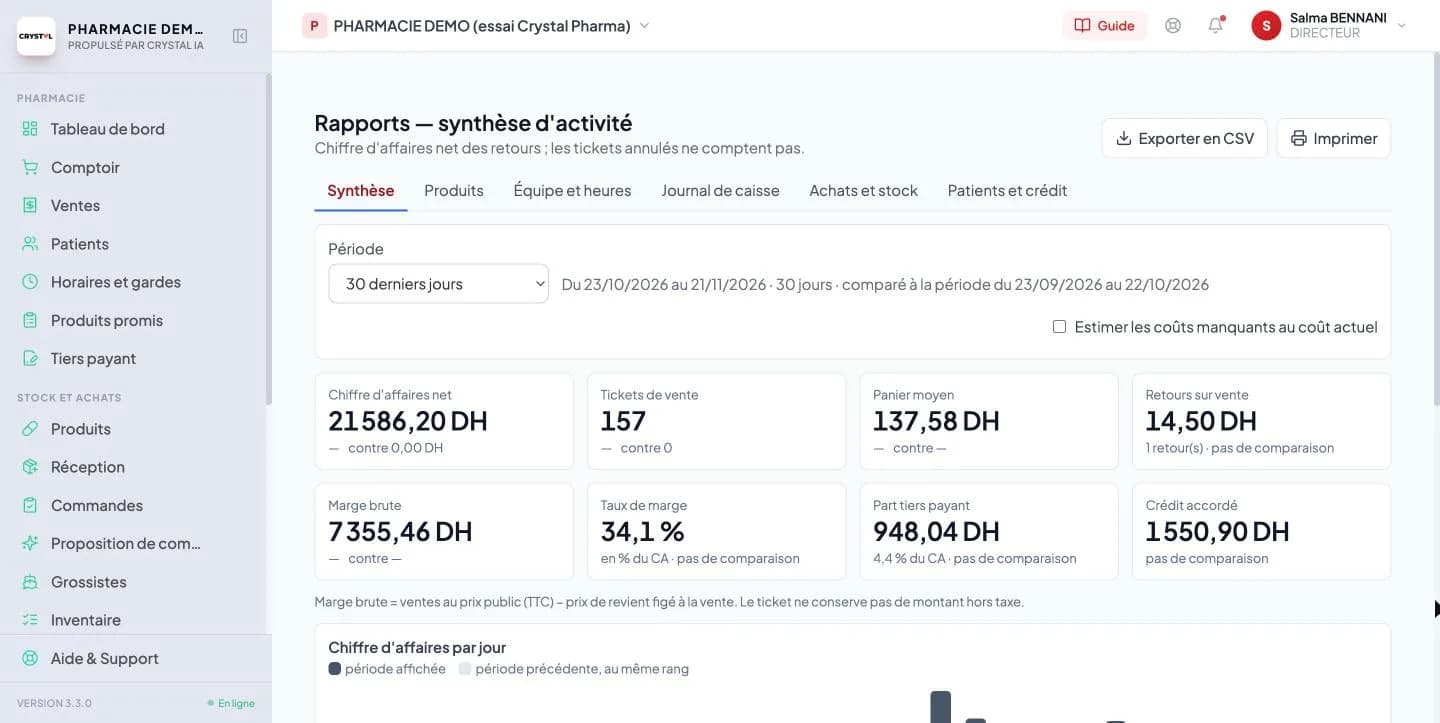
Beyond receivables tracking, Crystal Pharma provides a daily dashboard and periodic reports that integrate third-party payer billing into the overall view of activity. The 'patients and credit' report covers credit accounts and third-party payer sales, compared to the previous period. The till journal allows reconciling actual collections — patient shares — with amounts receivable from insurers. These reports are exportable and printable, to be handed to the accountant or used as the basis for claims.
The prescription register plays a complementary traceability role: every third-party payer sale involving a listed medication enriches the register, which can be printed by period. This register may be one of the supporting documents the head pharmacist is required to produce during inspections or to accompany a reimbursement request. The articulation between the prescription register, third-party payer statements and till reports forms the documentary basis for third-party payer tracking in a pharmacy. Our Pharmacy module (Crystal Pharma, our pharmacy management software) brings all these tools together in an online software with no local installation, developed by CRYSTAL IT in Rabat.
- Daily dashboard: synthetic view of activity, including the day's third-party payer sales.
- 'Patients and credit' report: tracking of credit accounts, third-party payer sales and comparison with the previous period.
- Till journal with collection breakdown: distinguishing collected patient shares from insurer receivables recorded.
- Prescription register: every third-party payer sale of a listed medication is traced, period printing available.
- Export and print all reports for handover to the accountant or preparation of claim files.
Third-party payer billing is one of the most sensitive aspects of managing a Moroccan pharmacy: every third-party payer sale generates a receivable from the insurer, and without an adequate tracking tool, these receivables accumulate and get lost. Our Pharmacy module (Crystal Pharma, our pharmacy management software) integrates third-party payer billing from the moment of sale: patient and insurer shares calculated automatically based on the patient file, internal statements per insurer, tracking of amounts receivable and detailed reports to hand to the accountant. The actual submission of reimbursement requests to insurers remains the head pharmacist's responsibility — Crystal Pharma provides the structured data to prepare them, not the electronic transmission. CRYSTAL IT, based in Rabat with over 20 years of experience serving Moroccan SMEs, develops this module in a pilot phase with partner pharmacists. To see how it adapts to your pharmacy's organisation and your third-party payer insurers, request a demonstration at (Crystal Pharma, our pharmacy management software).
The CRYSTAL IT solution on this topic
Have a project or a question? Let's talk with a CRYSTAL IT expert.
Request a demo