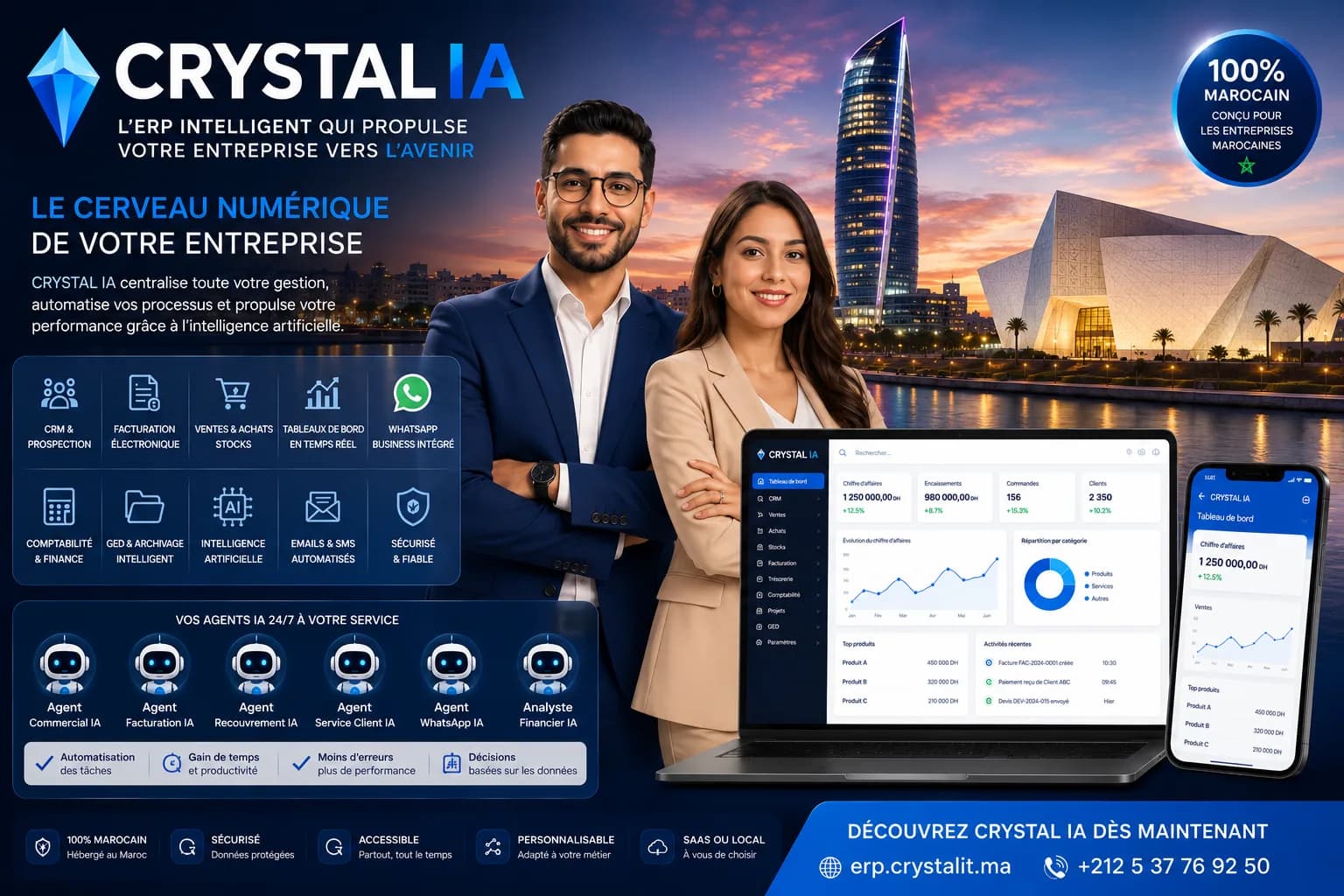
For thirty years, the ERP was a passive tool: it faithfully recorded what it was given and returned what you knew how to ask for. All the exploitation value rested on the user — knowing where to look, which report to build, which cross-analysis to run. Artificial intelligence reverses this relationship: the ERP becomes an assistant that answers questions asked in natural language, flags what deserves attention without being asked, and executes repetitive tasks end to end. For a Moroccan SME with no data analyst and no IT department, this shift matters more than for a large group: it is access to a level of data exploitation previously reserved for organisations with dedicated teams. This guide describes concretely what AI agents do in management software — drawing on what CRYSTAL IA brings to Crystal ERP (erp.crystalit.ma) —, what they do not replace, and where to start without spreading yourself thin.
From passive ERP to assistant ERP: what really changes
The difference between a classic ERP and an AI-powered one fits in one sentence: the first answers when queried correctly, the second understands what you are asking and takes the initiative to flag what matters. In a classic ERP, knowing "what is my margin on the spare-parts family this quarter" requires knowing the right report, the right filters, the right period. In an assistant ERP, the same question is asked the way it is phrased — in plain language, in one sentence — and the answer arrives grounded in the company's real data. That is exactly the role of the Chat IA built into Crystal ERP by CRYSTAL IA: turning management data into conversation.
The second change is initiative. An AI agent does not wait for the question: it watches the flows and surfaces what deviates from the ordinary — a regular customer who has not ordered this month, a margin eroding on a product family, a supplier whose lead times are slipping. This switch from consultation to notification changes the daily life of an SME director: instead of hunting for problems in the figures, the problems come to him, qualified and prioritised. To understand how these agents differ from simple website chatbots, our dedicated article draws the useful distinctions (AI agent or chatbot: what are the differences and how do you choose?).
- Natural-language querying: the question is asked as it is phrased, the answer rests on real data.
- Initiative: the agent watches and flags — customers dropping off, margins eroding, lead times drifting.
- Prioritisation: scoring helps decide where to invest sales time or collection effort.
- Execution: repetitive tasks (reminders, filing, reconciliations) are handled end to end.
- Accessibility: no analyst or query training needed — the entry barrier disappears.
Querying your data in natural language: the end of report dependence
In most SMEs, access to figures goes through a person: "ask Karim, he has the file". Reports exist, but few people know how to produce them, and every new question becomes a request that waits. Natural-language querying removes this queue: "what is my revenue this month by city?", "which customers are more than sixty days overdue?", "which products have not moved in six months?" — questions anyone, from the director to the sales rep, can ask the built-in assistant directly. Data stops being insider territory and becomes a common asset of the company.
The real reach of this feature depends on a condition too often left unsaid: the quality and uniqueness of the data. An AI assistant querying a centralised ERP — where sales, purchasing, stock and accounting live in the same database — answers correctly; an assistant plugged into scattered systems adds up the inconsistencies. That is why AI strengthens the case for the integrated ERP rather than replacing it: it is the best exploitation layer for a unified data foundation like Crystal ERP (Crystal ERP). On the same principle, companies that want to query their documents — contracts, procedures, catalogues — can extend the approach with a document agent (AI agents and RAG: query your business documents in natural language).
Business agents: reminders, alerts, scoring — concrete examples
Collections illustrate the agent logic well. The classic routine — printing the aged balance, sorting, deciding whom to chase, writing the messages — consumes hours every week and always happens too late. A reminder agent takes it over: it watches due dates, adapts tone and channel to the customer profile (formal email for a public body, WhatsApp message for a tradesman), spaces reminders according to the responses, and only escalates to a human the genuinely stuck cases. The result is not just time saved: it is steady, even collections that durably improve cash flow (Accounts Receivable Collection Software for Moroccan SMEs).
Two other agent families deliver immediate value. Alert agents watch for weak signals in the data: a quote's margin drifting from usual terms, a strategic product below its coverage threshold, a supplier invoice unusual in amount or frequency. Prioritisation agents — CRYSTAL IA's customer scoring, built into Crystal ERP, is an integrated example — rank the portfolio by potential and risk: the sales team knows every morning where to focus its calls. In every case the pattern is the same — the agent does the systematic triage nobody has time for, the human decides on the cases worth it. For a broader panorama of these uses in business, see our in-depth article (Crystal IA: artificial intelligence serving Moroccan businesses).
- Reminder agent: due dates watched, messages adapted to the profile, human escalation only for stuck cases.
- Alert agent: abnormal margins, stock below thresholds, unusual supplier invoices — flagged unprompted.
- Customer scoring: the portfolio ranked by potential and risk, to steer the sales effort each morning.
- Conversational assistant: management figures accessible to everyone in natural language, no reports to build.
- The model's constant: the agent triages systematically, the human decides what matters.
What an AI agent does not replace: human control and data quality
Enthusiasm should not blur two fundamentals. The first: an AI agent applied to management works on the data it is given. If receipts are entered a week late, the reminder agent will hound customers who have paid; if the product records are wrong, the stock alerts will be noise. AI does not fix broken management — it amplifies its quality, in either direction. Data-entry discipline and clean master data remain the foundation; indeed, that is often the first indirect benefit of an AI project: it forces the data into order.
The second fundamental: the decision remains human wherever it commits the company. An agent can prepare a reminder, flag an unusually discounted quote or propose a reconciliation; granting a payment extension to a loyal customer in difficulty, approving an exceptional discount or posting an adjustment entry are management decisions, with context the data does not always contain. Serious implementations write this division down in black and white: what the agent does alone, what it submits for validation, what it never touches. This clarity is also what makes teams accept agents — AI assists professionals, it does not replace them in their responsibilities.
Where to start in a Moroccan SME
The right entry point is the most costly problem, not the most impressive technology. Three questions suffice for the diagnosis: where is time lost on repetitive tasks (reminders, ticking-off, filing)? Where is visibility lacking (real margins, at-risk customers, dormant stock)? Where are responses too slow (customer requests, quotes)? The answer designates the first agent. For many Moroccan SMEs it is customer reminders or natural-language access to the figures — two uses with fast, visible returns that build confidence for what follows.
On the implementation side, two paths complement each other. If the company is choosing an ERP, the simplest is to pick a solution where AI is native rather than bolted on: Crystal ERP ships with CRYSTAL IA's Chat IA and scoring built in, with no additional technical project (Crystal ERP). For specific needs — a WhatsApp order-taking agent, a request-qualification assistant, an internal document agent —, bespoke development takes over: that is CRYSTAL IT's AI agent creation offering (our AI agent development service), with budget benchmarks detailed in our pricing article (How much does a custom AI agent cost in 2026?). In both cases: start small, measure, then extend — one useful agent in production is worth more than three ambitions in a meeting.
- Choose the first agent by the cost of the problem: reminders, margin visibility or customer responsiveness.
- Prefer AI native to the ERP over a bolted-on layer: less project, more usage.
- Write down the human-machine division: what the agent does alone, proposes, or never touches.
- Put the master data in order first: data quality conditions everything else.
- Start with one agent, measure the gain, then extend — trust is built by proof.
AI applied to management is neither a gadget nor a distant revolution: it is the shift from an ERP that records to an ERP that assists — answering questions in natural language, watching what drifts, executing the repetitive and leaving the decisions that matter to the teams. For a Moroccan SME the stake is very concrete: accessing, without an analyst, a level of data exploitation reserved yesterday for large organisations. The condition is just as concrete: clean data, an explicit human-machine division, and a progressive rollout that proves itself use case by use case. CRYSTAL IT carries this conviction in its two offerings: Crystal ERP (erp.crystalit.ma), where CRYSTAL IA's Chat IA and scoring are built in from the start, and bespoke AI agent creation (our AI agent development service) for each trade's specific needs. Contact the CRYSTAL IT team in Rabat to identify the agent that will pay off fastest in your organisation.
Have a project or a question? Let's talk with a CRYSTAL IT expert.
Request a demo