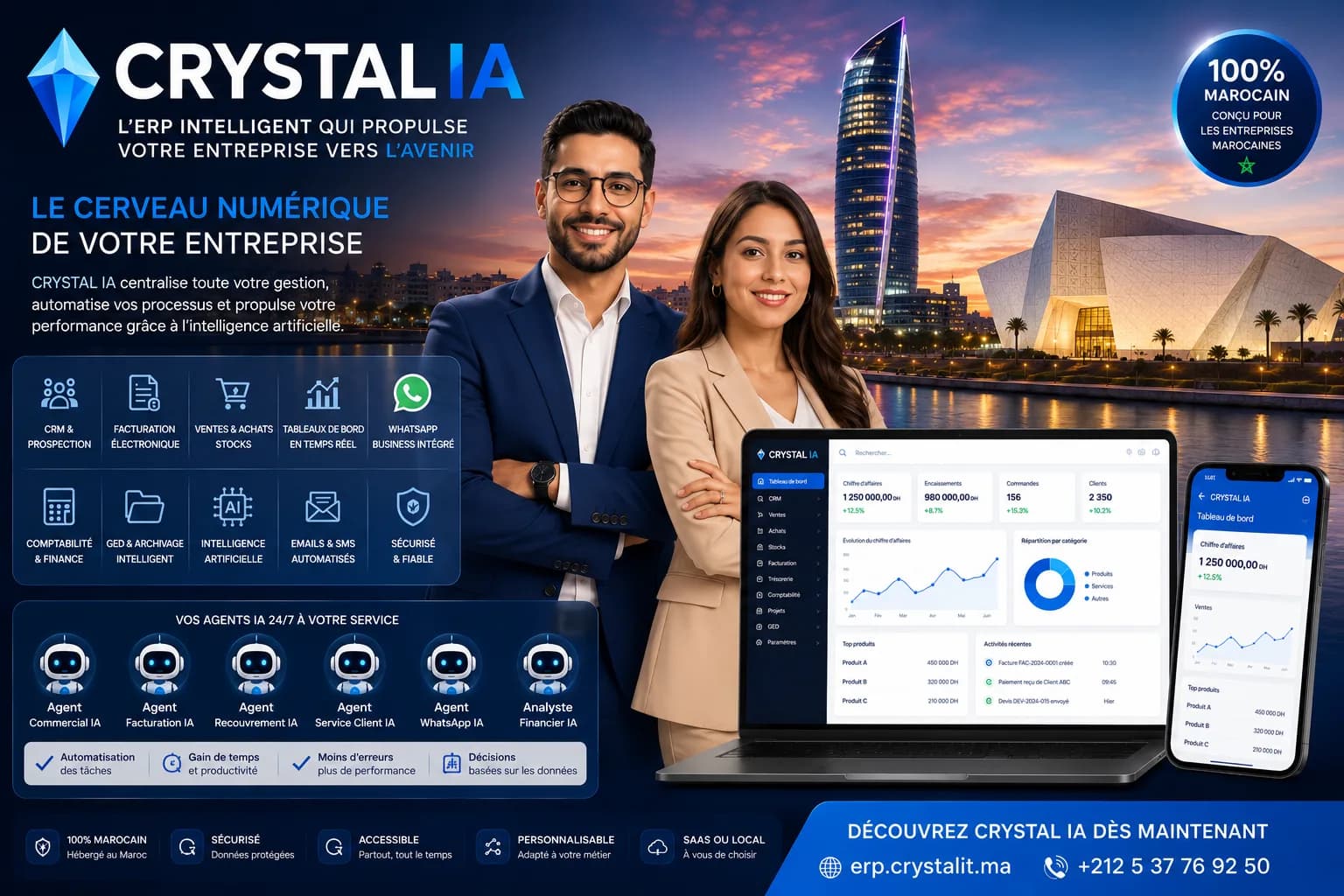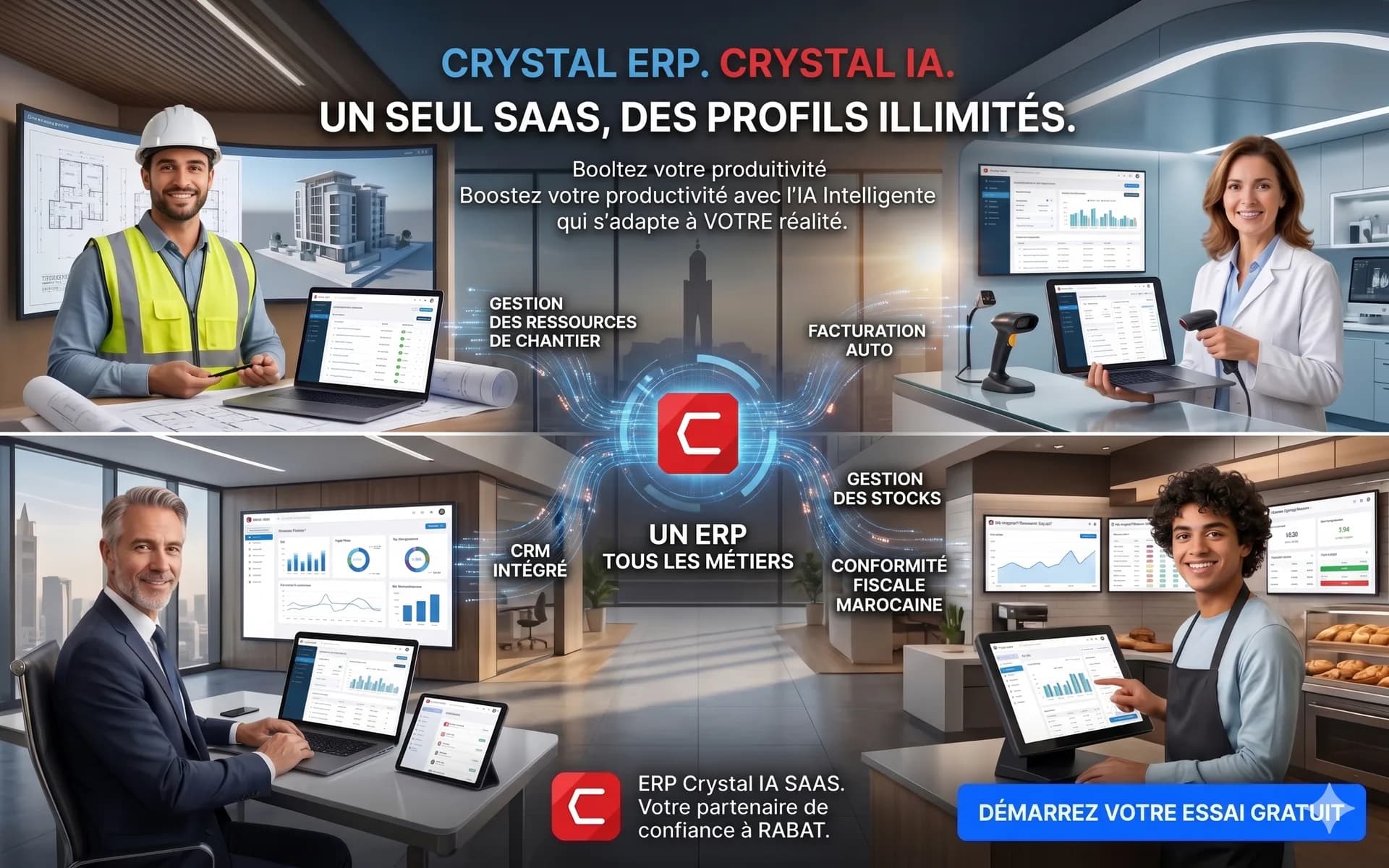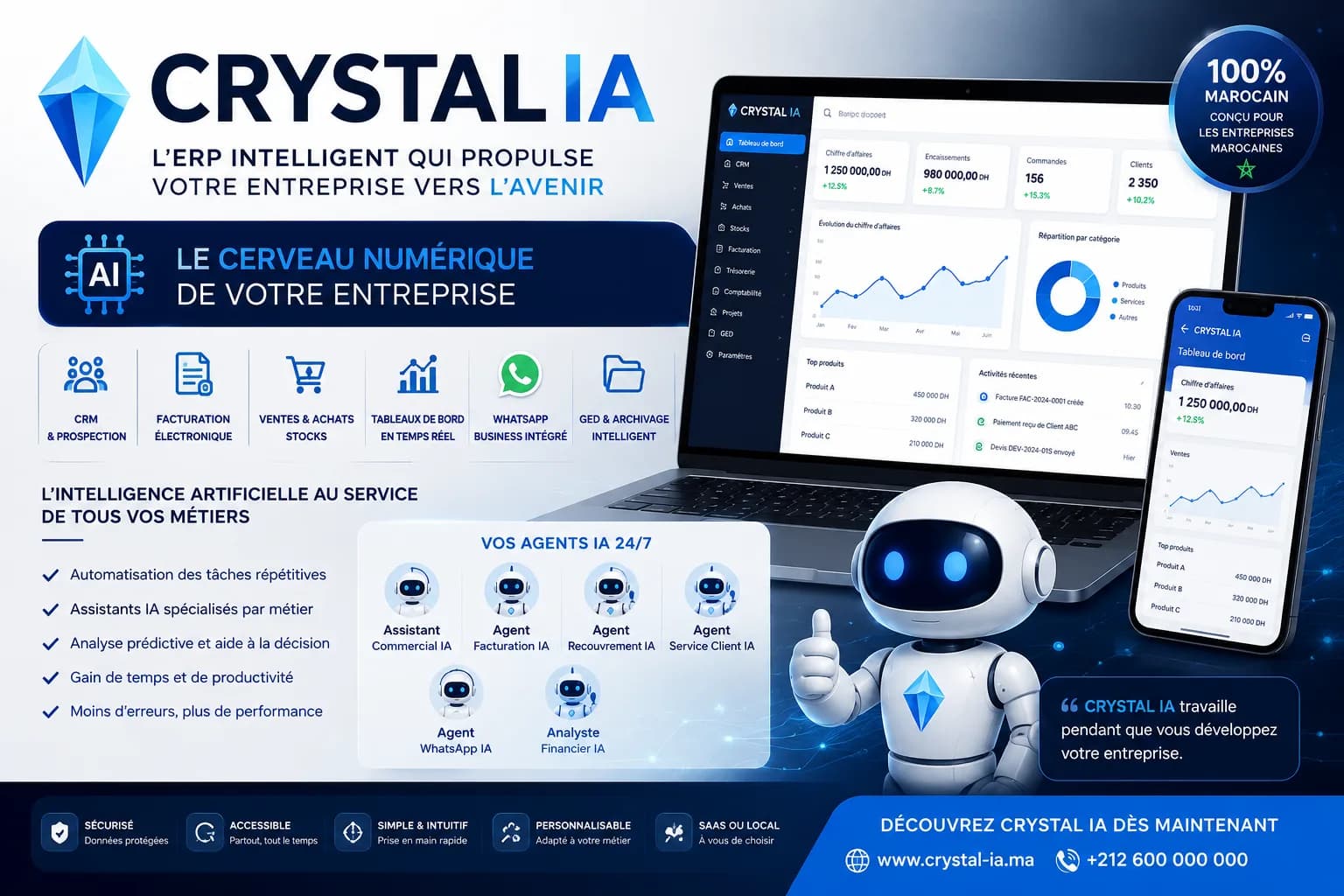
Clothing store management software in Morocco must address a reality unique to the fashion sector: each apparel item is not a single product, but a combination of sizes and colours that can easily generate fifteen to twenty distinct references for what appears to the customer as one garment. Multiplied across the hundreds of models in a collection, this variant complexity makes general-purpose tools — spreadsheets, basic POS systems, non-specialised billing software — quickly inadequate: size stockouts are discovered on the display rack rather than on a dashboard, end-of-collection items are cleared without a reliable inventory, and supplier orders are based on intuition rather than actual sales data. Crystal ERP (erp.crystalit.ma), developed by CRYSTAL IT in Rabat with over 20 years of experience serving Moroccan businesses, provides a retail management module that covers these needs: variant-based stock management, touchscreen POS, automatic promotions and an integrated CRM. This guide explains concretely how the right software transforms the operations of a clothing store in Morocco.
The Specific Challenges of Managing a Clothing Store in Morocco
The Moroccan ready-to-wear sector is characterised by frequent collection renewals — spring-summer, autumn-winter, Ramadan, Eid El Fitr, Eid El Adha, back to school — and by customers who return with precise expectations about models, available sizes and prices. Each collection change involves significant inventory work: identifying unsold items to clear, placing orders for the next season, and starting the new collection with a reliable stock count. Without specialised software, this cycle is handled manually with spreadsheets that quickly become unmanageable, and restocking decisions rely on estimation rather than real sales data.
Competition is intensifying in the sector, between established local boutiques, international franchise brands, and online marketplaces attracting a growing share of urban customers. In this context, margins are under pressure and procurement errors are costly: excess stock at the end of a collection ties up capital and forces heavy discounting, while a stockout on a popular size loses sales to competitors. Management software that provides real-time visibility of sales by variant and remaining stock levels becomes a direct operational advantage, not merely an administrative tool.
- Multiple seasonal collections: Moroccan fashion, Ramadan, Eid, back-to-school — each season requires a complete cycle of inventory, clearance and restocking.
- Variant complexity: each model exists in multiple sizes and colours, multiplying the number of references to track compared to conventional retail.
- Margins under pressure: competition from large brands and e-commerce — procurement errors and poorly managed end-of-collection items directly impact profitability.
- Invisible stockouts: without suitable tools, a stockout in a specific size is only detected on an empty rack, after sales have already been lost.
- Complex inventory: manually counting hundreds of variants at the end of a collection is time-consuming and generates errors that distort the next season's orders.
Stock by Variant (Size and Colour): The Complexity of Ready-to-Wear
Variant management is the core challenge for any fashion store: a jeans model offered in five sizes (38 to 46) and three colours generates fifteen distinct references (SKUs). Stock not managed by variant makes it impossible to know how many size 38 black units remain, or when that specific variant reaches its reorder threshold. Crystal ERP manages each variant as an independent stock unit: the barcode for each item reflects the model, size and colour, and every POS scan triggers a precise stock movement on the correct variant.
The practical value of this granularity is especially evident at the end of a collection. When preparing for sales, Crystal ERP gives the manager an instant list of overstocked variants and those near stockout. A selective discount can be applied to surplus sizes without clearing the entire model, preserving the margin on variants still selling well. For supplier orders, actual sales data by variant from the previous season is available — not a rough estimate by model — allowing purchasing decisions based on real figures, not intuition.
- Reference per SKU (model × size × colour): each variant is an independent stock unit with its own barcode, stock level and sales history.
- Stockout alert by variant: the alert fires when size 38 reaches zero, even if the other sizes of the same model are overstocked — no invisible stockouts.
- Assisted inventory by variant: the inventory list generated by Crystal ERP is organised by model then by variant — the count on the display follows the same logic.
- Selective end-of-collection discounts: apply a discount on surplus sizes without discounting variants that are still selling well.
- Sales history by variant: identify the best-selling sizes and colours to calibrate next season's orders on real data.
Touchscreen POS and Seasonal Promotions for a Fashion Boutique
A clothing store POS must work quickly, especially during sales periods or holidays when queues can grow. Crystal ERP's touchscreen interface is designed for fast entry: the cashier scans the barcode, the variant appears with its price, and any active discount is applied automatically — no manual promo code entry needed. Promotional rules are set up in advance and activate and expire based on defined dates and conditions.
Managing promotional periods is particularly critical in Moroccan fashion, where Eid sale events and end-of-year operations generate high volumes over short periods. Crystal ERP lets managers set up promotion rules in advance, activate them for a specific window, and deactivate them automatically at expiry without manual intervention. The daily cash close reconciles receipts by payment method and breaks down revenue between full-price and discounted sales, allowing the real impact of each promotional campaign to be measured.
- Scan and variant display: the barcode identifies model, size and colour in one scan — the variant appears instantly with its price and any active promotion.
- Automatic promotions: % discount, bundle pricing (3 for 2), loyalty pricing — preconfigured rules apply without manual entry, with automatic activation and expiry.
- Multiple payment methods: cash (change calculated), card, cheque, mixed payment — all payment modes common in Moroccan stores handled in a single transaction.
- Daily cash close: reconciliation by payment method, full-price versus discounted sales breakdown, cash discrepancy identified at end of day.
- Returns and exchanges: a returned item automatically restocks the correct variant and generates a credit note or exchange without re-entry.
Customer Loyalty and CRM: Turning One-Time Buyers into Regulars
In fashion retail, loyalty is a profitability lever often underused in Moroccan boutiques. A customer who returns for each new collection is worth significantly more than a one-time buyer. Crystal ERP integrates a CRM module that enables managing a customer database with the full purchase history: models purchased, preferred sizes and colours, visit frequency, total spend over the period. This data allows customer segmentation and identification of regular buyers who deserve particular attention — an invitation to the collection preview, a personalised discount, early access to new arrivals.
A simple loyalty programme managed natively in Crystal ERP reinforces this: each purchase credits a points balance to the customer's account, viewable by the cashier at every transaction. When the points threshold is reached, the customer automatically receives a discount or voucher. Segment analyses — new customers, regulars, customers inactive for more than six months — allow targeted SMS or WhatsApp outreach at end of season to reactivate dormant customers before the sales period.
- Customer profile with full history: models purchased, preferred sizes and colours, visit frequency and cumulative spend — all the data needed to personalise the relationship.
- Integrated loyalty programme: points accrued with each purchase, configurable discount threshold, balance checked at POS without a physical card.
- Segmentation by purchasing behaviour: identify regular customers, high spenders and inactive customers to target reactivation campaigns precisely.
- VIP collection invitation: notify top customers in advance of a new collection or private sale, before the general opening.
- End-of-season outreach: target customers inactive for X months with a personalised reactivation offer ahead of sales to maximise return rates.
Tracking Sales and Preparing Orders with Crystal ERP
One of the most common limitations for clothing stores relying on spreadsheets is the absence of fast reporting by dimension: how many items from the autumn-winter collection were sold this month, which size sells best in men's trousers, what is last week's revenue by product family? Crystal ERP generates these analyses automatically: sales by collection, by family (coats, dresses, trousers), by dominant colour, by period — directly from the manager's dashboard, without data manipulation.
Supplier order preparation benefits directly from this visibility. When the next collection approaches, the manager reviews sales data from the previous season for each variant: which sizes moved fastest, which colours remained overstocked, which models generated the best margins. This information allows order quantities to be adjusted variant by variant, enables better-informed negotiations with suppliers, and avoids the two classic mistakes — over-ordering on slow variants and under-ordering on those that sell out before the end of the collection.
- Sales by collection: revenue and units sold for each collection, with season-on-season comparison to measure the relative performance of each purchasing decision.
- Analysis by family and variant: identify the most profitable models, sizes and colours to inform next season's buying decisions.
- Stock turnover: average time from receipt to sale by product family — a key indicator to optimise stock levels and reduce tied-up capital.
- Real-time dashboard: today's revenue, units sold, average basket and discount rate from any browser, in-store or remotely.
- Integrated AI assistant: query sales data in natural language — 'which model sold best this month?' — for immediate answers without building a report.
Managing a clothing store in Morocco is more demanding than it appears: variant complexity, short collection cycles, seasonal promotions and the need to build loyalty in a competitive market require tools that go beyond what a spreadsheet or basic POS can provide. Crystal ERP (erp.crystalit.ma), developed by CRYSTAL IT in Rabat with over 20 years of experience serving Moroccan businesses, gives a fashion boutique accurate variant-based stock management, a touchscreen POS with automatic promotions, a CRM to build regular customer loyalty, and a dashboard to track sales and prepare orders with confidence. Contact the CRYSTAL IT team in Rabat to discover how Crystal ERP can be adapted to your boutique's reality, whatever its size, at erp.crystalit.ma.
The CRYSTAL IT solution on this topic
Have a project or a question? Let's talk with a CRYSTAL IT expert.
Request a demo