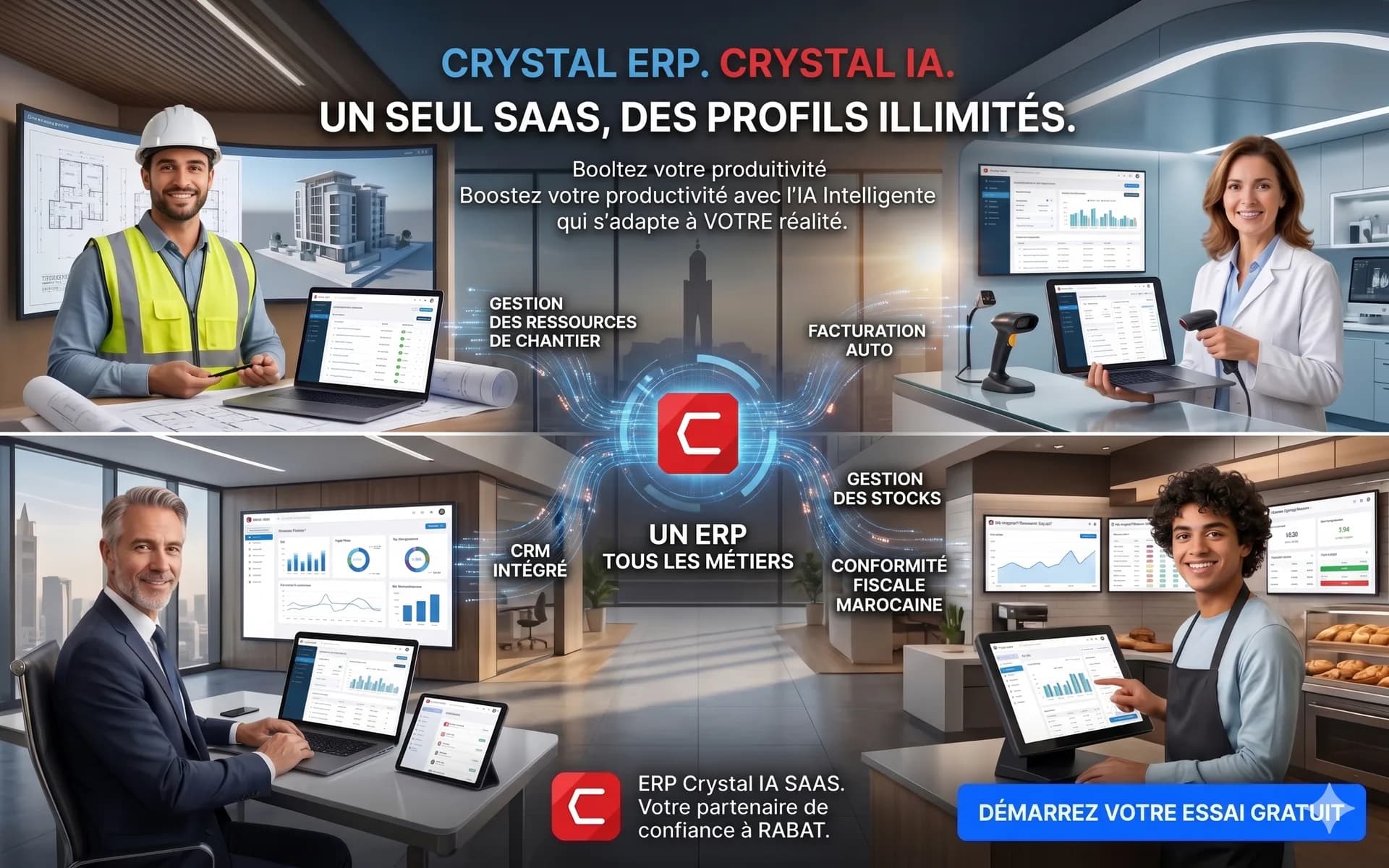
Laundry management software in Morocco is a tool that many pressing and blanchisserie owners discover too late — after losing a garment deposit, creating a payment mix-up, or spending an hour searching for a piece through a stack of paper tickets. Yet the operations of a Moroccan pressing, whether it serves a residential neighbourhood in Rabat, an office building in Casablanca, or a hotel in Marrakech, are structurally repetitive and perfectly suited to automation: each customer deposits garments, items are logged, treated, ready by the promised deadline, and collected at pick-up. This flow lends itself naturally to software management — but in practice, many Moroccan laundries still operate with paper ticket books, untracked cash, and no customer history whatsoever. The growing adoption of card and bank transfer payments, the expanding compliance requirements of the DGI's electronic invoicing reform (Electronic invoicing in Morocco in 2026), and the intensifying competition between neighbourhood pressings and organised collection-and-delivery services are all making integrated management increasingly necessary. Crystal ERP (erp.crystalit.ma), developed by CRYSTAL IT in Rabat with more than 20 years of experience serving Moroccan businesses, provides an integrated management solution adapted to laundries and dry cleaners: deposit tracking, invoicing, product stock, payment collection and a management dashboard. This guide explains what a laundry management system must cover for a Moroccan operation in 2026.
The Management Challenges of a Moroccan Pressing in 2026
A Moroccan pressing or laundry is a high-frequency business with repeated customer interactions: every day brings dozens of drop-offs, pick-ups, status enquiries and payment collections. In manual management, each deposit generates a paper ticket the customer keeps, and the shop maintains a register of items currently being processed. This apparent simplicity conceals several operational vulnerabilities. The first is garment loss or mix-up: without a reliable tracking number linked to a specific customer, a similarly-coloured shirt can be handed to the wrong customer, triggering a complaint that damages the shop's reputation. The second is the absence of history: without traceability of deposits and treatments, the owner cannot identify the most loyal customers, analyse the most in-demand services, or adjust pricing to reflect market reality. The third vulnerability is financial: untracked cash payments create till discrepancies that are hard to justify during a tax inspection and prevent the reconstruction of a reliable revenue figure.
The DGI's electronic invoicing reform progressively covers the entire Moroccan business fabric, following a timeline by company size whose precise dates must be set by decree — consult the official DGI portal (tax.gov.ma) and our dedicated guide (Electronic invoicing timeline in Morocco) to follow the latest developments. For laundries that invoice companies — professional uniform cleaning, hotel linen processing, corporate workwear — B2B transactions will progressively need to be issued in a structured format (UBL 2.1 or UN/CEFACT CII) and submitted to the DGI's electronic invoicing platform, whose technical specification has not yet been published. A management system that only produces manual tickets will no longer be adequate in this evolving regulatory environment.
- Garment mix-ups: without a deposit number and customer-based tracking, exchanging similar garments is a frequent operational risk in high-volume laundries.
- No customer history: without a digital customer file, it is impossible to call back regulars, offer a loyalty rate or analyse the most in-demand services.
- Untracked cash payments: cash payments without a digital ticket create till discrepancies and prevent reliable revenue reconstruction for financial reporting.
- Deadline tracking: without a system, promised deadlines are not stored and no reminders are triggered as uncollected items accumulate.
- Product stock management: detergents, solvents, packaging materials — without consumption tracking, shortages are discovered the day production stops.
Deposit and Garment Tracking: The Core of Laundry Operations
The most critical feature of a pressing management system is deposit tracking: each customer dropping off garments must receive a numbered deposit receipt linked to their customer file, detailing every piece (garment type, description, service requested — washing, dry cleaning, ironing, alteration), the promised processing deadline and the corresponding amount. This receipt is printed and given to the customer as a deposit voucher, and registered in the system to track the progress of each item through the treatment cycle. When a customer calls to ask if their clothes are ready, the front desk can answer in two seconds by consulting the deposit file without searching through notebooks. Crystal ERP (erp.crystalit.ma) manages this flow from deposit to collection in a commercial management module that links each deposit receipt to a customer invoice, a processing status and a full interaction history.
An appropriate system also handles the atypical situations that arise regularly in laundry operations: items with specific stains or special treatments (silk, leather, embroidery) requiring a note on the deposit slip, garments the customer forgot having left, disputes over the condition of a piece at collection. With a digital record for each deposit — attached photos, notes on the initial condition of the item, the customer's signature acknowledging the treatment terms — the pressing has documented evidence in the event of a complaint. This traceability protects both the customer and the business and avoids costly reputational and financial disputes. For a deeper look at customer relationship management in a pressing, see our guide on CRM (CRM software in Morocco: managing client relationships and growing…).
- Numbered deposit receipt: each drop-off generates a printed voucher with a unique number, list of items, services requested and promised processing deadline.
- Status-based tracking: each item passes through statuses (deposited, in treatment, ready, collected, in dispute) consultable from the counter in two seconds.
- Alerts for uncollected items: the system automatically generates a list of deposits whose deadline has passed, to follow up with the customer by SMS or phone.
- Initial condition notes: photos or comments on the item's condition at deposit (pre-existing stain, prior tear), available if a complaint is raised at collection.
- Full customer history: all of a customer's visits, treatment preferences and payment history accessible in one click from their customer file.
Payment Collection and Invoicing: The Pressing's Cash Register
A Moroccan pressing collects payment through a variety of methods: cash for neighbourhood walk-in customers, card payments via terminal for professional clients, deferred payments for corporate partners (hotels, clinics, law firms), and sometimes cheques for high-value settlements. Without a centralised till, each payment method is managed separately and end-of-day reconciliation becomes a source of errors. An integrated management system handles all these modes in a unified till: payment is triggered at garment collection (or at drop-off for prepaying customers), and the automatic end-of-day cash closure is generated with a breakdown by payment method. Crystal ERP (erp.crystalit.ma) links the pressing's till to the treasury module, so every payment is immediately reflected in cash flow forecasts without manual entry (Point of Sale Software in Morocco).
For laundries that work with professional clients — hotels, restaurants, clinics or companies that outsource their laundry — invoicing takes on another dimension. These clients typically receive a monthly consolidated invoice for all services rendered during the month, with VAT broken down. Crystal ERP (erp.crystalit.ma) handles this periodic invoicing: services rendered during the month are aggregated by professional client, a consolidated invoice is generated at the end of the period with deposit references, quantities and amounts. Under the electronic invoicing reform, B2B invoices will progressively need to be issued in a structured format and submitted to the DGI platform under a timeline whose precise dates have not yet been set by decree — consult tax.gov.ma for the latest information. Crystal ERP already allows invoices to be exported in standard UBL 2.1 format, pending publication of the DGI platform specification.
- Multi-mode till: cash, card terminal, cheque and bank transfer in one interface, with automatic cash closure and payment-method breakdown at end of day.
- Payment at drop-off or collection: configurable to match the pressing's policy — deposit on arrival, balance at collection, or full deferred payment for professionals.
- Monthly consolidated invoice for professional clients: monthly service aggregation, VAT breakdown, deposit references included for easy client verification.
- Credits and refunds: complaint handling with credit note or discount voucher issuance, without breaking the accounting flow.
- DGI compliance for B2B: invoices verified and exportable in standard UBL 2.1 format to prepare for electronic invoicing, via Crystal ERP (Electronic invoicing in Morocco in 2026).
Product Stock and Laundry Production Management
A pressing consumes significant quantities of products every day: detergents, dry-cleaning solvents, distilled water, steam, packaging materials (plastic covers, hangers, tape). Without consumption tracking, managers discover shortages at the last moment — when the machine is running and the product runs out. An integrated management system includes a product stock tracking module: receipts are logged with each supplier delivery, issues are automatically deducted according to the quantities used by service type, and reorder alerts are triggered when the minimum threshold is reached. Crystal ERP (erp.crystalit.ma) provides this tracking in its stock management module, with a weighted average cost valuation that enables the real cost of each service to be calculated and pricing to be adjusted accordingly (Inventory management software in Morocco).
Production management is the other operational dimension of a high-volume pressing. In an industrial laundry handling hotel or hospital linen, machines run in continuous flows by linen type (whites, colours, special treatment), and daily processing capacity is a critical parameter for meeting the deadlines promised to professional clients. An integrated system can schedule processing capacity by machine and by day, distribute pending deposits according to their priority (express, standard, deferred), and alert the manager when the daily workload exceeds available capacity. This avoids situations where a hotel partner receives its linen late because individual rush orders saturated production without any advance planning.
- Product stock tracking: detergents, solvents, packaging materials — receipts logged at delivery, issues deducted by service type, automatic reorder alerts.
- Service cost: weighted average cost valuation of consumed products to calculate the real cost of a wash, dry clean or iron and verify profitability.
- Supplier management: purchase order, receipt and supplier invoice in Crystal ERP for a fully traced purchasing cycle and reliable delivery deadline management.
- Production scheduling: distribution of pending deposits by deadline priority and treatment type to optimise machine utilisation without exceeding capacity.
- Batch traceability: for laundries processing healthcare linen, batch-level tracking (temperature, duration, products used) to demonstrate treatment compliance.
Customer Loyalty and Pressing Management
Loyalty is the main strategic issue for a neighbourhood pressing in a market where competition between local shops and new urban collection-and-delivery services is intensifying. A management system enables the creation of simple and effective loyalty programmes: automatic tracking of the number of items or cumulative spend per customer, with a loyalty status granting preferential rates or complimentary services when a threshold is reached. These mechanisms do not need to be complex: a customer who receives an SMS telling them they have reached a loyalty milestone and earned a free ironing service is a customer who remembers their pressing and comes back. Crystal ERP (erp.crystalit.ma) manages these programmes in its CRM module, linked to each customer's deposit history (CRM software in Morocco: managing client relationships and growing…).
Running a pressing well depends on a few simple but essential indicators the owner should be able to check in seconds without manually extracting data: revenue for the day and week, number of items processed by service type, average processing time, items uncollected beyond 15 days, and the return rate of regular customers. Crystal ERP (erp.crystalit.ma) provides these real-time dashboards from the management interface. For pressings that want to print their invoices, deposit receipts and supplier payment cheques without an additional tool, Easy Print (easyprint.crystalit.ma) — CRYSTAL IT's free multi-bank cheque printing software — complements Crystal ERP for supplier payments (Cheque printing software in Morocco: save time with Easy Print). Contact CRYSTAL IT in Rabat for a demo tailored to your pressing.
- Automated loyalty programme: points, thresholds and benefits all configurable — the customer receives an automatic notification when they reach a milestone, with no manual entry.
- SMS alerts when items are ready: automatic notification to the customer as soon as their deposit is ready for collection, reducing pick-up lead times and congestion.
- Daily dashboard: day's revenue, items processed by service type, cash closure and overdue deposits consultable in one click from the application home screen.
- Service analysis: monthly report on the most requested and most profitable services and peak hours, to optimise work organisation.
- Professional client monitoring: dashboard of active contracts, volumes processed by client, invoicing deadlines and outstanding payment status.
A Moroccan pressing or laundry that adopts an integrated management system does not simply make day-to-day operations easier — it builds traceability that protects the business, a customer base that helps retain regulars, and a management dashboard that enables informed decisions rather than improvisation. Crystal ERP (erp.crystalit.ma), developed by CRYSTAL IT in Rabat with more than 20 years of experience serving Moroccan businesses, covers this entire scope: garment deposit tracking, multi-mode payment collection, professional client invoicing, product stock management and an operational dashboard. For supplier cheque payments, Easy Print (easyprint.crystalit.ma) — CRYSTAL IT's free multi-bank cheque printing software — is available with no subscription and no fees. Contact CRYSTAL IT in Rabat to discover how Crystal ERP can be tailored to your pressing or laundry and support your digitalisation journey.
The CRYSTAL IT solution on this topic
Have a project or a question? Let's talk with a CRYSTAL IT expert.
Request a demo