The prescription logbook and the controlled substances register are core documentary obligations for every Moroccan pharmacy. These two registers follow different logics: the prescription logbook tracks every sale of a prescription-only medication, while the controlled substances register records every entry and exit of Schedule B medications with their cumulative running balance after each movement. In both cases, the requirement is the same: every movement must be recorded at the moment it occurs, with no gaps and no unjustified corrections. Maintaining these registers manually — in a notebook, a spreadsheet or by copying data from another tool — is not only time-consuming but risky: a sale recorded at the counter that is not entered into the register immediately creates a discrepancy. Our Pharmacy module (Crystal Pharma, our pharmacy management software), developed by CRYSTAL IT in Rabat with over 20 years of experience serving Moroccan SMEs, fills both registers automatically at the point of sale: every listed medication sold on prescription enriches the prescription logbook, and every controlled substance movement updates the register balance in real time. This guide explains how the mechanism works, what it covers and what it does not replace.
Prescription logbook and controlled substances register: two registers, two logics
The prescription logbook is the register in which a pharmacy records medications sold on prescription. Its role is to enable traceability of prescription-only medications: for each sale, the logbook captures the dispensed medication, the prescriber and the information associated with the dispensing. This register covers medications from the regulatory schedules that require a prescription — including Schedule B controlled substances as well as other regulated products. The prescription logbook is a documentary obligation whose content and maintenance procedures are governed by applicable legislation and the recommendations of the Order of Pharmacists. The head pharmacist is responsible for keeping it regularly updated and making it available during inspections.
The controlled substances register is distinct from the prescription logbook and follows a stricter logic: it records all movements — entries and exits — for each Schedule B medication, with the cumulative balance after each movement. This double-entry accounting makes it possible to verify at any time that physical stock matches the theoretical stock derived from the recorded movements. A discrepancy between the calculated balance and the accounting stock is a signal that requires an explanation. The two registers are complementary: the prescription logbook tracks dispensing, the controlled substances register tracks stock. For details on batch stock management and expiry verification for controlled substances, the article on pharmacy stock management (Pharmacy Stock Management in Morocco) covers the associated mechanisms.
- The prescription logbook tracks sales of prescription-only medications, including Schedule B controlled substances.
- The controlled substances register records every entry and exit for each Schedule B product, with the balance after each movement.
- The two registers are distinct: one tracks dispensing, the other tracks stock movements.
- The head pharmacist is responsible for maintaining both registers regularly and in compliance with applicable legislation.
- The Order of Pharmacists and health authorities are the regulatory references for the content and maintenance procedures of these registers.
Prescription logbook in Crystal Pharma: filled automatically at every sale
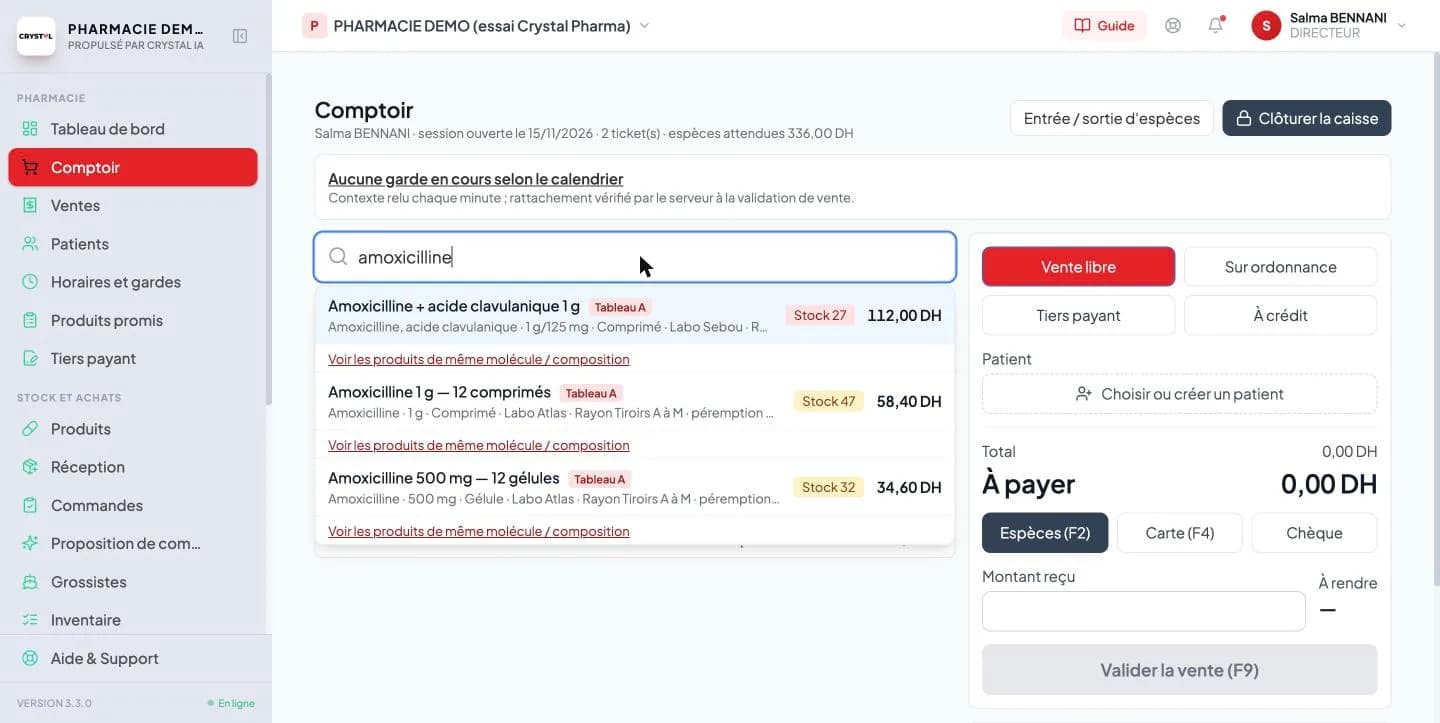
In Crystal Pharma, the prescription logbook is filled automatically at every sale of a listed medication. Selling a Schedule A, B or C medication at the counter requires the sale type 'on prescription', which means the prescriber must be entered. This entry is not optional: the software will not confirm the sale without an associated prescriber. As soon as the sale is confirmed, the medication concerned is added to the prescription logbook — with no additional action required from the dispenser. The logbook thus accurately reflects the sales recorded at the counter: every listed medication sale appears in it, without re-entry, without delay and without risk of omission.
This automation has a decisive advantage for data consistency: it is not possible to confirm the sale of a regulated medication without feeding the prescription logbook, and it is not possible to feed the logbook without a sale having been confirmed. The two are linked by design. In pharmacies that handle third-party payer sales for prescription medications, the same sale simultaneously creates an entry in the prescription logbook and records the receivable from the coverage insurer — two obligations handled in a single confirmation. For more details on third-party payer billing and its interaction with regulated medication sales, see our dedicated article (Third-Party Payer in Moroccan Pharmacies).
- Prescription logbook filled automatically at every sale of a listed medication, with no re-entry or additional action.
- Entering the prescriber is mandatory to confirm the sale of a Schedule A, B or C medication.
- The sale and the logbook are linked by design: neither can exist without the other.
- A third-party payer sale on prescription simultaneously creates a logbook entry and records the insurer receivable.
- Freely sold medications (outside the regulatory schedules) do not appear in the prescription logbook.
Controlled substances register: entries, exits and running balance updated in real time
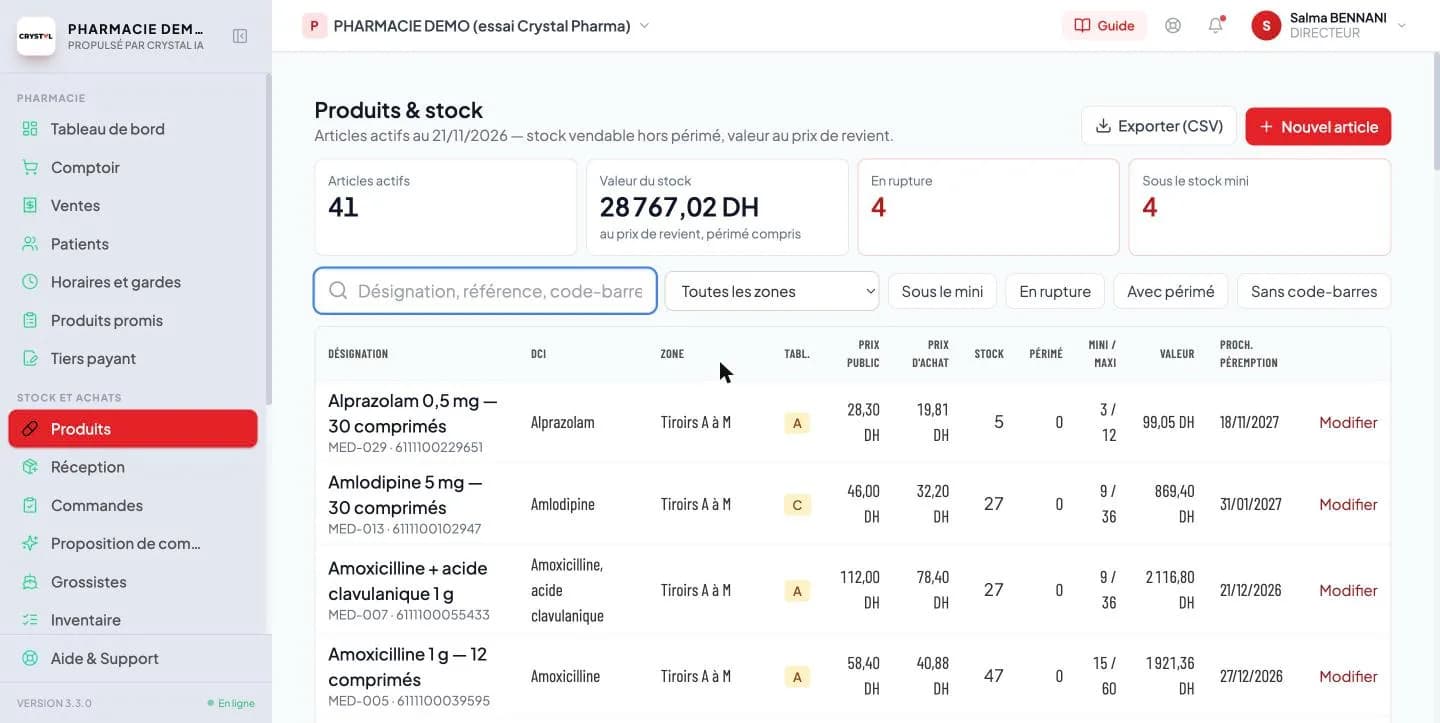
The controlled substances register in Crystal Pharma follows its own accounting logic: every movement of a Schedule B medication — whether an inbound stock entry upon receipt of a delivery or an outbound exit at the point of sale — is recorded with the cumulative balance after that movement. This approach makes it possible to retrieve the full movement history and the expected balance for each Schedule B product at any time, without manual reconstruction.
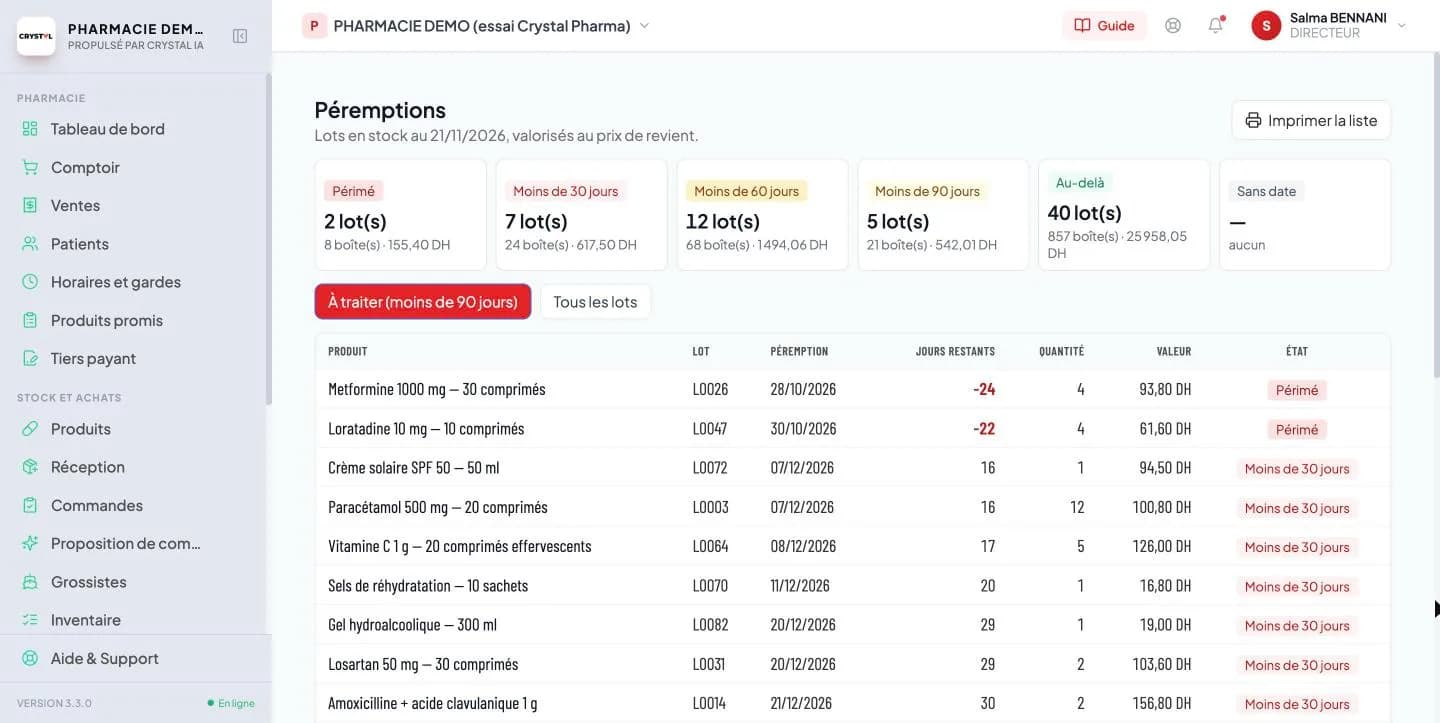
Entries in the controlled substances register are triggered by stock receipts: every delivery of a controlled substance feeds the register with an inbound entry. Exits are triggered by counter sales: every confirmed sale of a Schedule B medication automatically generates the corresponding exit in the register, with the balance updated. This mechanism ensures that the register is always current when the pharmacist opens it, without any synchronisation or manual reconciliation. Batch management, with priority given to the batch expiring soonest (FEFO), also applies to controlled substances at the counter — ensuring consistency between stock traceability and register records.
- Every inbound stock entry of a Schedule B medication generates an inbound entry in the controlled substances register.
- Every confirmed sale of a controlled substance generates the corresponding exit in the register, with the balance updated.
- The balance after each movement is calculated and recorded in real time — no manual reconciliation.
- Controlled substance batches are managed on a FEFO basis at the counter: the batch expiring soonest is dispensed first.
- The controlled substances register is distinct from the prescription logbook: a controlled substance sold on prescription appears in both.
Printing by period: preparing inspections without manual extraction
The Crystal Pharma prescription logbook can be printed by period. This feature simplifies situations that require producing evidence of dispensing for a given date range — an inspection, a reimbursement claim for a third-party payer insurer, or an internal review. Period-based printing eliminates the need to manually sort rows in a spreadsheet or leaf through a notebook: the software directly generates the list of listed medication sales for the requested period.
The controlled substances register benefits from the same logic: the movement history, with the balance after each entry and exit, is available for printing or consultation at any time. This immediate availability is a practical advantage during inspections: the head pharmacist can produce the register without delay, without reconstruction and without risk of transcription errors. The head pharmacist remains responsible for ensuring that the register is maintained in compliance with the requirements of the health authorities and the Order of Pharmacists — the software provides the data, not the compliance audit. Crystal Pharma also provides detailed CSV exports for the accountant, as described in our pharmacy management guide (Choosing pharmacy management software in Morocco).
- Prescription logbook printable by period: list of listed medication sales for the chosen date range.
- Controlled substances register viewable and printable at any time, with the balance after each movement.
- No manual reconstruction: data are immediately available in the software.
- The head pharmacist remains responsible for ensuring the register complies with applicable regulatory requirements.
- CSV exports available for sales reports, the cash journal and stock data.
Integration with the counter, stock and prescription sales
The prescription logbook and the controlled substances register are not isolated modules in Crystal Pharma: they are a direct extension of the counter and the stock. Every sale confirmed at the counter that triggers a prescription logbook entry simultaneously triggers a stock exit, a cash session entry and, if the medication is Schedule B, an exit in the controlled substances register. This integration avoids the classic situation in a non-digitised pharmacy: stock has been decremented and the cash register has collected payment, but the prescription logbook has not been filled in — or vice versa.
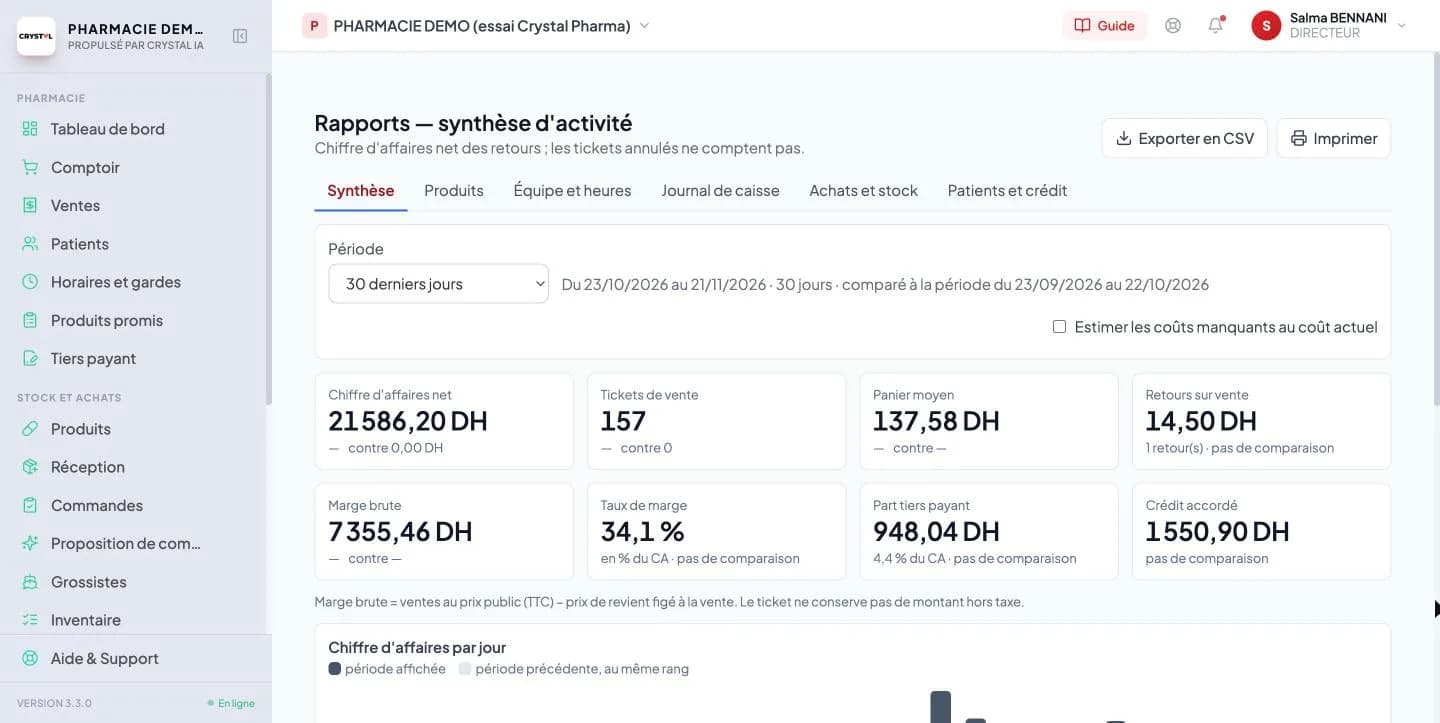
This consistency across modules is also reflected in the reports and dashboard. Prescription medication sales appear in the cash journal alongside other sales, controlled substance exits are reflected in the batch-level stock, and the prescription logbook is available for immediate verification. Our Pharmacy module (Crystal Pharma, our pharmacy management software) brings together all these functions in an online software accessible from a browser, with no local installation — developed by CRYSTAL IT in Rabat with over 20 years of experience serving Moroccan SMEs. The product is currently in a pilot phase with partner pharmacists.
- Every counter sale confirmation simultaneously triggers: a stock exit, a cash entry, a prescription logbook entry (and a controlled substances register exit if applicable).
- No de-synchronisation across modules: stock, cash, prescription logbook and controlled substances register all reflect the same data.
- Cash journal with prescription sale detail, for reconciliation with actual receipts.
- Dashboard and reports available to track activity, compared with the previous period.
- Online software, accessible from a browser, with no local installation at the pharmacy.
The prescription logbook and the controlled substances register are two documentary obligations that every Moroccan pharmacy must maintain with rigour. Maintaining them manually — by copying counter data into a notebook or spreadsheet — creates a risk of omissions, discrepancies and gaps that are difficult to explain during an inspection. Our Pharmacy module (Crystal Pharma, our pharmacy management software) fills both registers automatically: every listed medication sale feeds the prescription logbook at the moment of confirmation, and every controlled substance movement updates the register balance in real time. Period-based printing is available at any time, without manual reconstruction. The head pharmacist remains responsible for ensuring that these registers comply with the requirements of the health authorities and the Order of Pharmacists — the software provides the necessary data without being the guarantor of compliance. Crystal Pharma is developed by CRYSTAL IT in Rabat with over 20 years of experience serving Moroccan SMEs, and is currently in a pilot phase with partner pharmacists. To see how it adapts to your pharmacy's organisation, request a demonstration at (Crystal Pharma, our pharmacy management software).
The CRYSTAL IT solution on this topic
Have a project or a question? Let's talk with a CRYSTAL IT expert.
Request a demo