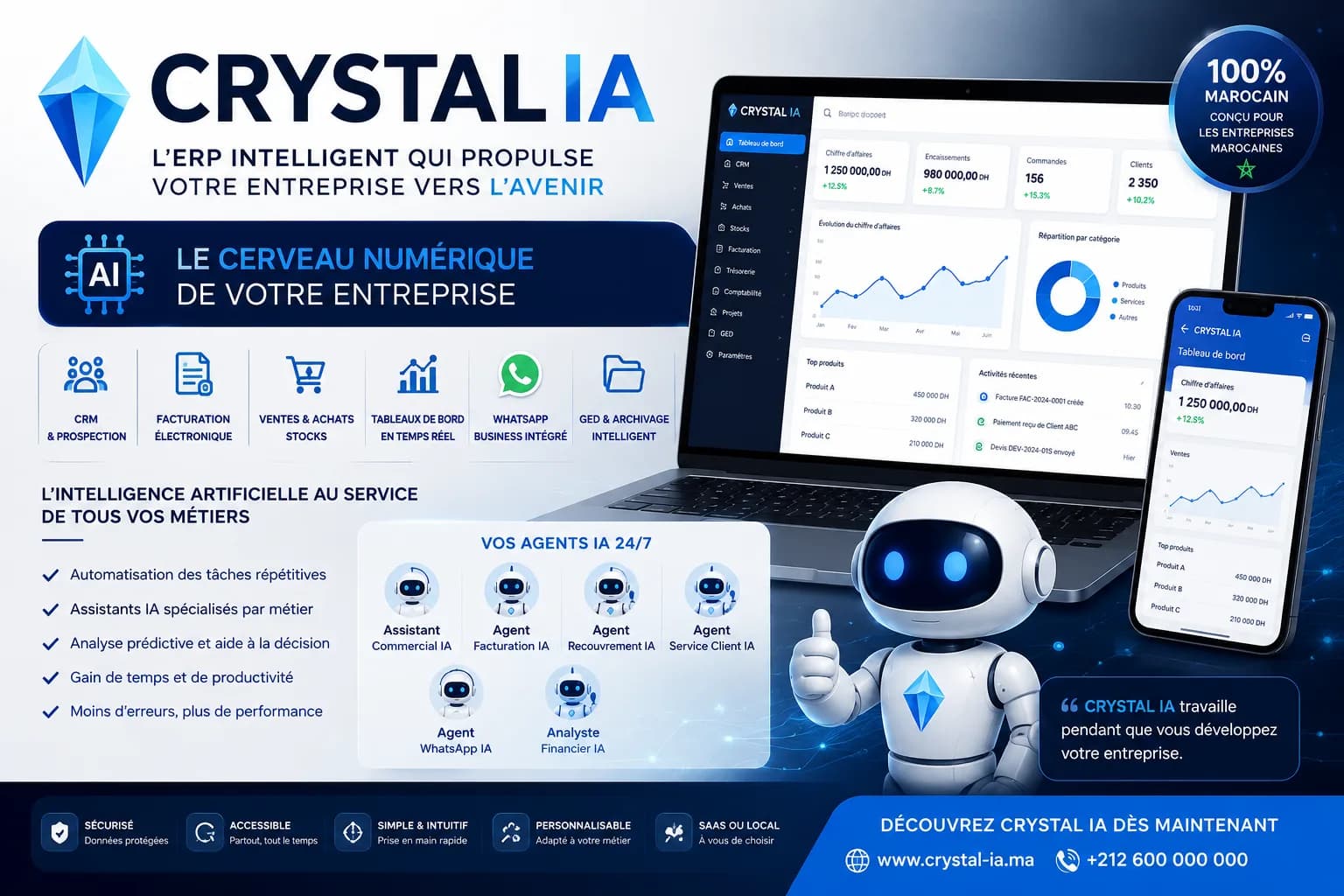
Management control in Moroccan SMEs suffers from a paradox: the ability to steer the business is most critical in companies with 10 to 100 employees, yet this function is most often absent there — delegated to an accountant who produces annual financial statements, or replaced by the manager's intuition. The result: many Moroccan SMEs run their business six months behind, discovering at year-end that a seemingly profitable activity consumed more cash than expected, that margins eroded in certain product families, or that a single client accounts for 40% of revenue without anyone having flagged it as a concentration risk. Management control for SMEs, as practised with the right tools for the company's size, is not a parallel accounting system: it is a lightweight management information system focused on operational decisions. It rests on three pillars — regularly measured KPIs, a budgeted forecast tracked against actuals, and minimal cost accounting — whose combination enables decisions grounded in real data rather than gut feel. Crystal ERP (erp.crystalit.ma), developed by CRYSTAL IT in Rabat with over 20 years of experience serving Moroccan businesses, natively integrates these three pillars in a single system: sales, purchasing, stock and accounting data continuously feed dashboards and variance analyses, without exports or manual re-entry. This guide explains how to structure management control in a Moroccan SME, which KPIs to track, and how an ERP can automate this oversight.
Why management control becomes essential beyond 10 employees
General accounting produces financial statements — balance sheet, income statement, cash flow statement — essential for tax authorities and banks, but ill-suited to daily steering. It is retrospective (it tells what happened), annual (financial statements arrive 3 to 6 months after year-end), and aggregated (it consolidates everything without distinguishing what performs from what loses). An SME relying solely on its general accounting navigates blind on the questions that matter: what is my margin by product family? Which client is overrunning payment terms? Does my core business generate enough cash to fund the growth I am planning? Management control answers these questions in near real time, provided the data is properly organised and the right tools are in place.
In a growing Moroccan SME, the critical moment is often the transition from management carried by the owner alone to an organisation where multiple managers — sales, production, procurement, logistics — take decisions whose financial impacts accumulate. Without a control system, these decisions remain siloed: the sales manager grants discounts without seeing the margin impact, the procurement manager optimises unit prices without factoring in extra storage costs, the logistics manager adjusts delivery times without measuring the effect on customer satisfaction. Management control creates the shared language that allows these decisions to coordinate around common, measurable objectives. For companies using Crystal ERP, this shared language is available from day one in the executive dashboard (Business dashboard in Morocco: managing your company in real time).
- Accounting lag: annual financial statements arrive 3 to 6 months after year-end — too late to correct a margin drift or a cash crunch.
- Misleading aggregation: a positive income statement can hide loss-making activities and highly profitable ones that offset each other.
- No budget tracking: without monthly targets, any variance is only detected at year-end, when corrective levers have disappeared.
- Invisible concentration risk: without client analysis, a portfolio with heavy dependency can appear stable until the first major contract is lost.
- Uncoordinated decisions: each manager optimises their silo without seeing the impact on the overall performance of the business.
Essential management KPIs for a Moroccan SME
An effective management control system for an SME does not need a hundred KPIs: a well-chosen ten, measured regularly, commented on and actionable, is enough. The golden rule is that each KPI must trigger an action if its value falls outside the acceptable range. A KPI that is observed without ever acting on it clutters the dashboard without adding value. The basic financial KPIs cover gross margin (revenue minus cost of goods sold or production), net operating margin, working capital requirement (WCR) and net cash position. These four measures, tracked monthly, give an accurate enough picture of the company's financial health to detect drifts before they become critical.
Operational KPIs complement the financial dashboard with leading indicators: stock turnover rate measures how many times the average stock is sold in a given period (a falling rate signals slow-moving inventory accumulating before the financial impact is visible); average customer payment days (DSO) measures the actual time between invoicing and collection (a rising DSO signals an upcoming cash crunch); quote conversion rate measures commercial effectiveness. For service companies, the resource utilisation rate (billed hours / available hours) is often the most revealing operational indicator. To go further on AI-powered cash flow forecasting, see our dedicated article (AI-Powered Sales and Cash-Flow Forecasting).
- Gross margin by product family: early warning on ranges losing profitability before the overall income statement reflects the deterioration.
- DSO (average customer payment days): detects chronic payment delays and quantifies their impact on working capital requirements.
- Stock turnover rate: identifies slow-moving references and excess stock that ties up cash.
- Quote conversion rate: measures prospecting effectiveness and guides resource allocation decisions for the sales team.
- 30/60/90-day rolling cash cover: a rolling horizon that anticipates cash stress before it forces urgent, costly decisions.
- Client concentration (top 3 / top 10): quantifies commercial risk and guides portfolio diversification policy.
Building an SME budget and analysing variances monthly
The budget forecast is the foundation of management control: it sets targets for revenue, margin and costs for the coming year, broken down month by month. Without a budget, any result is acceptable by default — there is no reference point to judge whether the business is performing in line with its ambitions or underperforming. Building an SME budget does not require senior controller expertise: start from historical data (the last 12 months, ideally month by month to capture seasonality), apply the growth assumptions decided by management (new client wins, price increases, new product launches), and translate those targets into variable costs (raw materials, subcontracting, sales commissions) and fixed costs (rent, payroll, subscriptions). The budget is a commitment by the management team, not a weather forecast: it embodies the strategy in numbers.
Monthly variance tracking is the centrepiece of the system. At the end of each month, actuals are compared to the budget at the same level of detail: volume variance (more or fewer units sold than planned), price variance (unit margin differs from what was budgeted), cost variance (a cost line exceeded budget). Each significant variance triggers a causal analysis: is it linked to a decision taken during the month, to an external event (rising material prices), or to a structural weakness in the budget (unrealistic growth assumption)? Variance analysis is not a retrospective justification exercise: it is a learning tool that improves forecast quality for subsequent months. For broader budget management, our dedicated guide (Budget Management Software for SMEs in Morocco) complements this article.
- Monthly budget by product/service family: monthly granularity captures seasonality and enables a realistic comparison — an annual budget flattened over 12 months masks peaks and troughs.
- Quarterly forecast revision (re-forecast): adjusts initial assumptions mid-year so the budget remains a useful tool even as conditions change.
- Automatic alert thresholds: Crystal ERP flags whenever a variance exceeds a defined threshold (e.g. margin 5 points below budget), without waiting for the monthly meeting.
- Variance attribution: distinguishing volume, price and mix variances to act on the right lever — reducing costs is pointless when the variance is purely volume-driven.
- Board presentation: the monthly variance report, automatically produced by the ERP, structures the agenda of the management steering meeting.
Cost accounting: allocating costs to steer by activity
General accounting records costs (purchases, salaries, rent, depreciation) without linking them to the activity or product that consumed them. Cost accounting, by creating analysis axes — cost centres, product families, projects, geographies, distribution channels — answers questions that general accounting leaves open: was this project profitable? Does this branch generate enough margin to cover its overhead? Does this product line make a positive contribution to results, or is it cross-subsidised by other activities? For an SME, cost accounting does not need to be sophisticated: a simple axis plan — around ten cost centres representing the main business activities — is enough to provide the decision-making insight that general accounting cannot.
The main obstacle to implementing cost accounting in Moroccan SMEs is the data-entry effort: if every cost must be manually assigned to an axis, the accounting team does not find the time to do it consistently. Crystal ERP (erp.crystalit.ma) solves this through automation: purchases are automatically allocated to the corresponding cost centre according to the company's rules, sales are broken down by product family and salesperson at the point of entry, and indirect costs are apportioned according to an allocation key defined once and for all. The management controller, or the owner who plays that role in an SME, no longer spends time rebuilding data: they consult and analyse it. To go deeper on cost accounting, our dedicated guide (Cost Accounting for Moroccan SMEs) covers cost centre configuration in a Moroccan ERP.
- Cost centres: each major activity (production, sales, logistics, administration) forms a centre that aggregates its costs and measures its weight in the cost structure.
- Profit centres: revenue-generating activities (product families, branches, projects) become profit centres whose net contribution is measured.
- Automatic allocation: an ERP sets up allocation rules once and applies them consistently — no manual entry of analytical axes on each accounting document.
- Product cost price: calculating the real cost (purchase + direct costs) enables setting sales prices consistent with the profitability target.
- Monthly analytical reporting: a margin-by-axis table, automatically updated from real accounting data, is the main output of a well-configured cost accounting system.
Crystal ERP: management control integrated with operational management
One of the traditional obstacles to implementing management control in SMEs is data fragmentation: sales in one tool, purchases in another, payroll in a third, accounting in a fourth. Producing a management dashboard requires extracting, reconciling and consolidating — work that takes several days per month and yields data that is already stale by the time it is available. Crystal ERP (erp.crystalit.ma) breaks down this fragmentation by centralising commercial data (quotes, orders, invoices, collections), purchasing data (supplier orders, receipts, purchase invoices), stock data (inflows, outflows, valuation), accounting data (journal entries, ledgers, trial balance) and HR data (payroll, absences, attendance) in a single system. From this unified, real-time database, management control dashboards are generated without manual intervention: every operational entry automatically enriches the steering KPIs.
For SME managers without a management controller in their org chart, Crystal ERP effectively fills that role: it produces the monthly budget-vs-actual comparison, displays margin by product family, flags out-of-threshold variances, calculates WCR in real time and forecasts cash over the next 30 to 90 days from open receivables and payables. For SMEs that already have a finance manager, Crystal ERP frees them to focus on analysis rather than data collection. Available in SaaS mode, it can be accessed from any browser without server infrastructure. To understand how Crystal ERP integrates with the tools you already use, see our ERP integration guide (Connecting Your ERP to Your Tools).
- Executive dashboard: gross margin, net cash, DSO, stock turnover and WCR updated continuously from real operational data.
- Automatic budget tracking: monthly budget entered once, variances calculated and displayed as soon as actuals are recorded — no manual consolidation.
- Integrated cost accounting: cost and profit axes configured in the ERP, automatic allocation on every document, monthly analytical reporting without exports.
- Rolling cash forecast: projection of inflows and outflows over 30/60/90 days from open customer receivables and supplier payables.
- Configurable alerts: alert thresholds on critical KPIs (stock below minimum, customer credit limit exceeded, budget variance > 10%) to act before the problem worsens.
- Multi-user SaaS: manager, CFO, sales director and management controller access the same data simultaneously, from head office or on the road.
Implementing management control in a Moroccan SME does not require hiring a full-time controller: pick ten KPIs suited to your business, build a monthly budget forecast, configure basic cost accounting, and equip yourself with a tool that feeds all three pillars automatically from real operational data. Crystal ERP (erp.crystalit.ma) is designed precisely for this: it turns daily entries — invoices, orders, payments, stock — into real-time steering data, with no consolidation work. CRYSTAL IT, based in Rabat with over 20 years of experience serving Moroccan businesses, accompanies you in configuring your management control system, from defining cost axes to training your teams. Discover Crystal ERP at erp.crystalit.ma and book a demonstration tailored to your sector.
The CRYSTAL IT solution on this topic
Have a project or a question? Let's talk with a CRYSTAL IT expert.
Request a demo