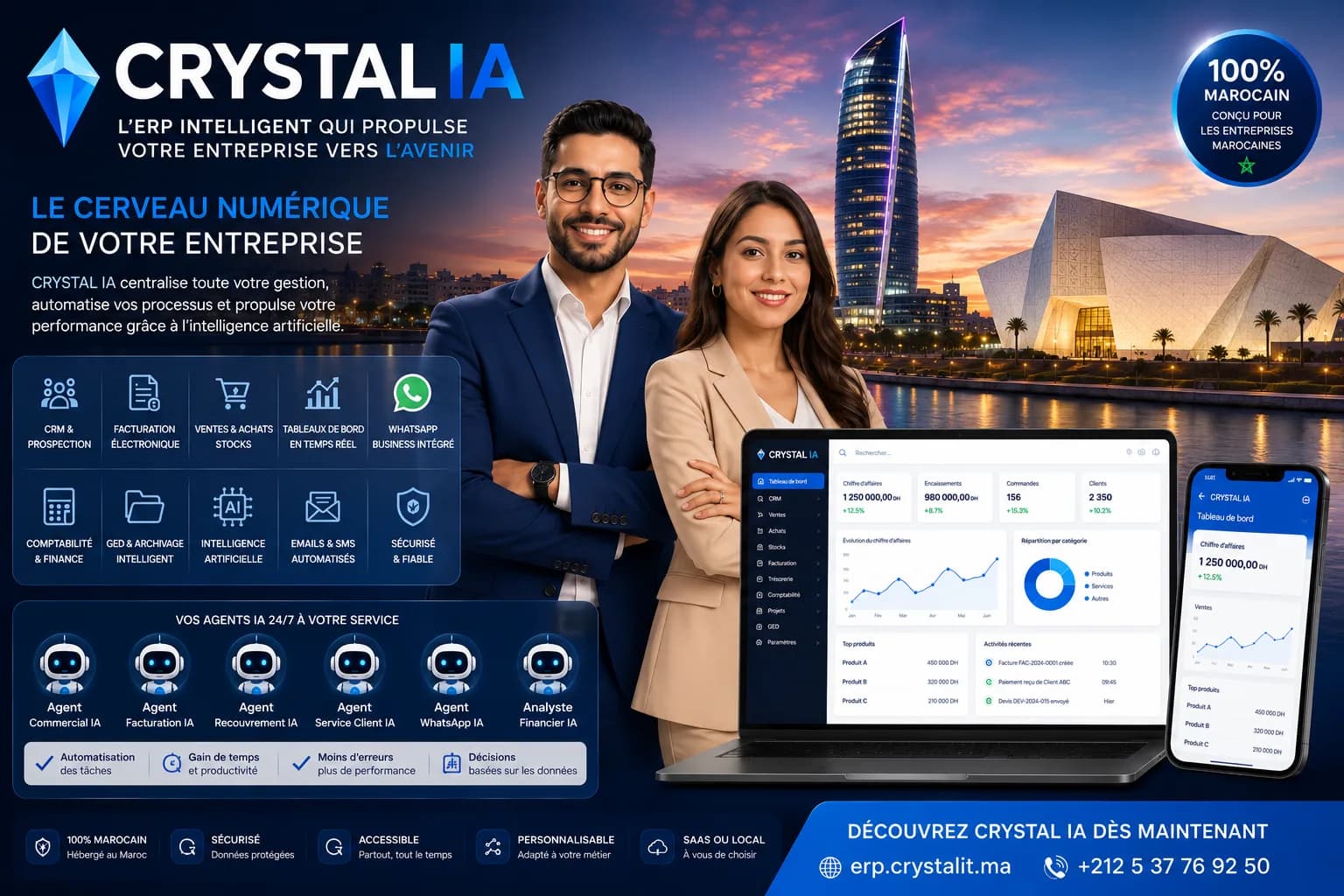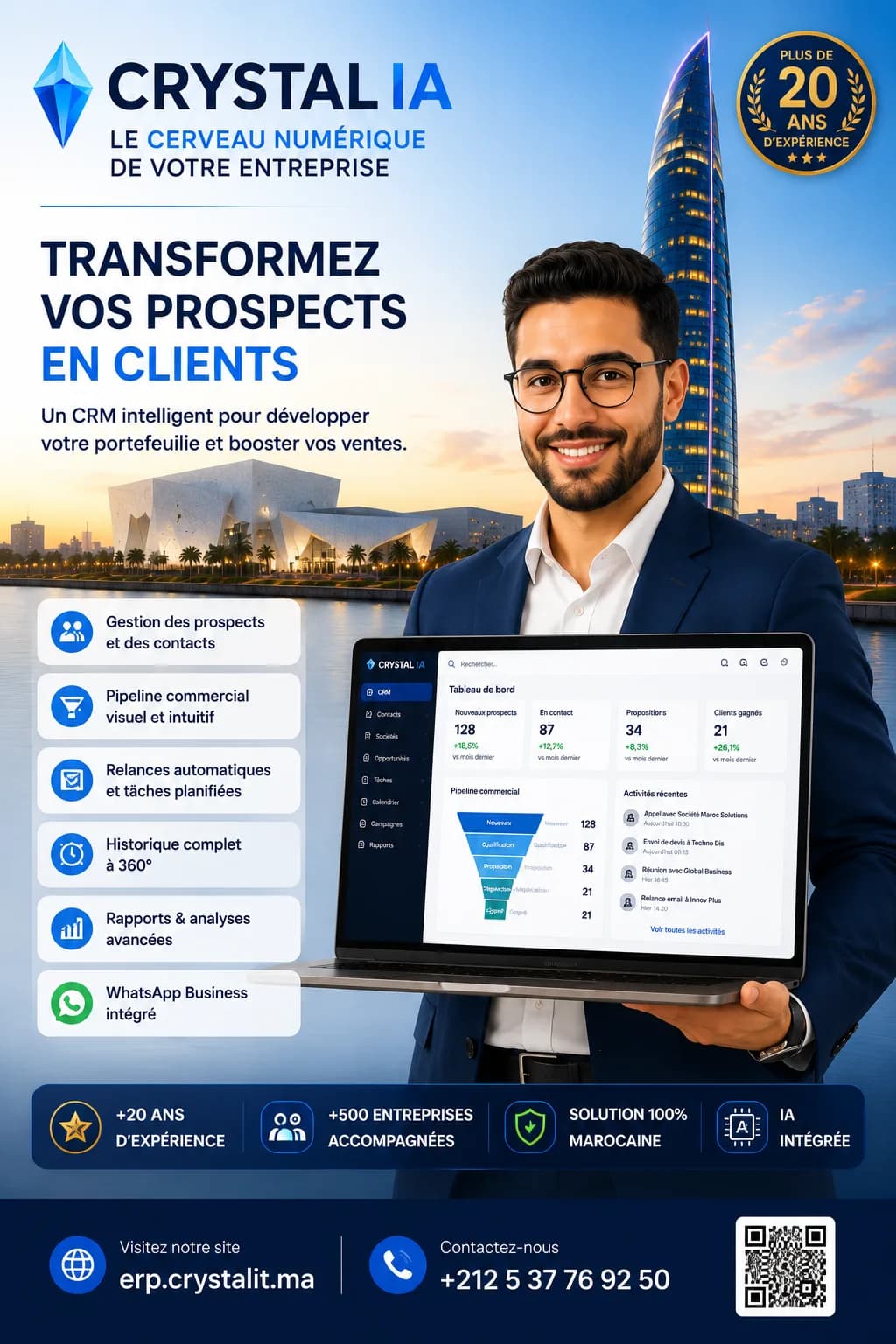
Catering and event management software in Morocco responds to a singular operational reality: each event is a unique project — a wedding in Marrakech, a corporate seminar in Casablanca, an awards ceremony in Rabat — that mobilises mobile teams, perishable stock, equipment dispatched across multiple sites and an invoice built on a quote that is often revised several times before the event. Unlike a fixed restaurant with predictable flows, the event caterer manages a fragmented logistics chain: supplier orders triggered per event, a variable workforce (waiters, cooks, maîtres d'hôtel) allocated differently from one weekend to the next, and equipment (tables, chairs, crockery, mobile cooking gear) that must be transported, installed, collected and inventoried after each engagement. Managing all of this with Excel spreadsheets, Word quotes and coordination phone calls silently accumulates risk: food ordered at twice the quantity for a cancelled event, an understaffed team on the day, an unreceived deposit that creates an accounting gap at year-end. Crystal ERP (erp.crystalit.ma), developed by CRYSTAL IT in Rabat with over 20 years of experience serving Moroccan businesses, covers these needs in an integrated environment — quotes and orders, team management, inventory tracking and invoicing, all connected in a single flow with no re-entry. This guide explains the concrete challenges facing a Moroccan caterer and how purpose-built management software can resolve them.
The Management Challenges of a Catering or Event Company in Morocco
The particularity of the event catering sector in Morocco lies in the very nature of its business model: each engagement is a high-visibility project, often prepared weeks in advance, that concentrates all organisational effort into a few hours. A single wedding or seminar may represent a significant share of the provider's monthly revenue — which makes every organisational error (wrong menu, insufficient staff, missing equipment) an immediate and highly visible impact on reputation and profitability. The pressure on deadlines is absolute: the service cannot be postponed, and surprises must be absorbed on the spot by an already fully deployed team.
Added to this operational pressure is the complexity of managing variable resources. Unlike a business that employs a stable team, an event caterer typically mobilises a combination of permanent staff and temporary workers whose numbers vary with the order book. Managing availability, fixed-term contracts, CNSS declarations for short-term engagements and pay slips calculated on variable days and hours is an HR challenge that few generic tools cover correctly. Finally, food inventory management in an event context follows a different logic: purchases are tied to specific orders rather than regular daily consumption levels, products are perishable and their wastage directly reduces margin, and a shortage on the day of service has no simple solution.
- Each event is a standalone project: a fixed date, specifically mobilised resources and a pre-defined budget — a spreadsheet is no substitute for a project management tool suited to the event context.
- Variable workforce per event: casual staff, ad-hoc waiters and seasonal cooks — availability changes every week and social declarations must keep pace.
- Perishable food stock tied to orders: buying too much means loss; buying too little means disappointing the client — the precision of quantities ordered directly determines profitability.
- Evolving quotes: a wedding client changes the guest count, menu or duration between signing and the event day — the quote and final invoice must track these changes.
- Deposits and payment schedules: major events often involve successive deposits and a balance at close — without structured tracking, partial receipts create accounting gaps that are difficult to reconcile.
Quotes and Tracking of Event Orders
The quote is the founding document of any catering engagement: it commits the provider to a menu, a quantity, a service format and a price, and serves as the basis for planning purchases, staffing and the equipment required. In practice among Moroccan caterers, this quote is typically drawn up in Word or Excel, sent by email or WhatsApp and then revised several times before signature — with a persistent risk of confusion between successive versions. When the quote is not linked to a central information system, changes made by the sales contact do not automatically cascade to the purchase list or the staffing schedule: the information must be re-transmitted to every stakeholder involved, with the losses and misunderstandings that entails. Management software solves this at the source: the quote is the single entry point for the event, from which subsequent steps flow automatically. For a complete overview of best practices in quote management, see our dedicated guide (Commercial Quoting Software in Morocco).
Managing confirmations and deposits is the second challenge in the sales phase. A confirmed event without a deposit is a fragile booking, subject to cancellation without compensation if the provider has not formalised the conditions. Crystal ERP (erp.crystalit.ma) allows these stages to be formalised: creating a quote with menu variants and service formats, tracking revisions, obtaining client approval, generating a deposit invoice based on the agreed percentage and sending an automatic reminder if the deposit is not paid within the agreed timeframe. Each confirmed event then enters the planning calendar, visible to all teams involved (kitchen, logistics, service), triggering the next steps — supplier orders, staff allocation, equipment preparation — with no re-entry or manual information transfer.
- Quote linked to events: each quote is associated with an event (date, venue, service type, guest count) — any modification cascades to downstream planning.
- Menu options: multiple menu choices offered within a single quote, with differentiated pricing and automatic estimated cost calculation.
- Revision tracking: each quote change logged with date and author — the current version is always clearly identifiable.
- Automatic deposit invoice: one-click generation of the deposit invoice based on the contractual percentage, with reminder if not paid within the agreed timeframe.
- Quote → purchase order → final invoice flow: integrated document chain with no re-entry, from quote acceptance to the balance invoice after the engagement (Invoicing software in Morocco).
Team Coordination and External Contractors
Staff planning is one of the most time-consuming and most critical tasks for an event caterer. Each engagement requires a specific headcount — so many waiters, cooks, a maître d'hôtel, possibly a logistics supervisor — with schedules defined by the event's timeline (set-up, service, break-down). These staffing needs vary considerably from one week to the next depending on the order book. A busy weekend may require twice the staff of a quiet one, which means relying on casual workers whose availability must be verified and confirmed in advance. Crystal ERP (erp.crystalit.ma) integrates a scheduling module that displays the upcoming events calendar, shows staffing requirements by role for each engagement and allows team members — permanent staff or the casual reserve — to be allocated while checking their availability in real time.
For engagements that call on external contractors — crockery hire, furniture and marquee rental, musical entertainment, security or valet services — coordination extends to managing these third-party providers. Each has its own pricing, conditions and availability calendar. Without a tool to centralise this information, the coordinator must manage dozens of contacts by email and phone for every major event. Crystal ERP allows contractors to be referenced with their rates and contacts, associated with event-specific purchase orders, and their service delivery and invoice settlement to be tracked. This centralisation reduces omissions, duplicate payments and situations where a key contractor is not confirmed in time. For a deeper look at HR management, see our guide (HR Management Software in Morocco: the Complete Guide for SMEs).
- Planning per event: staffing needs (headcount, roles, schedules) are linked to the event — no manual reconstruction each time.
- Availability check: the system shows who is available (permanent or casual) for each slot, taking into account leave and previously confirmed events.
- Casual and temporary staff management: casual worker profiles with availability, skills and rates — allocation in a few clicks with no manual search through separate lists.
- External contractor management: crockery, furniture, service providers — event-specific purchase orders, confirmation tracking and invoice settlement in one system.
- Mission briefs per engagement: automatic briefing for each team (timing, tasks, venue, contacts) generated from the event record — no verbal briefings that leave information only in people's heads.
Food Inventory and Event Equipment Management
Inventory management in the event catering sector is fundamentally different from that in a shop or a standard restaurant: it is driven by the order book, not by regular daily consumption levels. A month with three major events may call for purchases five times larger than a quiet month, and products bought in excess of what confirmed orders require quickly become a loss if they have a short shelf life. The golden rule for caterers is therefore to buy according to confirmed orders, with a controlled safety margin. Crystal ERP (erp.crystalit.ma) makes this precision achievable: from the menus confirmed in event orders, the system calculates the ingredient quantities required, generates the corresponding supplier purchase orders and updates stock levels when deliveries are received. For details on the inventory management module, see our guide (Inventory management software in Morocco).
Event equipment — tables, chairs, linen, crockery, mobile cooking gear, marquees, sound systems — is the second inventory management challenge. This equipment must be tracked unit by unit (or batch by batch) to know what is available at the depot, what is currently out at a venue and what is under maintenance or repair. Without traceability, improvisation is common: at loading time it is discovered that twenty plates are missing because some crockery was broken at the previous engagement and has not yet been replaced. Crystal ERP integrates event equipment tracking into its stock management module: each item is referenced with its status (available, at an event, under repair, out of service), its acquisition cost and its replacement cost. The loading list for each event is generated from the system and checked on return to identify breakages and losses requiring replenishment.
- Needs calculated from confirmed menus: Crystal ERP automatically derives the ingredient quantities required from the menus in confirmed orders — purchases calculated, not guessed.
- Supplier purchase order generated: from the calculated need, a purchase order is proposed to the supplier with the quantities and lead times required by the event.
- Perishable product tracking: expiry dates recorded by batch at receipt — alerts prioritise consumption of products closest to their expiry date.
- Event equipment traceability: tables, chairs, crockery — real-time availability status (at depot, at event, under repair) for a reliable loading list.
- Breakage and loss recording: each damaged or missing item logged on return from the engagement, with automatic replacement order triggered if the minimum level is breached.
Invoicing, Collections and Financial Steering
Event catering invoicing has specificities that make it difficult to handle with a simple general-purpose billing tool. First, the final invoice does not always match the initial quote: last-minute changes (additional guests, menu changes during service, supplementary consumption) may alter the total amount. Second, the payment structure is often multi-staged: a first deposit at booking, a second deposit midway between booking and the event, and a balance payable upon delivery of the service. Tracking these stages manually — ensuring each deposit received is correctly allocated to the right order and deducted from the final invoice — is a frequent source of errors in small operations. Crystal ERP manages this process in one integrated flow: quote → deposit invoices → balance invoice with automatic deduction of deposits received, with no manual calculations.
Overall financial steering is the third challenge. A caterer must be able to answer several management questions in real time: what is the actual profitability of each event, once food purchases, staff and contractors are charged to it? Which types of events (wedding, seminar, corporate buffet, family reception) are the most profitable at a comparable volume? What is the three-month cash flow plan, factoring in deposits already received and balances to be collected? Crystal ERP provides these indicators in an integrated dashboard. Event-level management accounting allows each cost (purchase, staff, contractor) to be attributed to the relevant event and the net margin per engagement to be calculated — essential information for refining pricing and identifying the event types to prioritise. For a deeper look at cash flow management, see our dedicated guide (Cash Flow Management for Moroccan SMEs).
- Multi-stage invoicing: successive deposits tracked and automatically deducted from the balance invoice — no manual calculations and no risk of overlooking a deposit received.
- Invoice adjusted for changes: last-minute modifications (additional guests, extra services) added to the original order and reflected in the final invoice with no re-entry.
- Profitability per event: purchases, staff and contractors attributed to each event — net margin visible per engagement (Accounting software in Morocco).
- Cash flow forecast: calendar of expected deposits and balances to collect set against upcoming purchases and costs — no cash flow surprises (Cash Flow Management for Moroccan SMEs).
- Overdue alerts: automatic reminders for unpaid deposits and unsettled balances after the event — an essential tool for providers working with clients on long payment terms.
The Moroccan event caterer and organiser operates in a demanding environment: every engagement is irreversible, logistics are fragmented and reputation is built one event at a time. Managing this reality with disconnected office tools accumulates risks that an integrated management platform can eliminate: quotes aligned with planning, teams assigned from the order book, purchases calculated from confirmed menus and structured invoicing that accounts for every deposit. Crystal ERP (erp.crystalit.ma), developed by CRYSTAL IT in Rabat with over 20 years of experience serving Moroccan businesses, offers an integrated management environment that connects commercial operations, logistics, inventory and accounting in a single flow — with no re-entry between tools. Contact the CRYSTAL IT team in Rabat for a Crystal ERP demonstration tailored to your catering and event management activity.
The CRYSTAL IT solution on this topic
Have a project or a question? Let's talk with a CRYSTAL IT expert.
Request a demo