A policyholder may forget who sold them their policy; they never forget how their claim was handled. In Morocco, where the intermediary is the claimant's first port of call — it is to the agency or the firm that people turn after an accident, a fire, water damage — claims management is the true arbiter of the client relationship. It is also the hardest process to run without a tool: long files, multiple documents, varied parties (policyholder, insurer, loss adjuster, garage, third party), deadlines to meet and anxious policyholders calling to know where their file stands. This guide details the complete claim cycle on the Moroccan intermediary's side, the usual friction points, and what software such as CRYSTAL ASSUR IA (Crystal Assur, the insurance software for agents and brokers) — with the support of artificial intelligence — concretely changes at each step.
The claim on the intermediary's side: a central role, a real burden
In the Moroccan claim circuit, the intermediary occupies a pivotal position. They receive the policyholder's declaration, check the policy's cover, assemble the file, forward it to the insurer, follow the loss adjustment, chase for indemnification and keep the policyholder informed throughout the journey. This position is a commercial strength — the policyholder sees their broker or agent fighting for them — but it is also a burden: each file represents dozens of interactions spread over weeks or months.
Without a structured tool, that burden quickly spins out of control. Declarations arrive through every channel — at the counter, by phone, over WhatsApp — and get recorded unevenly. Documents get lost between email, the desk and the paper file. Reminders depend on the handler's memory. And when the policyholder calls, retrieving the exact state of the file takes long minutes, when it is possible at all. The result shows in settlement times and in policyholder dissatisfaction — precisely what a firm cannot afford in a competitive market.
Structuring the cycle: from declaration to closure
Claims management software imposes a structured path on the file. The declaration opens the file, attached to the policy and the policyholder, with an immediate check of the cover: the handler knows from the first minute whether the claim is covered, with what deductible and what limits. The list of expected documents is generated according to the claim type — accident report, photos, invoices, police report, repair estimate — and each document received is ticked, dated and archived in the file.
The rest of the journey is staged: transmission to the insurer, appointment of the loss adjuster where applicable, adjuster's report, indemnification offer, settlement, and where relevant recourse against a third party. At each milestone, the software time-stamps the event, raises alerts on lengthening delays and keeps a trace of the exchanges. The file stops being a folder whose contents only its handler knows: any team member can answer the policyholder by looking at the screen, and the manager sees at a glance which files are bogging down.
- File opening attached to the policy, with an immediate check of cover, deductibles and limits.
- Document checklist by claim type, with received / missing status and archiving in the file.
- Time-stamped milestones: transmission to insurer, loss adjustment, offer, settlement, recourse.
- Alerts on dormant files and drifting deadlines.
- Complete history accessible to the whole team: the policyholder gets an immediate answer, whoever they speak to.
Chasing missing documents: where files bog down
Ask the handlers where the time is lost: waiting for documents. An accident report the policyholder is slow to drop off, an invoice that never arrives, a police report still pending — and the file stops, often without anyone noticing before the policyholder's next complaint. The paradox is that this blockage, the most frequent of all, is also the most automatable.
With tooled tracking, every missing document triggers automatic reminders — by WhatsApp or SMS, the channels Moroccan policyholders actually read — until it is received. The handler no longer spends their energy on it: they are alerted only when the reminders go unanswered. CRYSTAL ASSUR IA offers precisely a claims-reminder add-on dedicated to the automatic follow-up of files and outstanding documents. The effect is twofold: shorter settlement times, and policyholders who feel supported rather than forgotten.
What AI brings: reading documents, routing flows, prioritising
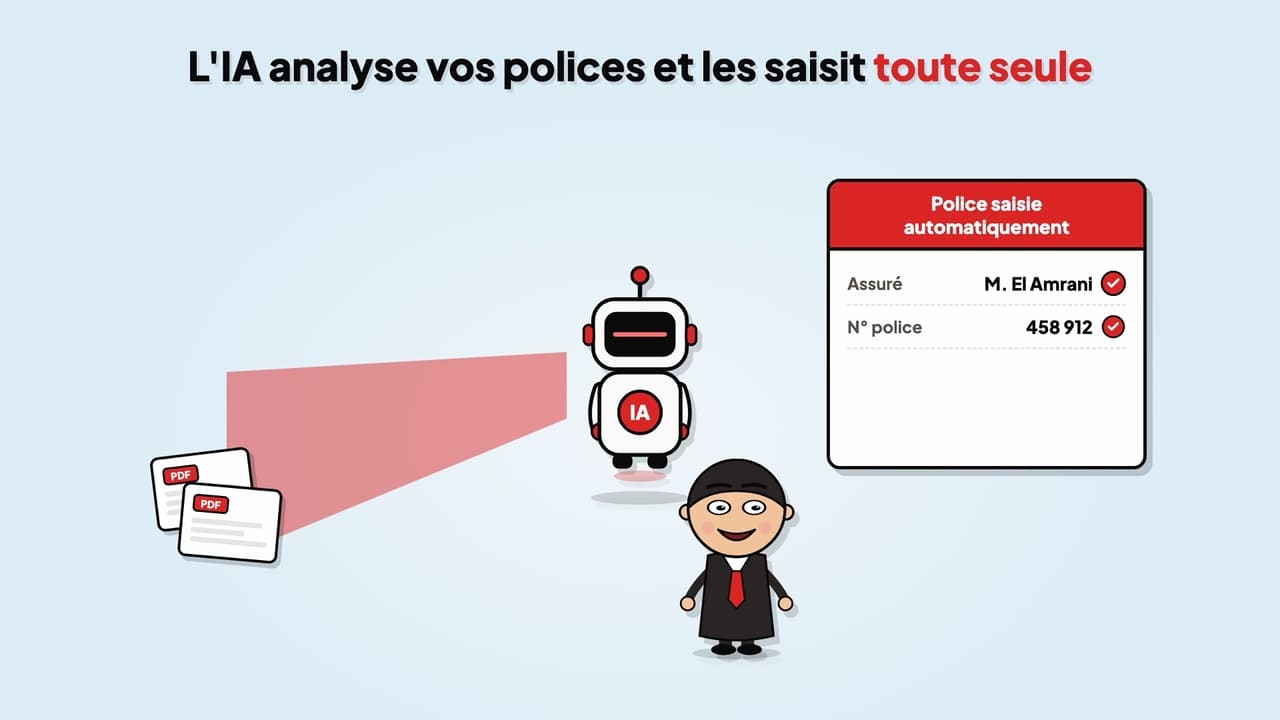
Artificial intelligence brings very concrete gains to claims handling. Intelligent OCR reads incoming documents — accident reports, invoices, adjusters' reports, police reports — identifies them, names them and files them automatically in the right folder, pre-filling the useful information. Automatic email sorting routes every incoming message to the right file and the right handler, instead of letting the agency's shared inbox act as a bottleneck.
These capabilities are at the heart of CRYSTAL ASSUR IA: document OCR, intelligent email dispatch and AI-assisted claims steering. They do not replace the handler — they give back the time that document shuffling stole, to be spent on what requires their judgment: qualifying complex files, negotiating with the insurer, supporting the policyholder. For a panorama of profitable AI uses in the trade, see our dedicated article (AI for insurance brokers: the use cases that save time).
The claim, litmus test of the whole management
A well-handled claim file rests on everything that precedes it: a policy correctly recorded with its cover, an up-to-date policyholder record with contact details, contractual documents archived and retrievable. That is why a stand-alone claims module always delivers less than an integrated solution where the claim opens on the policy, inherits the policyholder's data and feeds the firm's reporting.
That is the choice made by CRYSTAL ASSUR IA: claims management — declaration, follow-up, loss adjustment, indemnification and recourse — is a native module of the same platform as production, receipting and the policyholder relationship. The firm gains a complete view: how many claims in progress, in which lines, for how long, with what impact on retention. For an overview of what insurance software must cover in Morocco, our reference article complements this guide (Digitalizing an insurance brokerage or agency in Morocco: the guide).
Claims management is the moment of truth for a Moroccan insurance firm: it is where policyholders' trust is won or lost. Business software turns this high-pressure journey into a staged process — a file structured from declaration, documents tracked and chased automatically, AI that reads and files the paperwork, full visibility for the team and the manager alike. CRYSTAL ASSUR IA, the first insurance application in Morocco published by CRYSTAL IT since 2014 and deployed in more than 500 firms and companies, integrates this AI-driven claims management at the heart of its platform. Request a free demonstration on your own files: you will see what your policyholders will see.
Have a project or a question? Let's talk with a CRYSTAL IT expert.
Request a demo