Electronic signature in Morocco has been governed since 2007 by Law 05-53 on the electronic exchange of legal data, which gives it probative value equivalent to a handwritten signature when the required technical conditions are met. Yet the majority of Moroccan SMEs still sign their contracts, purchase orders and HR documents by hand and then scan them — a slow, document-management-heavy process ill-suited to the growing demands of digitalisation. The e-invoicing reform announced by the DGI adds to this momentum: companies preparing for it would do well to consider electronic signature for their documents too, even though the requirements specific to invoices have not yet been published. This guide explains what Law 05-53 covers, which use cases are now mature for Moroccan SMEs, how to get equipped in practice, and how a solution like Crystal ERP (erp.crystalit.ma) supports this transition.
Legal framework for electronic signature in Morocco: Law 05-53
Law 05-53 of 30 November 2007 on the electronic exchange of legal data forms the bedrock of electronic signature law in Morocco. It establishes two fundamental principles: an electronic signature has the same probative value as a handwritten signature, provided the technical process used guarantees the identity of the signatory and the integrity of the signed document. This legal equivalence is the prerequisite for companies to substitute hand-signed paper with electronically signed documents.
The law distinguishes three levels of electronic signature based on the degree of assurance they provide: simple (a checkbox or scanned handwritten signature), advanced (linked to an electronic certificate that identifies the signatory and detects any alteration of the document), and qualified (the highest level, requiring a secure signature creation device and a certificate issued by an ANRT-accredited provider). In practice, B2B transactions and high-value contractual documents require at least an advanced signature.
- Law 05-53 (2007): legal equivalence between electronic and handwritten signatures under defined technical conditions.
- Three levels: simple (low assurance), advanced (certificate + integrity), qualified (ANRT-accredited provider).
- ANRT (National Telecommunications Regulation Agency): Morocco's reference certification authority.
- Accredited providers: Barid Al Maghrib (BAM Certification), accredited banks and sectoral operators.
- Storage of electronically signed documents: probative archiving requirements compatible with DGI and CNSS audits.
Practical use cases for electronic signature in Moroccan SMEs
Electronic signature is no longer reserved for large groups or public administrations. Moroccan SMEs today have immediate, mature use cases, notably in two domains — commercial contracts (client and partner agreements, NDAs) and HR documents (employment contracts, amendments, certificates of employment) — plus a third to watch: e-invoicing, whose signature requirements have not yet been published by the DGI. These domains cover the bulk of documents for which a handwritten signature currently creates delays, travel costs and risk of loss.
For SMEs working with public sector clients or responding to tenders (public procurement), electronic signature is already an operational reality: Morocco's e-Public Procurement platform requires electronically signed offers. The extension to the private sector is natural: a supplier equipped with a valid electronic signature can sign a purchase order in seconds, from anywhere, without printing or postal delivery.
- Commercial contracts: client and supplier contracts, NDAs, letters of intent — signed in minutes without travel.
- HR documents: employment contracts, amendments, termination documents — archiving compliant with Morocco's Labour Code.
- E-invoicing: one to watch, as signature requirements under the DGI reform have not yet been published.
- Public tenders: Morocco's e-Procurement platform already requires electronic signatures on submitted bids.
- Customs documents and certificates of origin: progressive digitalisation of exchanges with the Customs Administration.
How to get equipped with electronic signature in Morocco
Getting equipped with electronic signature in Morocco involves three steps: obtaining an electronic certificate from an ANRT-accredited provider, integrating a signing tool into the company's document workflows, and setting up probative electronic archiving of signed documents. The first step is often the biggest hurdle for SMEs, due to limited awareness of available providers.
Barid Al Maghrib, through its subsidiary BAM Certification, is Morocco's reference provider of electronic certificates. It issues personal and corporate digital certificates usable for document signing and authentication with online services (DGI, CNSS, e-Public Procurement Portal). The cost of a corporate certificate is accessible — a few hundred dirhams per year — and installation requires no specialist technical skills. For SMEs wishing to go further, SaaS signature solutions handle the entire process (sending, signing, archiving) from a web interface.
- Personal certificate: for directors and authorised signatories — available from BAM Certification.
- Corporate certificate: linked to the trade register, identifies the signing legal entity.
- SaaS signing solutions: web interface to send, sign and archive documents with no installed software.
- Probative archiving: storage of signed documents in a digital vault with time-stamping.
- Team training: identify priority use cases and configure approval workflows.
Electronic signature and DGI e-invoicing: what we know
The e-invoicing reform announced by Morocco's Directorate General of Taxes (DGI) provides for invoices to be issued in structured form and sent to the DGI's electronic invoicing platform, under a principle of prior validation whose technical terms have not been published. The Moroccan e-invoice profile, which is to specify the required fields and the signature, is not yet known: it is therefore not known today which signature mechanism, if any, will be required for invoices. Independently of the reform, electronic signature remains the means recognised by Law 05-53 to guarantee the identity of the signatory and the integrity of a document.
For an SME anticipating the switch to e-invoicing, getting equipped with electronic signature already meets concrete needs — digitalising contracts and HR documents — and puts it in a good position if signature requirements for invoices are confirmed. This should guide the choice of solution: an ERP platform that structures invoices and can work alongside a signing tool avoids proliferating tools. To follow the announced timeline and the reform's requirements, see our guide on e-invoicing in Morocco (Electronic invoicing in Morocco in 2026) and our article on SME preparation (Preparing for mandatory e-invoicing).
- Signing electronic invoices: no requirement specified to date, as the Moroccan technical profile has not been published.
- Document integrity: any modification after signing is detectable — the very principle of an advanced signature.
- Archiving: keep invoices and supporting documents for the legal periods, and check the rules specific to electronic invoices on the DGI portal (tax.gov.ma).
- Solution choice: prefer an ERP that structures invoices and works alongside signing tools over a standalone signing tool.
- Early adoption: SMEs equipped before the mandatory deadline avoid last-minute migration.
Crystal ERP: ready for electronic signature and document digitalisation
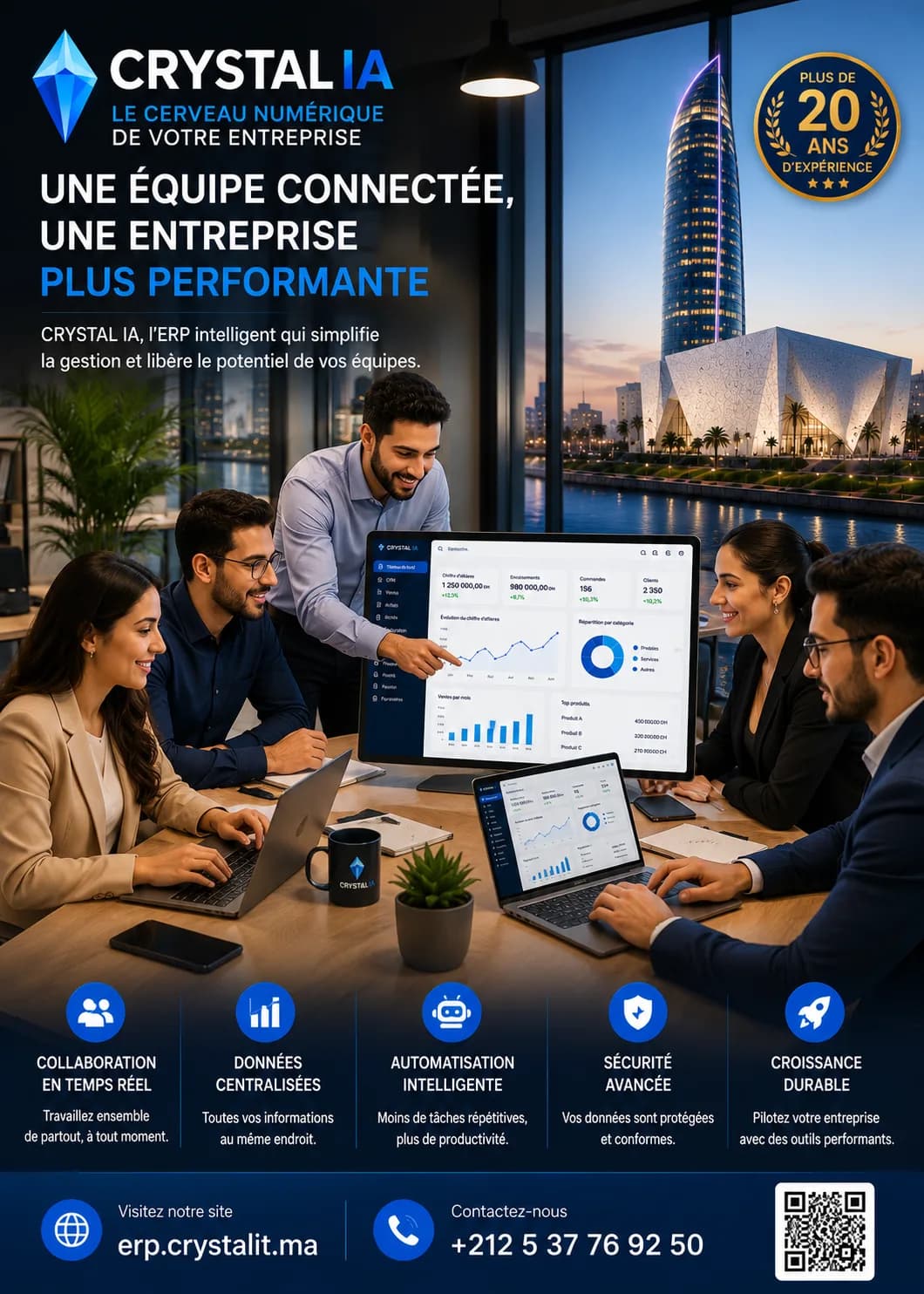
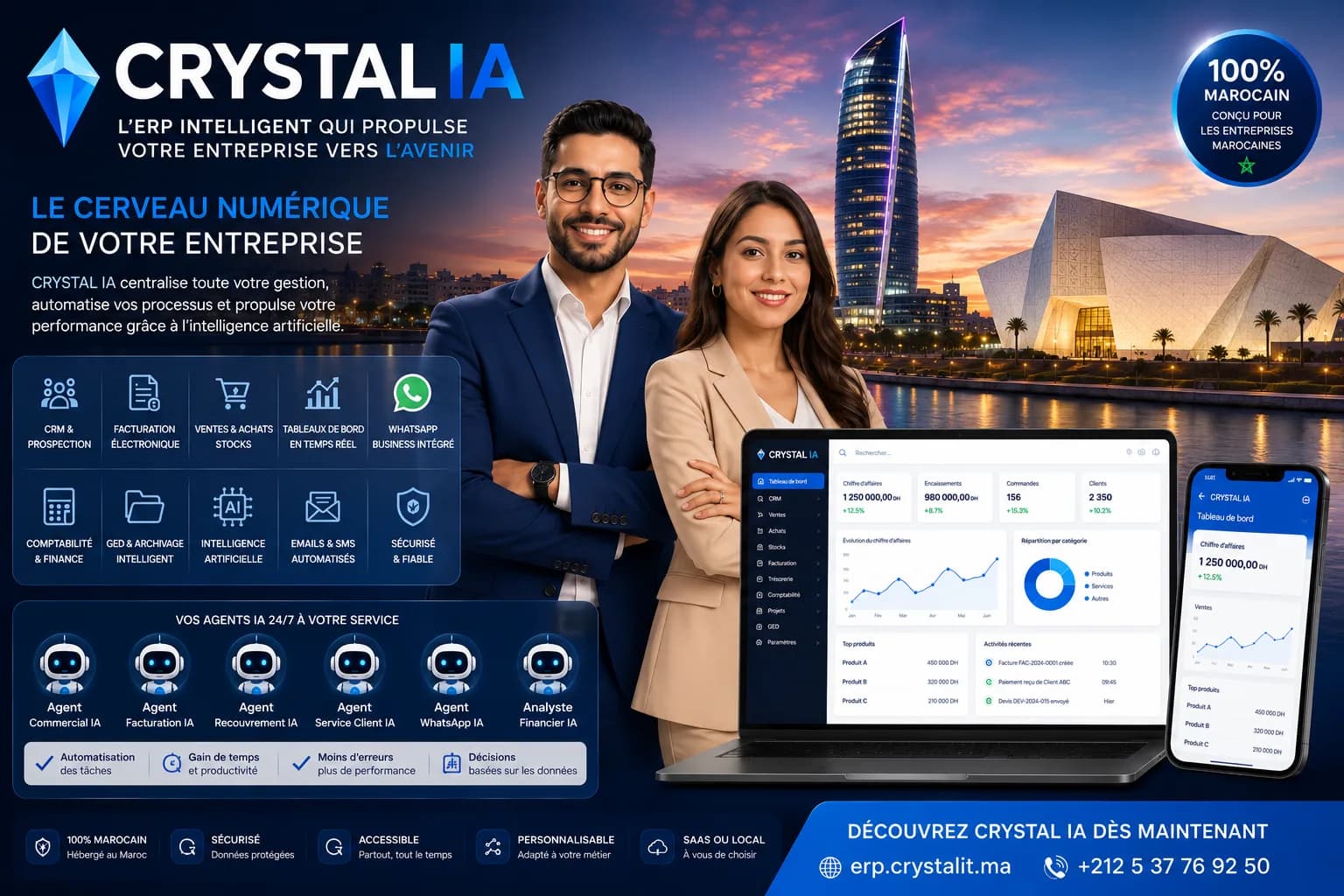
Crystal ERP (erp.crystalit.ma) is the SaaS ERP developed by CRYSTAL IT — a Moroccan publisher based in Rabat with more than 20 years of experience in management software for Moroccan companies — whose invoicing module checks each invoice's readiness (ICE, mandatory details, structure) and exports it in standard UBL 2.1 format. Transmission to the DGI's electronic invoicing platform will be added once its specification is published. Invoicing is integrated within the same platform as accounting, purchasing, sales and stock.
For SMEs wishing to go further in their document digitalisation — contracts, HR documents, purchase orders — Crystal ERP integrates with the electronic signature solutions available on the Moroccan market, enabling full document-cycle coverage from a single entry point. Regulatory updates (new DGI requirements, UBL format changes, CNSS and IGR rate modifications) are incorporated automatically in SaaS mode, without any action from your teams. For more on e-invoicing compliance, see our article on the UBL format (UBL 2.1 format for electronic invoicing in Morocco: complete guide) and our guide on preparing for e-invoicing (Preparing for mandatory e-invoicing).
Electronic signature in Morocco has had a solid legal framework since 2007 — Law 05-53 gives it full probative value — and use cases are now mature for SMEs: commercial contracts, HR documents, public tenders. Getting equipped does not require a complex project: an electronic certificate from BAM Certification, a suitable signing solution, and an ERP that structures your invoices are enough to cover the essentials. Crystal ERP (erp.crystalit.ma), developed by CRYSTAL IT — a Moroccan publisher based in Rabat for more than 20 years — is the platform that connects invoicing, accounting and document management in a single system, and will add transmission to the DGI platform once its specification is published. Contact the CRYSTAL IT team for a Crystal ERP demonstration tailored to your digitalisation roadmap and your preparation for the DGI reform.
The CRYSTAL IT solution on this topic
Have a project or a question? Let's talk with a CRYSTAL IT expert.
Request a demo