Wholesale pharmacy ordering is one of the cycles that most directly determines medicine availability in a Moroccan pharmacy. Between wholesaler shortages, variable delivery times, partial shipments and delivery notes to check line by line, supplying a pharmacy is far from simple: it is a precise sequence that starts with detecting a need, moves to preparing and sending the purchase order, then to controlled goods reception — with batch and expiry date verification — before ending with tracking pending partial deliveries and credit notes to claim. Without a structured tool, this cycle is managed through paper notes, scattered emails and spreadsheets: an organisation that struggles to cope with volume growth or the arrival of a new team member. Our Pharmacy module (Crystal Pharma, our pharmacy management software), developed by CRYSTAL IT in Rabat with over 20 years of experience serving Moroccan SMEs, covers this cycle end to end: an order proposal calculated on actual sales and available stock, a purchase order generated and sent to the wholesaler by email or WhatsApp directly from the software, scanner or CSV reception with batch and expiry control, tracking of pending partial deliveries and wholesaler credit notes. This guide explains each step and what a Moroccan pharmacy can expect from it — with particular attention to what Crystal Pharma handles and what it does not replace.
Wholesale pharmacy ordering: procurement challenges in a Moroccan pharmacy
The procurement cycle of a Moroccan pharmacy is constrained by factors that ordinary retail does not face. On one side, the nature of the products: medicines, some subject to prescription, to regulatory schedules and to batch management with expiry dates. On the other, the structure of the pharmaceutical wholesale market: several distributors with distinct catalogues, availability that varies from one supplier to another, and delivery times that determine how many days' stock the pharmacy must keep to avoid a stockout. Between the two, the pharmacy must navigate in real time: identify products at risk of running out, choose the right distributor, send the purchase order at the right moment, and receive deliveries rigorously to ensure every batch entered matches what was ordered.
In a pharmacy without a structured tool, this cycle typically relies on the memory of the responsible pharmacist or the most experienced assistant: the stockout is spotted when the counter can no longer serve the patient, the order is placed by phone or email, and the delivery is received by ticking the paper delivery note. This works up to a point — but it cannot cope with growth, absences or busy periods when several deliveries arrive on the same day. Wholesale order management software must automate need detection, structure purchase order dispatch and make reception reliable. For batch stock management and expiry tracking, which ties directly into delivery reception, see our dedicated article (Pharmacy Stock Management in Morocco).
- Several distributors with distinct catalogues: availability varies and the pharmacy may need to query multiple sources for a product.
- Variable delivery times: depending on the distributor and period, the lead time determines the minimum stock level required to avoid a stockout.
- Batch-by-batch reception: every delivered product must be entered with its batch number and expiry date to maintain traceability from the point of entry.
- Frequent partial deliveries: a wholesaler rarely delivers the full order in one shipment; the remaining quantity must stay visible.
- Credit notes to track: every return of an expired or damaged product generates a credit to claim, tracked separately from the rest of the order.
Preparing the order: configuring the catalogue and stock thresholds
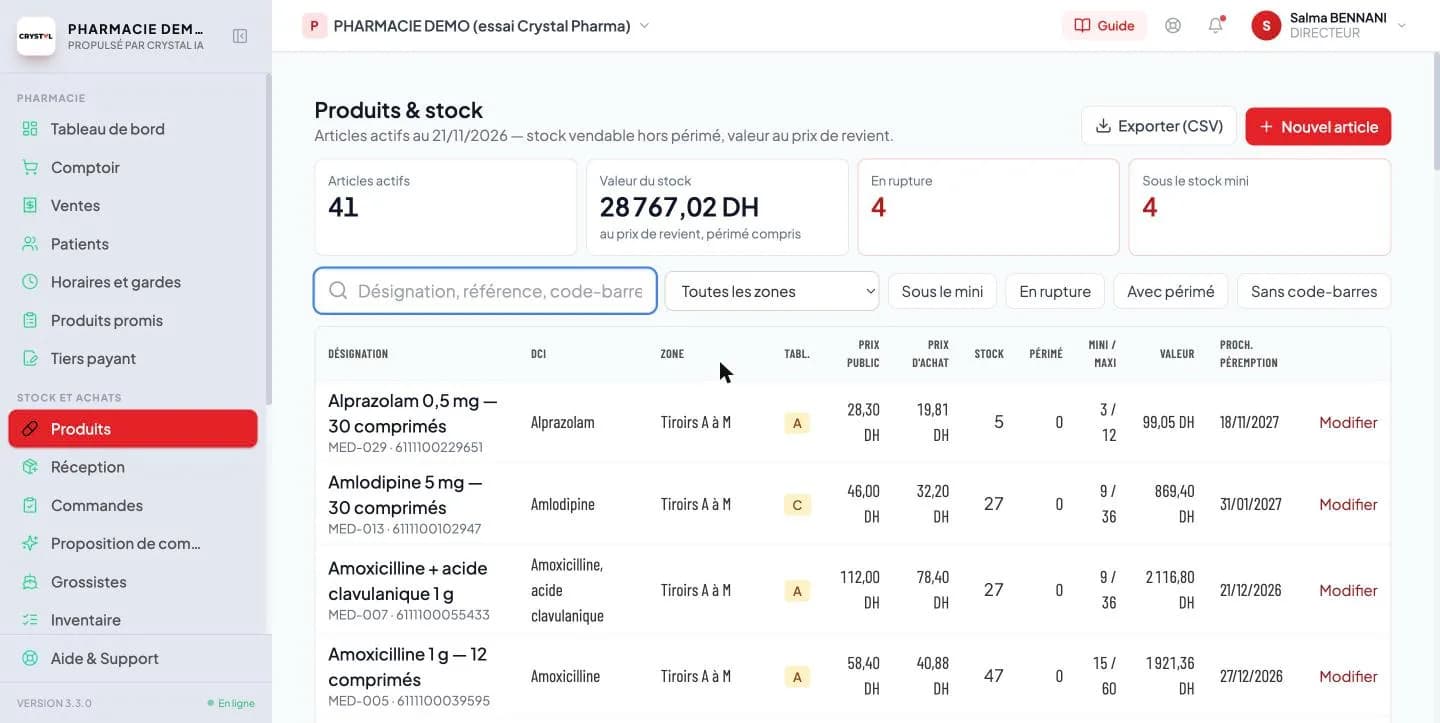
Preparing a wholesaler order begins well before opening the purchase order form. It relies on a structured catalogue: a minimum and a maximum stock level must be set for each reference. These two thresholds are the basis of the automatic order proposal calculation in Crystal Pharma: when the sellable stock of a reference — total stock minus expired or near-expiry batches — falls below the minimum, the reference appears as an alert and feeds the proposal. Without these parameters, the proposal stays empty or incomplete and the order must be built entirely by hand.
The Crystal Pharma catalogue allows each reference to be configured with its barcode (leading zeros preserved), storage zone, regulatory schedule, photo and min/max stock thresholds. Dedicated filters give an instant view of references on outage, below the minimum threshold or with a near-expiry batch — quick starting points for building the next order. The order proposal itself is calculated on several criteria: actual sales by period, sellable stock, orders already sent to wholesalers (to avoid ordering a reference already on its way) and products promised to patients. When a patient has requested an out-of-stock product, that need stays visible until it is fulfilled and feeds directly into the proposal.
- Min/max thresholds per reference: the basis of the automatic order proposal calculation in Crystal Pharma.
- Catalogue filters: outage, below minimum, with expired batch — instant view of purchasing priorities before placing the order.
- The proposal accounts for orders already sent: no double ordering on a reference already in transit.
- Products promised to patients feed the proposal: an unserved request stays visible until its fulfilment.
- CSV export of the catalogue and stock reports for handover to the accountant or external analysis.
Placing the purchase order and sending it to the wholesaler
In Crystal Pharma, the order proposal is a starting point, not an automatic action: it can be adjusted before being converted into a purchase order. The assistant or the responsible pharmacist can add references outside the proposal, modify quantities or remove products if delivery conditions or cash flow justify it. This flexibility is important: a proposal calculated on sales data cannot incorporate parameters such as seasonal preventive orders or wholesaler promotional offers, which only the pharmacist knows about.
Once the purchase order is confirmed in the software, it is sent to the wholesaler by email or WhatsApp directly from Crystal Pharma. There is no direct connection between the software and the distributors: no API, no EDI, no online interface with wholesaler catalogues. The order is sent as a message, and the distributor's reply — availability confirmation, delivery note, invoice — arrives through its own channels. This limitation is important to understand: Crystal Pharma structures and sends the purchase request, but it cannot check real-time availability at the distributor or automatically receive the order confirmation. For a full presentation of Crystal Pharma's functions and the cash management associated with purchases, see our guide on pharmacy management in Morocco (Choosing pharmacy management software in Morocco).
- The order proposal is adjustable before confirmation: quantities, additions, removals according to the pharmacy's context.
- The purchase order is sent to the wholesaler by email or WhatsApp directly from the software.
- No direct connection to distributors: no API, no EDI, no real-time catalogue querying.
- One purchase order per distributor: several wholesalers can be targeted from the same proposal.
- The sent order stays visible in the software until full reception or cancellation.
Receiving the delivery: scanner or CSV import
Goods reception is the most critical step in the procurement cycle: this is when batch numbers and expiry dates enter the system, and any input error propagates to the counter. In Crystal Pharma, two reception modes are available. The first is scanner entry, line by line: for each delivered product, the assistant scans the barcode, enters the quantity, batch number and expiry date. This approach suits routine deliveries and teams accustomed to working with a scanner. The second mode is CSV import of a delivery note using the Crystal template: the assistant receives the file from the wholesaler, imports it into the software and has a full preview before validating. In both cases, stock only updates on validation — a reception in progress does not affect stock levels visible at the counter.
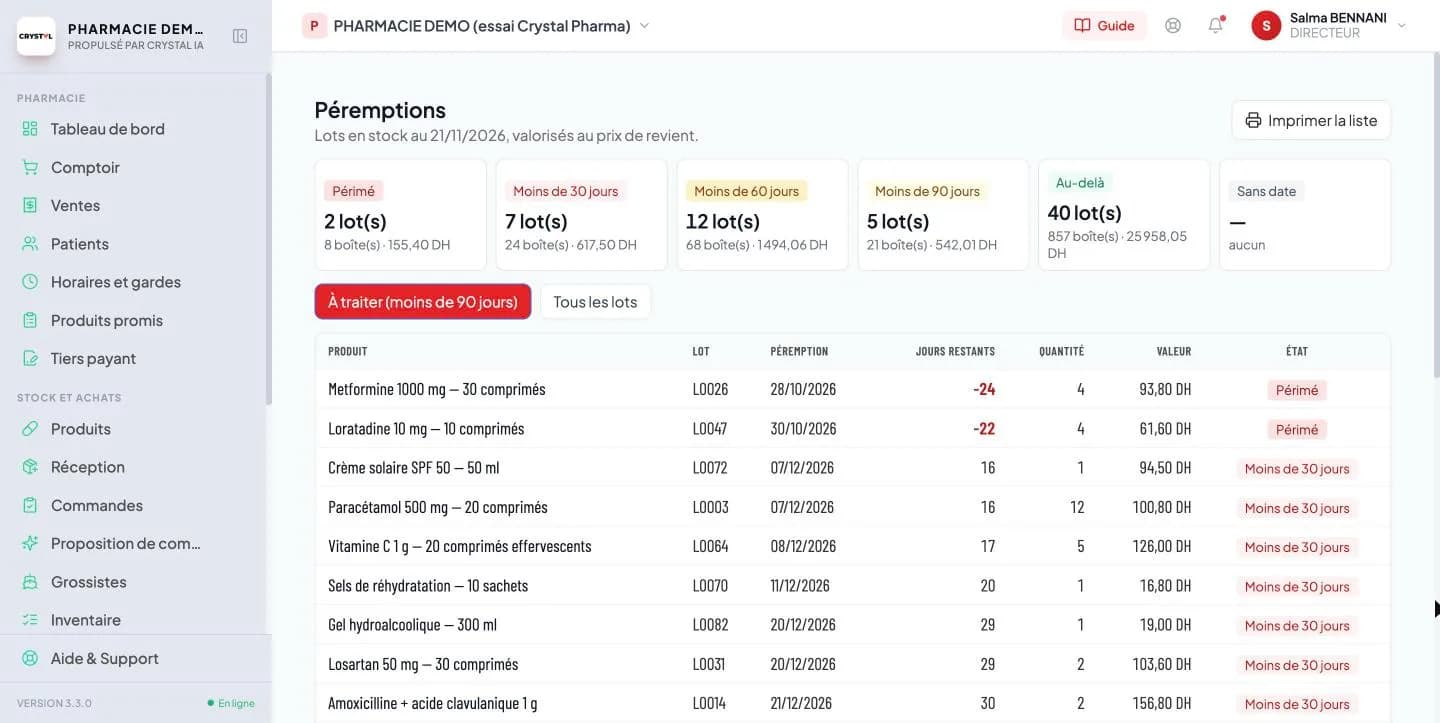
An automatic check is performed at reception: if a delivered batch has a past expiry date, the software rejects it. It is impossible to record a batch in stock if its date has passed — which prevents any expired product from entering the sales cycle. Reception can be carried out against the original order, allowing line-by-line verification that the delivered products match what was ordered. Any discrepancies — different product, lower quantity, missing reference — are visible at the point of entry. Crystal Pharma does not automatically read wholesaler delivery notes: manual scanner entry or CSV import remain the only two available input modes.
- Two reception modes: scanner entry line by line, or CSV delivery note import with preview before validation.
- Stock only updates on validation: no impact on counter-visible levels during entry.
- Automatic rejection of expired batches: impossible to record a batch whose date has passed.
- Reception against order: each delivered line is checked against what was ordered.
- No automatic reading of wholesaler delivery notes: scanner entry or CSV import only.
Partial deliveries, credit notes and inter-colleague exchanges
Complete deliveries in a single shipment are far from the norm in pharmaceutical distribution. A wholesaler often delivers part of the order, with the rest promised for the following day or week. Crystal Pharma handles this: the partial reception is recorded against the original order, and the remaining ordered quantity stays visible until full arrival or cancellation. This traceability prevents ordering a reference a second time after a partial delivery — or forgetting that a reference is still on its way when the next order proposal comes around.
After a reception, some products may be returned to the wholesaler: a batch already expired on delivery, a damaged product, a reference error. These returns generate a credit to claim from the distributor. Crystal Pharma allows these stock movements to be recorded with a reason (wholesaler return, destruction, breakage) and the expected credit to be tracked: total amount of the return, partial credits already received, balance still due. This tracking is purely internal — Crystal Pharma does not generate accounting entries, and the credit note summary is intended for the accountant. Inter-colleague exchanges — loans and borrowings of products between pharmacies — are part of the same tracking system: each loan or borrowing is recorded by batch, with a balance per colleague and movement traceability. Our Pharmacy module (Crystal Pharma, our pharmacy management software) brings all these functions together in an online software with no local installation.
- Partial reception against order: remaining ordered quantity stays visible until full delivery or cancellation.
- No duplicate ordering: a reference already partially received does not feed the next proposal for the received quantity.
- Stock exits with reason: wholesaler return, destruction, breakage — printable slip and credit to track.
- Wholesaler credit notes: amount expected, partial credits received, balance due — without generating accounting entries.
- Inter-colleague exchanges: loans and borrowings by batch, balance per colleague, movement traceability.
The procurement cycle of a Moroccan pharmacy — from detecting a need to tracking wholesaler credit notes, via the purchase order and controlled goods reception — is too critical to manage without a tool. An unanticipated stockout, a reception entered without a batch number, a credit note left untracked: every weak link in this cycle costs either lost availability or forgotten cash. Our Pharmacy module (Crystal Pharma, our pharmacy management software) covers this entire flow in an online software with no local installation: an order proposal calculated on real data, an order sent by email or WhatsApp, scanner or CSV reception with automatic rejection of expired batches, partial delivery tracking and wholesaler credit notes. Crystal Pharma has no direct connection to distributors: orders go out as messages, deliveries are entered manually — but the entire flow is tracked and managed in a single tool. CRYSTAL IT, based in Rabat with over 20 years of experience serving Moroccan SMEs, develops this module in a pilot phase with partner pharmacists. To see how it adapts to your pharmacy's organisation and your usual distributors, request a demonstration at (Crystal Pharma, our pharmacy management software).
The CRYSTAL IT solution on this topic
Have a project or a question? Let's talk with a CRYSTAL IT expert.
Request a demo