A group that opens or acquires a subsidiary in Morocco soon finds that its global ERP was not built for it. Statutory accounting under the Moroccan chart of accounts, mandatory invoice details (ICE, IF, itemised VAT), VAT returns filed through the SIMPL portal, CNSS social declarations, the dirham as the accounting currency and, now, the phased rollout of electronic invoicing announced by the DGI: these are local obligations a central template handles poorly, late or not at all. The usual outcome is a parallel spreadsheet kept by the local accountant, double entry and month-end closes that keep slipping. This guide is written for group CFOs, finance directors and IT managers at UK, US, European and Gulf groups. It sets out what a Moroccan subsidiary actually needs from its ERP software, compares three options — extending the group ERP, a local SaaS ERP such as Crystal ERP (Crystal ERP, the Moroccan sales management and ERP software) feeding group consolidation, or a custom build — and ends with a decision grid and an implementation plan.
Two sets of books, one system: Moroccan statutory accounting alongside group reporting
The first obstacle is accounting. The subsidiary must keep its books under the Moroccan chart of accounts, produce local financial statements and file its tax returns within that framework. The group, meanwhile, expects reporting in its own framework — IFRS, home-country GAAP or an in-house chart — on its own closing dates. A global ERP configured from headquarters usually imposes the group framework and pushes Moroccan statutory accounting into a period-end restatement, done outside the system by a local firm or the subsidiary's accountant. That restatement is hard to audit, depends on one or two people, and has to be repeated every month.
What the subsidiary needs is the reverse: books kept natively in the Moroccan chart of accounts, with a mapping table to the group's accounts, so that consolidated reporting is an automatic projection rather than manual work. Journals, general ledger and trial balance must come out in the format the Moroccan statutory auditor expects; the same entries, aggregated through the mapping table, feed consolidation. When this dual view is designed into the configuration from day one, the local close and the group submission stop being two competing projects — which is exactly what accounting software for a foreign company in Morocco should deliver.
- Books kept in the Moroccan chart of accounts, the subsidiary's legal framework.
- A mapping table to the group chart of accounts, maintained inside the ERP rather than in a spreadsheet.
- Local financial statements and the consolidation trial balance produced from the same entries.
- A closing calendar that respects both the Moroccan fiscal year and the group's reporting dates.
Invoices, VAT, CNSS and e-invoicing: the day-to-day Moroccan obligations
An invoice issued in Morocco must carry specific details: the ICE and tax identifier (IF) of both issuer and customer, VAT itemised by rate, sequential numbering and the usual legal mentions. A global ERP can print an invoice, but it will not always refuse an incomplete one under Moroccan rules. Crystal ERP checks these elements before issue, which avoids reissued invoices and deductibility disputes on the customer's side. Then come the VAT return, filed and paid online through the DGI's SIMPL portal, and the social declarations to the CNSS, which the local payroll function must produce every month from reliable headcount and pay data.
Electronic invoicing adds a deadline. The DGI has announced a phased rollout (Electronic invoicing in Morocco in 2026): 2026 for B2G transactions of large companies with turnover above 200 MDH (about 1,655 companies), 2027-2028 for SMEs and mid-caps, and after 2028 for very small businesses, with precise dates to be set by decree. The structured formats cited are UBL 2.1 and UN/CEFACT CII (UBL 2.1 format for electronic invoicing in Morocco: complete guide). The platform was developed by xHub for the DGI; its public name and technical specification are not yet published, and SIMPL is not that platform. Crystal ERP checks invoice readiness and exports standard UBL 2.1; transmission will be added once the specification is published. For official dates, refer to tax.gov.ma.
- Mandatory details (ICE, IF, VAT by rate, sequential numbering) checked before the invoice is issued.
- VAT return prepared for the SIMPL portal from the ERP's own entries.
- Payroll and headcount data ready for CNSS declarations.
- UBL 2.1 export ahead of Morocco e-invoicing; announced sanctions: tax penalties, rejected deductibility, prosecution in fraud cases.
Dirham, Office des Changes and trilingual teams: what headquarters underestimates
A Moroccan subsidiary keeps its accounts in dirhams. That sounds obvious, yet a global ERP configured in euros or dollars with the dirham as a "secondary currency" produces conversion differences that end up in suspense accounts. Intra-group flows — service recharges, royalties, dividend repatriation, shareholder loans — and invoicing in foreign currency follow the rules of the Office des Changes, Morocco's exchange-control authority. The ERP does not apply those rules for you, but it must let you document each flow, keep the supporting documents attached and retrieve them without delay when the bank or the administration asks for them.
The other underestimated point is language. On site, the accounting, sales and logistics teams work in French and Arabic; the group controller reads in English. An ERP whose screens, account labels and reports exist only in English slows local adoption; one available only in French denies headquarters a direct view. CRYSTAL IT's teams work in all three languages, and Morocco stays on GMT+1 all year, which puts Rabat in the same working day as London, Paris, Frankfurt or Dubai. That detail matters at close, when a question needs an answer within the hour rather than the next morning.
Three options: extend the group ERP, a Moroccan SaaS ERP, or a custom build
The first option is to roll out the group ERP in the subsidiary and add a Moroccan localisation layer: chart of accounts, invoice templates, tax reports. It guarantees uniform processes and immediate consolidation in the group's own framework. Its real cost lies in per-user licences, the localisation project itself — often handed to an integrator with little knowledge of Morocco — and dependence on headquarters' release calendar for every local regulatory change, from VAT rates to invoice mentions. For a subsidiary of a few dozen people, this option is frequently out of proportion to what is at stake.
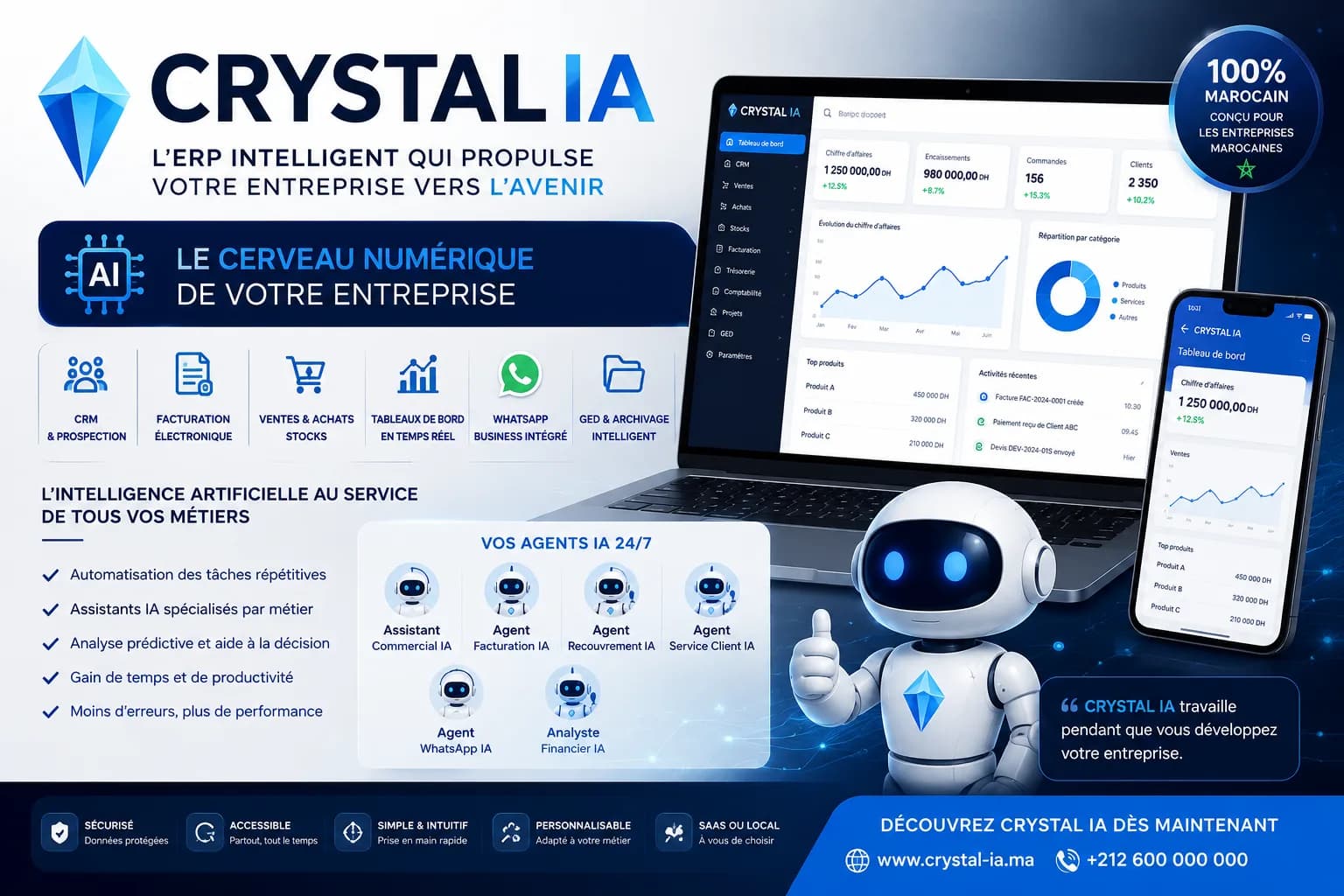
The second option is a Moroccan SaaS ERP, built for the local framework, that feeds group consolidation through CSV/Excel exports and a REST API. Crystal ERP (SaaS ERP: why Moroccan companies are moving to the cloud to run their…) covers quotes, orders, delivery notes, invoices, multi-warehouse stock, supplier purchasing, CRM, accounting under the Moroccan chart of accounts, cash flow and dashboards, with an AI assistant. The subsidiary works in business software that speaks its regulation, and headquarters receives structured data at the frequency it sets. The third option, a custom ERP (our ERP development service), is justified when the subsidiary's business — manufacturing, bonded logistics, contract outsourcing — imposes processes that no standard package reproduces faithfully.
- Extending the group ERP: uniform processes, but costly localisation that depends on headquarters.
- Moroccan SaaS ERP: native local compliance, group feed through exports and API, fast go-live.
- Custom ERP: fitted to a specific business, reserved for processes the standard does not cover.
- In all three cases, the account mapping table and master-data governance still have to be defined.
A decision grid for the group CFO
The choice is not made on licence price alone but on four criteria. The first is the subsidiary's size and autonomy: a production unit with several hundred employees embedded in the group's supply chain does not have the same needs as a sales entity or a shared-services centre. The second is the depth of integration expected: monthly consolidation of trial balances, or real-time interfacing of orders and stock with the group's plants. The third is headquarters' ability to maintain a Moroccan localisation over time, at every change in tax rules or invoice requirements.
The fourth criterion is timing. A subsidiary starting operations or changing its fiscal year has a natural window to switch; one already trading must plan data migration and a period of parallel running. We generally suggest reading the grid in this order: if the subsidiary is modest in size and headquarters needs only periodic consolidation, a local SaaS ERP connected through exports and API is the leanest choice; if operational integration with the group is daily, extending the global ERP becomes defensible; if the business is atypical, custom development is the answer. Our guide to choosing ERP software in Morocco (How to choose an ERP in Morocco: criteria, cost and mistakes to avoid) lists the questions to put to each vendor.
- Size and autonomy of the subsidiary: headcount, functions present on site, degree of local decision-making.
- Depth of integration: periodic consolidation of trial balances or real-time operational exchanges.
- Headquarters' capacity to carry the Moroccan localisation through every regulatory change.
- Cut-over window: incorporation, change of fiscal year, or takeover of an existing operation.
Implementation plan and support from Rabat
A rollout in a subsidiary follows four steps. First, account mapping: build the correspondence table between the Moroccan chart of accounts and the group chart, then validate it with the local chartered accountant and central controlling. Next, master data: customers with their ICE, suppliers, items, warehouses, VAT rates, document templates in French and Arabic. Then cut-over, ideally at the opening of a fiscal year, with opening balances loaded and a short period of parallel running to reconcile the two systems. Finally, on-site training in the users' language, and the exports to the group consolidation tool set up and tested.
CRYSTAL IT supports these projects from Rabat, where the company has published and developed software for more than twenty years. Exchanges with headquarters take place in English, workshops with the subsidiary in French or Arabic, and the GMT+1 time zone allows meetings within European and Gulf office hours. Groups that want to go further — specific interfaces, a supplier portal, automations — can draw on our nearshore development teams (our nearshore software development teams in Morocco). A single partner then covers the ERP, its interfaces and its regulatory updates, which simplifies project governance on the group side and avoids multiplying vendors.
A Moroccan subsidiary does not need a bigger ERP; it needs one that knows its framework: Moroccan chart of accounts, mandatory invoice details, VAT through SIMPL, CNSS, dirham accounting and, soon, electronic invoicing on the timetable the DGI will set. The group, for its part, needs reliable, structured data delivered on its dates. The two requirements reconcile when the local tool is designed to feed consolidation rather than replace it. If you are opening or reorganising a subsidiary in Morocco, our team in Rabat can review your situation in English and arrange a demonstration of Crystal ERP tailored to your group: contact us (contact us).
The CRYSTAL IT solution on this topic
Have a project or a question? Let's talk with a CRYSTAL IT expert.
Request a demo