Dental office management software in Morocco addresses a growing need among dental surgeons who juggle each day between demanding technical care, complex billing with CNOPS and AMO, and an administrative operation that is often under-equipped. In Rabat, Casablanca, Fès and Marrakech, most Moroccan dental practices still operate with a paper diary, handwritten patient cards and fully manual billing — a way of working that costs time, generates billing errors and compromises treatment follow-up. Dentistry is a specialty with its own specific constraints: a patient file that includes a complete dental chart and procedures per tooth, third-party billing specific to oral care under AMO, numerous and costly supplies (composite resins, anaesthetics, impression materials, sutures) requiring rigorous management, and equipment — chair, handpiece, dental unit — to maintain on strict schedules. Crystal ERP (erp.crystalit.ma), developed by CRYSTAL IT in Rabat with over 20 years of experience serving liberal professions and Moroccan SMEs, offers a modular platform adaptable to the specific needs of dental practices, from the smallest individual structures to multi-practitioner offices. This guide reviews what dental office management software must cover to meet Moroccan realities.
The Specific Challenges of Managing a Dental Practice in Morocco
A Moroccan dental practice faces management constraints that are its own, distinct from those of a general medicine practice. The first relates to the nature of care itself: in dentistry, each procedure is associated with a specific tooth and a specific fee code — scaling, root canal treatment, filling, extraction, crown fitting, orthodontic treatment. This level of granularity requires a structured patient file that goes well beyond a simple consultation notebook: it must include a digital dental chart, the treatment history per tooth, the results of panoramic X-rays and periapical films, the validated treatment plans and the procedures performed at each session. Without this tool, the dental surgeon operates without a reference from one session to the next, at risk of forgetting a treated tooth, repeating a diagnosis or losing time reconstructing the history with the patient.
The second difficulty is financial. Dental billing in Morocco combines two distinct regimes: procedures covered under the AMO basket that are reimbursable under third-party payment, and non-reimbursable procedures such as orthodontics or implants, billed freely. In a practice receiving 15 to 30 patients per day, this duality generates a daily administrative burden: distinguishing covered procedures, calculating the patient co-payment, preparing reimbursement files on time, chasing up paying bodies and managing outstanding receivables. Without a dedicated tool, errors accumulate and financial losses remain invisible. Add to this the management of costly supplies and specialised equipment, and you have a practice whose actual profitability is difficult to steer without appropriate software.
- No dental chart: without a digital chart, the treatment history per tooth cannot be reconstructed, with risks of clinical errors and wasted time at every session.
- Treatment plans not recorded: the absence of a formalised plan prevents tracking of stages and makes it impossible to hand over between practitioners in a multi-dentist practice.
- Dual billing not mastered: distinguishing AMO-reimbursable procedures from free-billed ones, calculating shares and manually tracking third-party files absorbs hours of administrative work.
- Supplies not tracked: resins, anaesthetics, impression materials, sutures — costly purchases whose actual consumption is rarely monitored, leading to shortages and emergency orders.
- Equipment maintenance not scheduled: handpiece, compressor, autoclave and X-ray unit require regular servicing; without planning, breakdowns occur during sessions.
Specialised Scheduling and Dental Patient Records: the Management Foundations
A dental practice's scheduling system has finer requirements than a general practitioner's. Each type of care requires a slot of varying duration: an initial assessment, a scaling session, a multi-session root canal treatment or an implant placement do not take the same operating time. Good dental practice software allows appointment types to be configured with standard durations, the schedule to be displayed as a column per chair in multi-unit practices, automatic reminders to be sent to patients by SMS or email, and confirmations and cancellations to be managed. This organisation reduces no-shows — unnotified absences — which in a dental practice represent 30 to 60-minute slots impossible to fill at short notice and directly damaging to revenue.
The dental patient record is the heart of the software. It centralises essential information: identity and healthcare coverage details, medical history (allergies, contraindications to anaesthetics, systemic conditions), a complete dental chart showing the status of each tooth (sound, filled, crowned, missing, implanted, to be treated), session history with procedures performed and materials used, X-rays and clinical images, and provisional treatment plans. This file serves both clinical quality — the practitioner instantly accesses the overall oral health status before each session — and continuity of care in practices where multiple dentists alternate on the same patients. See also our guide on general medical practice management (Medical Cabinet and Clinic Management Software in Morocco).
- Schedule by chair: in multi-unit practices, each chair has its own time column to optimise workstation occupancy.
- Appointment duration by procedure type: standard duration configuration per type of care — 30 min for a consultation, 45 min for scaling, 90 min for root canal treatment — without manual entry at each appointment.
- Automatic patient reminders: SMS or email sent 24 or 48 h before the appointment to reduce no-shows, with the option to confirm or cancel.
- Digital dental chart: graphical representation of the dentition showing each tooth's status — one click to view the treatment history of each dental unit.
- Formalised treatment plans: sequencing of stages, intervals between sessions, procedures planned for each visit — viewable and editable throughout treatment.
Dental Billing and AMO/CNOPS Third-Party Payment: Automate to Stop Losing Revenue
Dental billing in Morocco combines two distinct regimes depending on the type of care. Oral care procedures included in the AMO basket — consultations, scaling, extractions, basic conservative treatment — are reimbursable under third-party payment: the patient pays their share, and the practice submits a reimbursement file to CNOPS or the patient's AMO body to recover the covered portion. Non-reimbursable procedures — orthodontics, implants, custom prosthetics, cosmetic treatment — are billed freely at rates set by the practitioner. Dental practice management software must handle both regimes in parallel, automatically calculate the patient/body split for AMO procedures, and track reimbursement files until settled.
Management of reimbursement files is often the biggest source of financial losses in an unequipped dental practice: incomplete files, submission deadlines missed, follow-ups forgotten, rejections not actioned. Software with an integrated third-party tracking module displays the status of each file (submitted, pending, accepted, rejected, paid), triggers alerts on files with no response and allows follow-up in one click. Integrated accounting automatically records every receipt — the patient's co-payment in cash or by card, or a CNOPS bank transfer — and updates the cash position without re-entry. With the DGI electronic invoicing reform progressively applicable since 2026, practices that bill bodies or businesses in a B2B context must also anticipate issuing structured invoices in the required formats (Electronic invoicing in Morocco in 2026).
- Automatic AMO/patient split calculation: for each procedure in the care basket, the software instantly calculates the insured portion and the patient co-payment according to the coverage scheme.
- Third-party file dashboard: status of each file — submitted, pending, accepted, rejected, paid — with alerts on files exceeding the normal processing deadline.
- Free billing for non-reimbursable procedures: pricing customisable by procedure and by practitioner, with the option to schedule instalments and track deposits.
- Multi-mode receipts: cash, cheque, bank card and transfer — all recorded in the cash book and accounting automatically.
- Receivables management: list of outstanding balances with follow-up history and alerts on aged files, for actual collection of revenue.
Dental Supply Stock and Equipment Management
Dental supply management is a line item often poorly controlled, yet it represents between 7 and 12% of revenue in a mid-sized practice. Supplies — composite resins, impression materials, local anaesthetics, sutures, gloves, burs, polishing discs — have varying shelf lives, specific storage conditions and very different rotation rates from one product to another. Managing this stock manually inevitably leads to unexpected shortages mid-procedure, more costly emergency purchases and an overstated overall stock level that ties up cash. Dental software with an integrated stock module links each supply used during a session to the corresponding stock movement, and automatically triggers replenishment alerts when an item falls below its minimum threshold.
Dental equipment maintenance is another management dimension not to be neglected. A dental chair, handpiece, air compressor, autoclave or digital X-ray unit requires preventive maintenance at regular intervals — generally defined by the manufacturer. Management software can integrate a preventive maintenance module that schedules these interventions, records completed services and their costs, and alerts at upcoming deadlines. This planning reduces in-session breakdowns — particularly damaging in a dental practice where a faulty handpiece can immobilise an entire chair — and optimises maintenance costs over time. For best practices in stock management, see our dedicated guide (Inventory management software in Morocco).
- Supplies linked to procedures: each treatment recorded in the patient file automatically triggers the corresponding supply stock movement — no parallel manual entry.
- Replenishment alerts: automatic notification when an item falls below its order threshold — no more discovering a shortage mid-preparation.
- Expiry date management: preventive alert on anaesthetics, materials and resins approaching their use-by date, to avoid waste and incidents.
- Supply stock valuation: tracking the actual cost of materials per procedure to refine margin analysis by care type and optimise pricing.
- Equipment maintenance log: scheduling of periodic services, history of interventions and costs, alerts at upcoming deadlines.
Crystal ERP: the Management Solution for Moroccan Dental Practices
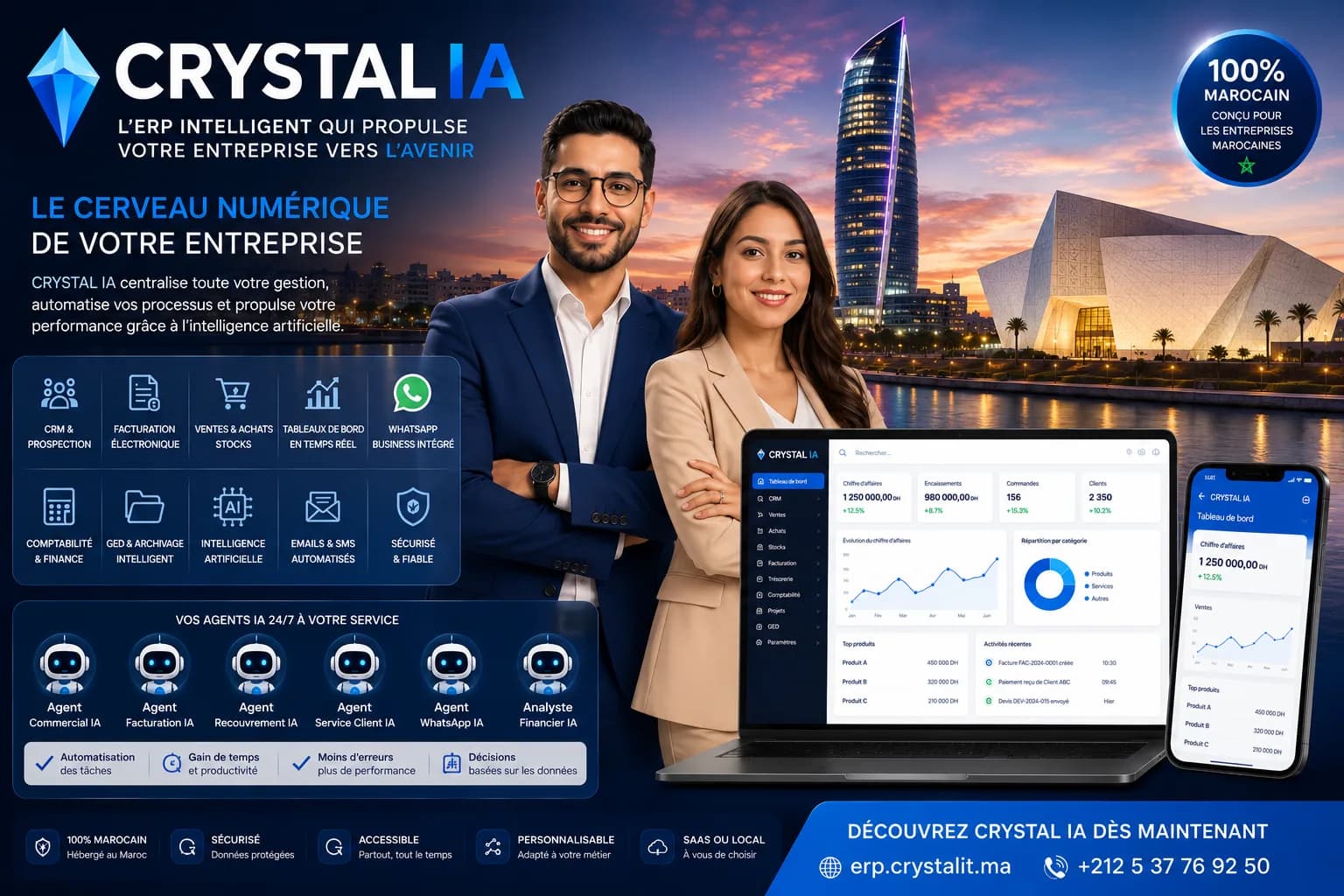
Crystal ERP (erp.crystalit.ma), developed by CRYSTAL IT in Rabat with over 20 years of experience serving liberal professions and Moroccan SMEs, offers a modular ERP platform adaptable to dental practices of any size. Its modules — scheduling and appointment management, patient records with dental chart, multi-regime billing, supply management, integrated accounting and cash management — operate as a unified system: each treatment recorded in the patient file simultaneously updates the invoice, the stock movement for supplies used and the accounting journal. For an individual dental practice, Crystal ERP can start with the scheduling and billing modules and later be extended with stock and accounting as the structure grows. For a multi-dentist practice with several chairs, Crystal ERP centralises schedules, shared patient records, billing by practitioner and analytical accounting by work unit.
Crystal ERP's SaaS architecture guarantees access to the patient file from the treatment room, the reception or remotely, without a local IT infrastructure to manage. Updates are automatic, backups daily and compliance with Law 09-08 on the protection of personal data assured. For practices also wishing to integrate full accounting management, Crystal ERP covers general accounting, cash management and the balance sheet (Accounting software in Morocco). The specialist configuration — dental procedure nomenclatures, digital dental chart, AMO/CNOPS fee codes for oral care — is set up in collaboration with the CRYSTAL IT team during initial implementation, so the software matches the practice's actual workflows from day one.
- Specialist dental configuration: procedure nomenclature, digital dental chart, treatment plans and AMO/CNOPS fee codes pre-configured for dentistry.
- Scalable modular platform: start with scheduling and billing, add stock and accounting as the practice grows.
- Multi-practitioner and multi-chair: each dentist has their individual schedule; patient records are shared and role-secured.
- SaaS accessible anywhere: access from the treatment chair, reception or a mobile device — no local installation and daily backups.
- CRYSTAL IT support: initial setup, team training and ongoing support from Rabat by a team that knows the Moroccan regulatory context.
Managing a dental practice in Morocco without dedicated software means accepting approximate AMO billing, fragmented patient records and supplies ordered blindly. Dental office management software brings together in one flow the specialised scheduling system, the patient records with dental chart, AMO/CNOPS third-party billing and supply management — four dimensions that neither a spreadsheet nor a generic application can cover coherently. Crystal ERP (erp.crystalit.ma), developed by CRYSTAL IT in Rabat with over 20 years of experience serving Moroccan liberal professions, tailors its modular platform to the specific constraints of dentistry. Contact the CRYSTAL IT team for a Crystal ERP demonstration configured for your dental practice and your organisation.
The CRYSTAL IT solution on this topic
Have a project or a question? Let's talk with a CRYSTAL IT expert.
Request a demo