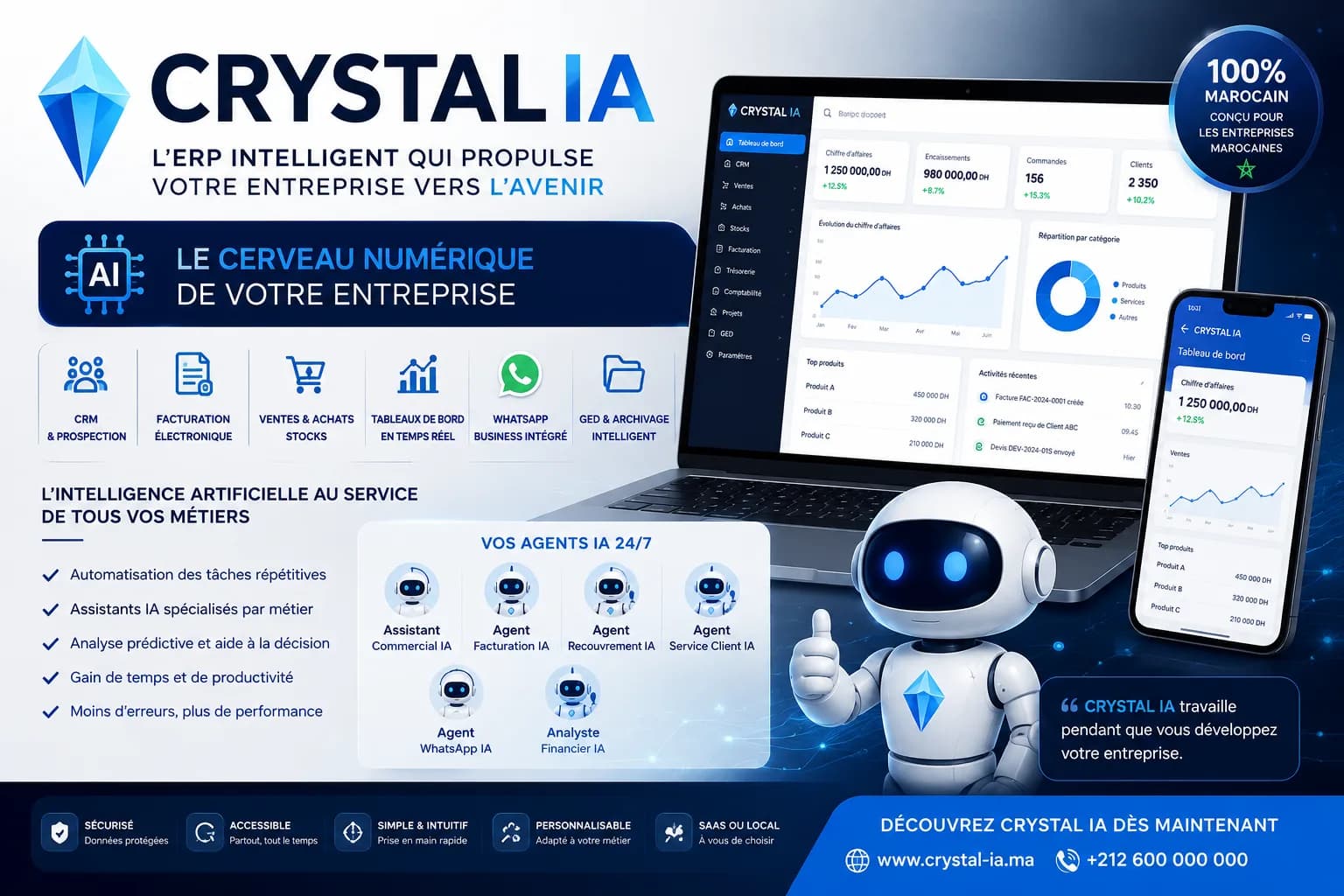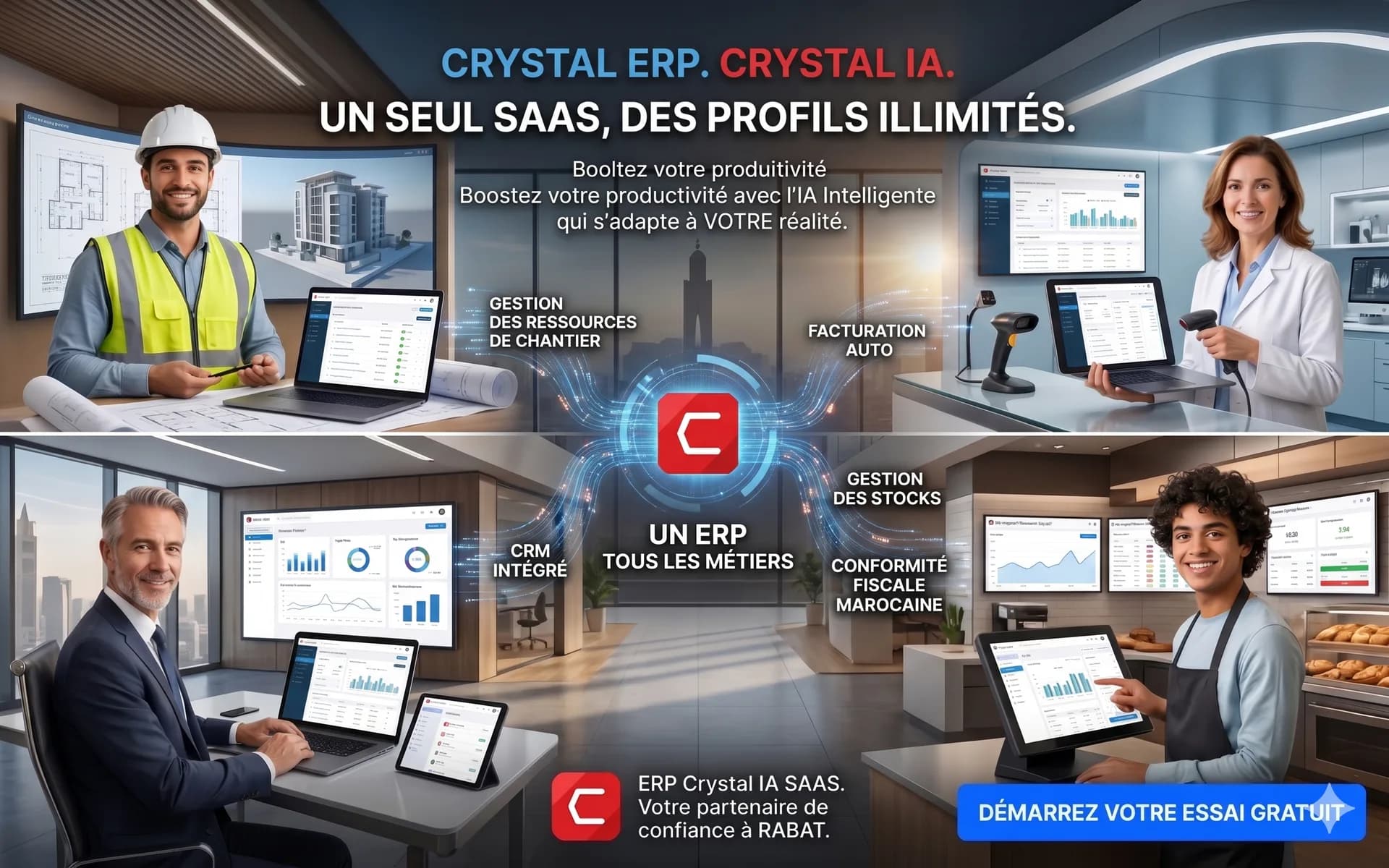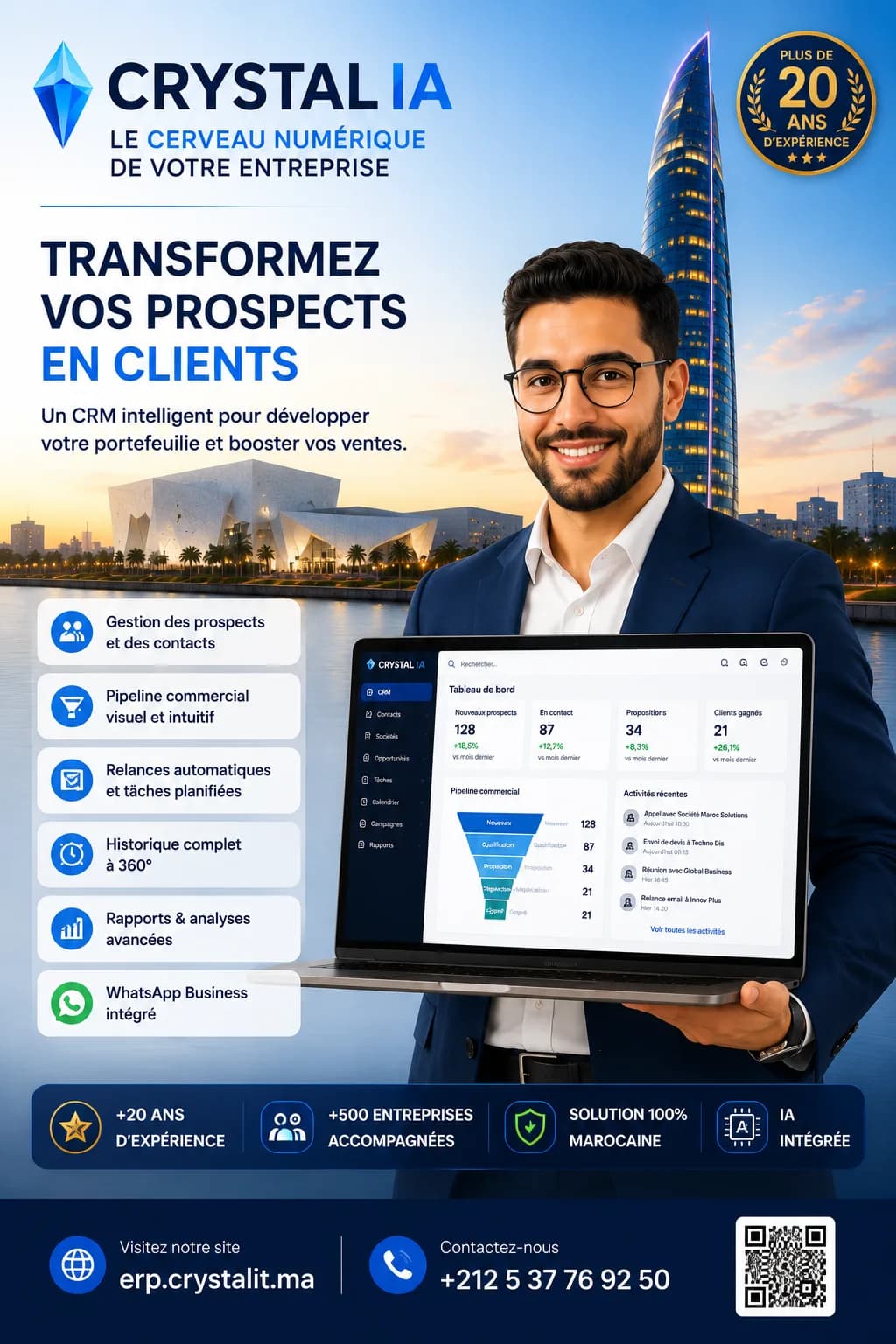
Morocco's economic fabric is full of "groups" that do not see themselves as such: a founder created a second company for a new activity, a third with a partner for a project, a warehouse opened in Casablanca then another in Tangier — and ten years later, the whole forms a small de facto group, managed as a sum of isolated businesses. Each company has its own software or spreadsheets, its customer files that partially overlap its neighbour's, its accounting sometimes with a different fiduciary; sales between group companies are laboriously re-invoiced, stock is transferred on handwritten notes, and nobody can produce an overall view without a weekend of consolidation in Excel. A multi-company, multi-site ERP solves this problem by construction: shared master data, rigorously separated accounting, tooled inter-company flows and consolidated steering in real time. This guide details what to expect from it and how to put it in place, with the approach of Crystal ERP (erp.crystalit.ma), developed by CRYSTAL IT in Rabat.
The daily life of SME groups: a sum of isolated businesses
The multiplication of structures answers legitimate logic: separating risks between activities, partnering on a specific project, housing real estate separately, seizing an opportunity under a new brand. But management rarely follows: each company inherits its own tools, and legal boundaries become information boundaries. The symptoms are always the same: a customer served by two group companies is known twice, with two balances and two histories nobody reconciles; a product sold by both is coded differently here and there; prices and discounts diverge for no reason; and the director, who steers the whole, never sees the whole.
The most visible cost is consolidation time — rebuilding a group view every month from heterogeneous exports. The most serious cost is invisible: decisions taken company by company that contradict each other at group level. Buying from a supplier at the rate negotiated by one company while the other pays full price; leaving one warehouse overstocked while the other is out of stock on the same reference; granting credit to a customer already behind on payments at the sister company. None of these problems is inevitable: they all stem from the fragmentation of information, and disappear when management is unified.
- Legal boundaries turned into information boundaries: each company lives in its own tools.
- Customers and products coded differently from one company to another: reconciliation impossible, duplicates guaranteed.
- Credit granted to a customer already defaulting at the sister company: the invisible risk of fragmentation.
- Supplier terms not pooled: the group buys less well than its size would allow.
- The overall view rebuilt by hand every month — when it is rebuilt at all.
Multi-company: shared master data, separate accounting
The principle of a multi-company ERP fits in one formula: share what benefits from being shared, separate what must be separated. What is shared is the master data — a single customer file where each partner is known once with its consolidated position across the group, a common product catalogue with homogeneous coding, pooled supplier terms, single users who navigate from one company to another according to their rights. What is rigorously separated is everything legal and fiscal: each company keeps its own accounting, its continuous and distinct invoice numbering, its VAT returns, its financial years, its journals and its financial statements — exactly as if it were alone, because in the eyes of the law, it is.
This separation is non-negotiable and becomes even more structuring with the DGI's electronic invoicing: each entity invoices under its own identifiers (ICE, tax ID), with its own series, and transmits its own flows to the administration's platform (Electronic invoicing in Morocco in 2026). A multi-company ERP worthy of the name guarantees this watertightness by construction: it is impossible to book an expense of company A in the accounts of company B, every document carries the full legal identity of its issuer, and access controls follow the same partitioning. That is the whole difference from the common makeshift — a single database where everything mixes, or several databases with no link — which accumulates the drawbacks of both worlds (How to choose an ERP in Morocco: criteria, cost and mistakes to avoid).
- Shared: customers, products, price lists, supplier terms, users — one single truth for the whole group.
- Separate: accounting, invoice numbering, tax returns, financial years — each company is legally on its own.
- Electronic invoicing per entity: each company transmits its flows under its own ICE and its own series.
- Watertightness guaranteed by construction: no entry can cross the boundary between two companies.
- Consolidated customer position: a partner's balance and risk are read at group level.
Inter-company flows: re-invoicing and transfers without friction
As soon as a group exists, flows run through it: the trading company buys and resells to the distribution company, the holding re-invoices management services or rent, one company helps the other out with goods. Handled manually, these inter-company flows are an inexhaustible source of friction: forgotten or late re-invoicing, transfer prices inconsistent from one month to the next, reciprocal balances that never reconcile — and inter-company current accounts the chartered accountant untangles at year-end.
A multi-company ERP tools these flows: a transfer from company A to company B is entered once and produces the two symmetrical movements — the sale at one, the purchase at the other — with transfer prices defined in advance in dedicated price grids, and reciprocal accounts that reconcile naturally since they arise from the same operation. Recurring re-invoicing — rents, head-office services, staff made available — is scheduled and executed every month without omission. The result: inter-company relations kept clean as you go, documented by genuine compliant invoices, which is also a requirement of tax regularity — transactions between related companies must be invoiced and justified like any others.
Multi-site: warehouses, stock transfers and a consolidated view
The multi-site dimension arises in the same terms, within one company or across the group: several warehouses, shops or branches each holding stock. Without a suitable tool, each site becomes an island — overstock here, stock-outs there, transfers on handwritten notes nobody values, inventories impossible to consolidate. A multi-site ERP keeps one stock per warehouse in real time: every sale, receipt or transfer updates the site concerned, availability can be consulted across all sites, and a salesperson in Casablanca sees that three units remain in Tangier before turning down a sale (Inventory management software in Morocco).
Inter-site transfers become traced operations: request, dispatch, receipt, with in-transit stock visible between the two — no more goods "somewhere between the warehouses". Replenishment is steered per site, with thresholds specific to each location, and inventories are carried out site by site without stopping the others. For distribution and wholesale businesses, this mechanism is the heart of the trade, and extends to rounds and deliveries (Distribution and Wholesale Management Software in Morocco). On the steering side, each site naturally becomes an analytical section: revenue, margin and expenses per location, to know what each site really contributes (Cost Accounting for Moroccan SMEs).
- One stock per warehouse in real time, availability consultable across all sites.
- Traced transfers with in-transit stock: no more goods "between two warehouses".
- Replenishment thresholds specific to each site — a coastal warehouse does not live like an inland one.
- Inventories per site, without stopping the activity of the other locations.
- Each site as an analytical section: the real contribution of each location, in figures.
Access rights, consolidation and group steering
Unifying management immediately raises the question of rights: not everyone should see everything. A serious multi-company ERP manages permissions along two crossed dimensions — who accesses which company, and who does what in each. Company A's accountant sees only its accounts; the Tangier warehouse manager moves only his stock; the sales director sees both companies' sales but not payroll; the director and the CFO see everything. These rules are defined by profiles, can be audited — who did what, when — and protect internal confidentiality as much as customers' personal data within the meaning of Law 09-08 (Cybersecurity and law 09-08).
Then comes the reward for the whole: consolidated steering. Because the master data is common and the data homogeneous, the group view is no longer a weekend of Excel but a permanent dashboard: revenue, margins, cash and receivables per company and cumulatively, valued stock per site, consolidated customer and supplier positions (Business dashboard in Morocco: managing your company in real time). With CRYSTAL IA integrated into Crystal ERP, this consolidation can be queried in natural language — "the group's revenue this month, by company" — and the director regains over his whole group the same immediacy a shopkeeper has over his shop. It is the logical culmination: legally distinct companies, unified management information (Crystal ERP).
Managing an SME group as a sum of isolated businesses costs dearly in consolidation time, in terms not pooled, in undetected risks and in contradictory decisions. A multi-company, multi-site ERP reverses the logic: master data — customers, products, suppliers — becomes common, each entity's accounting and tax obligations remain rigorously watertight, inter-company flows and transfers between warehouses are tooled and traced, and consolidated steering stops being a monthly exercise to become a permanent state. Crystal ERP (erp.crystalit.ma), developed by CRYSTAL IT in Rabat with more than 20 years of experience serving Moroccan companies, carries this architecture natively — and CRYSTAL IA makes it queryable in one question, from a site's margin to a customer's balance across the whole group. If your "de facto group" is still managed company by company, contact the CRYSTAL IT team to draw the target: what is shared, what is separated, and the path to get there.
Have a project or a question? Let's talk with a CRYSTAL IT expert.
Request a demo