Fixed asset management in Morocco is one of the most sensitive accounting and financial challenges for SMEs: every acquired asset — land, building, vehicle, machine, IT equipment — must be registered, depreciated according to Moroccan tax and accounting rules, and eventually disposed of. Poorly managed, this process generates depreciation errors that distort net profit, ghost assets that nobody can physically locate, and risks during DGI tax audits. In practice, many Moroccan SMEs still manage their fixed assets in Excel spreadsheets: an acquisitions table, a manual depreciation calculation at year-end, a physical inventory conducted sporadically before audits. This approach becomes unmanageable as the asset pool grows, multiple sites are involved, or depreciation rules change. A fixed asset management solution integrated with an ERP automates the entire asset lifecycle: from initial registration, linked to the purchase order or supplier invoice, to automatic calculation of depreciation allowances each month or quarter, through to inventory disposal in the event of sale, scrapping or theft. This guide explains what such software must cover for a Moroccan SME, how the depreciation methods applicable in Morocco are handled, and how Crystal ERP (erp.crystalit.ma), developed by CRYSTAL IT in Rabat with over 20 years of software publishing experience, simplifies this process within an integrated ERP workflow.
Challenges of Fixed Asset Management in Moroccan SMEs
The first difficulty is maintaining the fixed asset register. This mandatory document must record every asset with its acquisition date, original cost, depreciation method, net book value (NBV) at each close and any disposal date. Maintained in a spreadsheet, this register quickly falls out of sync with the general ledger: depreciation is booked in the accounts but the per-asset breakdown is not updated, or vice versa. This discrepancy creates errors in financial statements and difficulties during audits or tax inspections.
The second difficulty is fiscal depreciation. In Morocco, the General Tax Code sets regulated depreciation rates based on asset type: 4% for commercial buildings, 20–25% for plant and equipment, 25% for IT equipment, 20–25% for vehicles. These rates must be applied correctly to calculate the deductible charge and avoid DGI tax adjustments. A spreadsheet does not automatically verify that the right rate is applied to the right asset type, or that time-apportionment was respected on mid-year acquisitions or disposals.
- Outdated fixed asset register: assets purchased but not recorded, disposals not removed, incorrect net book values.
- Incorrect depreciation: inappropriate rates, forgotten time-apportionment on acquisitions or disposals mid-year.
- Ghost assets: fixed assets still on the books but physically untraceable for years.
- Disconnect between accounts and register: booked depreciation does not match the sum of per-asset depreciation.
- No consolidated view for SMEs with multiple sites or entities.
Depreciation Methods Applicable in Morocco
In Morocco, two depreciation methods are recognised by the General Tax Code (CGI) and the Moroccan General Chart of Accounts (PCGM). The straight-line method applies a fixed rate each year to the asset's gross value: it is the most common method for buildings, equipment and furniture. The declining-balance method (fiscal accelerated) applies a progressively decreasing rate to the residual value, with a multiplier coefficient of 1.5, 2 or 3 depending on the asset's useful life. It allows more depreciation to be charged in the early years, accelerating the tax deduction and improving cash flow in the years immediately following the investment.
The choice of method is made at acquisition and cannot be changed during the asset's useful life. It is therefore essential that the fixed asset management software records the chosen method per asset and automatically calculates the annual allowance while respecting time-apportionment rules: an asset acquired or disposed of mid-year is only depreciated for the fraction of the year elapsed since its acquisition or until its disposal date.
- Straight-line method: fixed rate applied to the original cost, the same amount each year until fully depreciated.
- Declining-balance method: variable rate applied to the residual value, with a tax coefficient of 1.5, 2 or 3 depending on useful life.
- Mandatory time-apportionment: any asset acquired or disposed of during the financial year is only depreciated for the actual period.
- Component accounting (IFRS): for subsidiaries of international groups, complex assets may be broken down into components depreciated separately.
- Exceptional or accelerated depreciation: certain specific investments (industrial upgrading, R&D) may benefit from accelerated depreciation under specific tax provisions.
The Fixed Asset Lifecycle in an ERP
A fixed asset management solution integrated with an ERP covers the entire asset lifecycle in four key steps. The first is acquisition: as soon as a supplier invoice is validated and posted, the ERP automatically creates the corresponding fixed asset card with the entry cost, acquisition date, asset category and applicable depreciation method. This direct link between accounts payable and the fixed asset register eliminates registration oversights and duplicate entries. For more on purchasing management, see our dedicated guide (Purchase management software in Morocco).
The second step is the asset's active life: each month or quarter, the ERP automatically calculates the depreciation allowance according to the chosen method and posts the corresponding accounting entries, with no manual intervention. The net book value of each asset is updated in real time. The third step is revaluation or transfer: if an asset is revalued or moved between sites, the ERP handles these events without breaking the audit trail. Finally, asset disposal — sale, scrapping or theft — automatically generates the disposal accounting entries, including calculation of the gain or loss on disposal, and simultaneously updates the register and ledger. For more on integrated accounting, see our guide (Accounting software in Morocco).
- Complete asset card: reference, description, supplier, entry date, original cost, location, depreciation method and rate.
- Automatic depreciation calculation: no manual depreciation entry — the ERP calculates and posts allowances periodically.
- Revision management: changes to useful life or residual value with a complete history audit trail.
- Disposal and scrapping: automatic disposal entries (gain or loss on disposal), simultaneous update of the register and ledger.
- Cost-centre allocation: each asset is linked to the department or site that uses it for accurate analytical reporting.
Physical Asset Inventory: Automated Reconciliation
Physical inventory of fixed assets is an accounting obligation: it involves physically locating all company assets to verify they match those recorded in the accounting register. For many Moroccan SMEs, this exercise is dreaded because it means reconciling two lists that nobody has synchronised for years: the fixed asset register on one side, the assets physically present at each site on the other. The usual result: a list of ghost assets (on the books but untraceable) and orphan assets (present but not recorded).
A fixed asset management solution simplifies this inventory through asset tagging — barcodes, QR codes or RFID tags generated from the ERP — and a mobile inventory app: a technician scans each asset in the field, the app locates it in the register and flags discrepancies in real time. This automated reconciliation significantly reduces the time spent on inventory and limits human errors. Identified discrepancies are resolved through a corrective posting plan directly in the ERP, without re-entry. For more on inventory and asset management, see our guide (Inventory management software in Morocco).
- Asset tagging: barcodes, QR codes or RFID tags generated from the ERP for each fixed asset.
- Mobile inventory app: field scanning and asset recognition with no paper or re-entry.
- Automated reconciliation: instant comparison between the register and physical inventory, with a list of discrepancies.
- Correction plan: direct creation of missing asset cards or disposal records for untraceable assets.
- Configurable frequency: rolling inventory by asset category or annual global inventory, schedulable from the ERP.
Reporting and Strategic Decisions on the Asset Portfolio
Fixed asset management goes beyond accounting and tax compliance: it feeds important strategic decisions for Moroccan SME managers. What is the age profile of the machinery fleet? Which assets need replacing within the next two years? What impact will these future investments have on the budget and cash flow? To these questions, the fixed asset dashboard provides a consolidated view that neither a spreadsheet nor standalone accounting can offer. For more on overall financial management, see our dashboard guide (Business dashboard in Morocco: managing your company in real time) and our budget management guide (Budget Management Software for SMEs in Morocco).
Effective fixed asset reporting must at minimum cover: the total gross and net book value of the asset base, by category, by site and by department; the forward depreciation schedule for future years, useful for budgeting upcoming allowances; the average obsolescence rate of the fleet, an ageing indicator that signals when to invest; and the list of fully depreciated assets still in service, candidates for disposal or revaluation.
- Fixed asset dashboard: gross value, net book value and accumulated depreciation by category and by site.
- Forward depreciation schedule: projected depreciation charge over N years for budget planning.
- Fleet obsolescence rate: ageing indicator showing the average depreciation level to anticipate renewal needs.
- Fully depreciated assets still in service: list for decision on disposal, revaluation or accounting extension.
- Fixed asset tax report: deductible allowances per financial year, forming the basis of the fixed assets tax return.
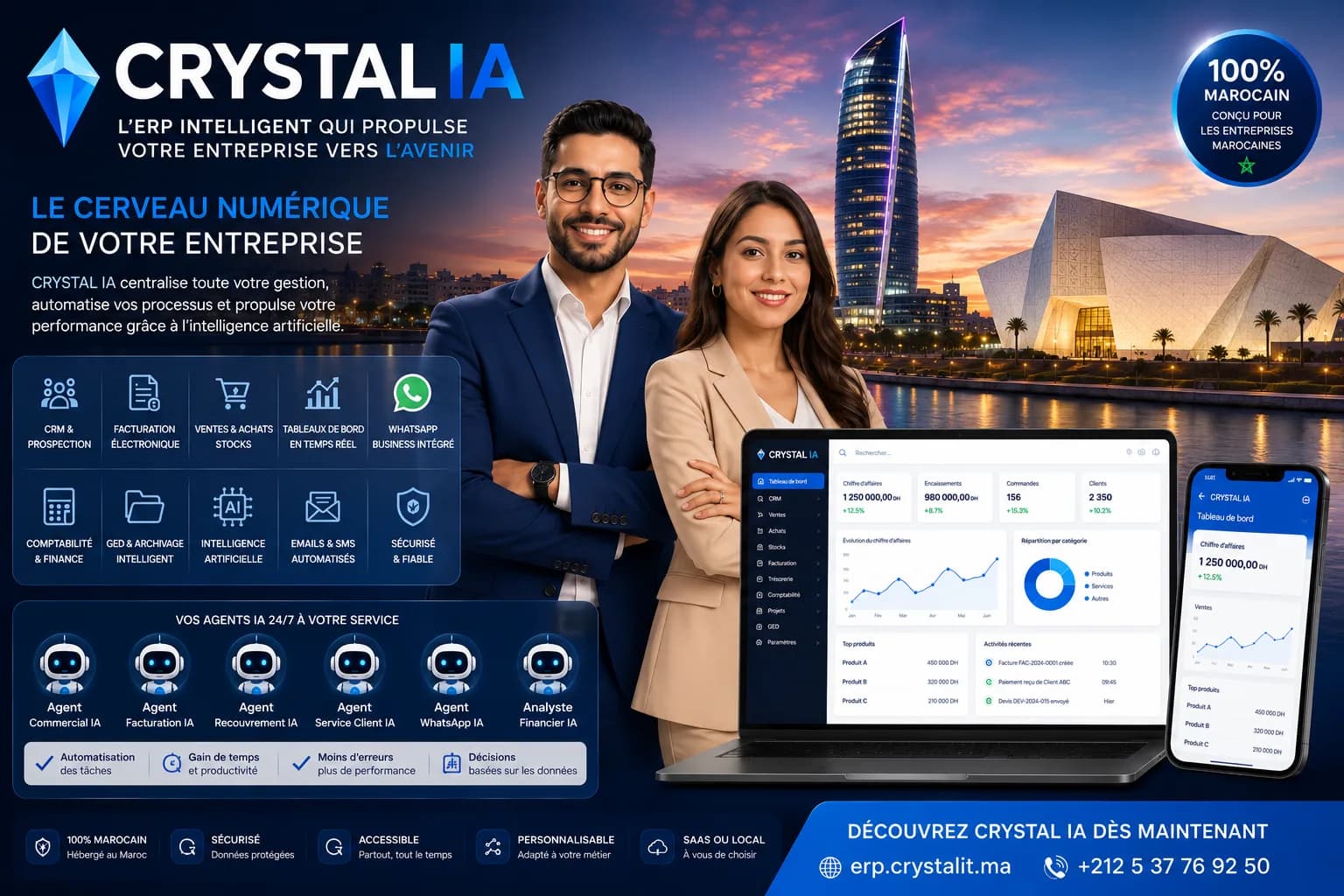
Fixed asset management in a Moroccan SME is far more than an accounting obligation: it is a pillar of financial tracking and a strategic decision-making tool. Automating depreciation calculations, synchronising the asset register with the general ledger, and planning fleet renewals is exactly what a fixed asset management solution integrated with an ERP makes possible — without administrative overload. Crystal ERP (erp.crystalit.ma), developed by CRYSTAL IT in Rabat with over 20 years of experience publishing management software for Moroccan companies, integrates fixed asset management into the same workflow as general accounting, purchasing, treasury and financial reporting. Every acquisition automatically generates the asset card, every depreciation allowance is posted without manual intervention, and every renewal decision is informed by reliable data. Contact the CRYSTAL IT team for a Crystal ERP demonstration tailored to the size of your asset base and your Moroccan tax and accounting obligations.
The CRYSTAL IT solution on this topic
Have a project or a question? Let's talk with a CRYSTAL IT expert.
Request a demo