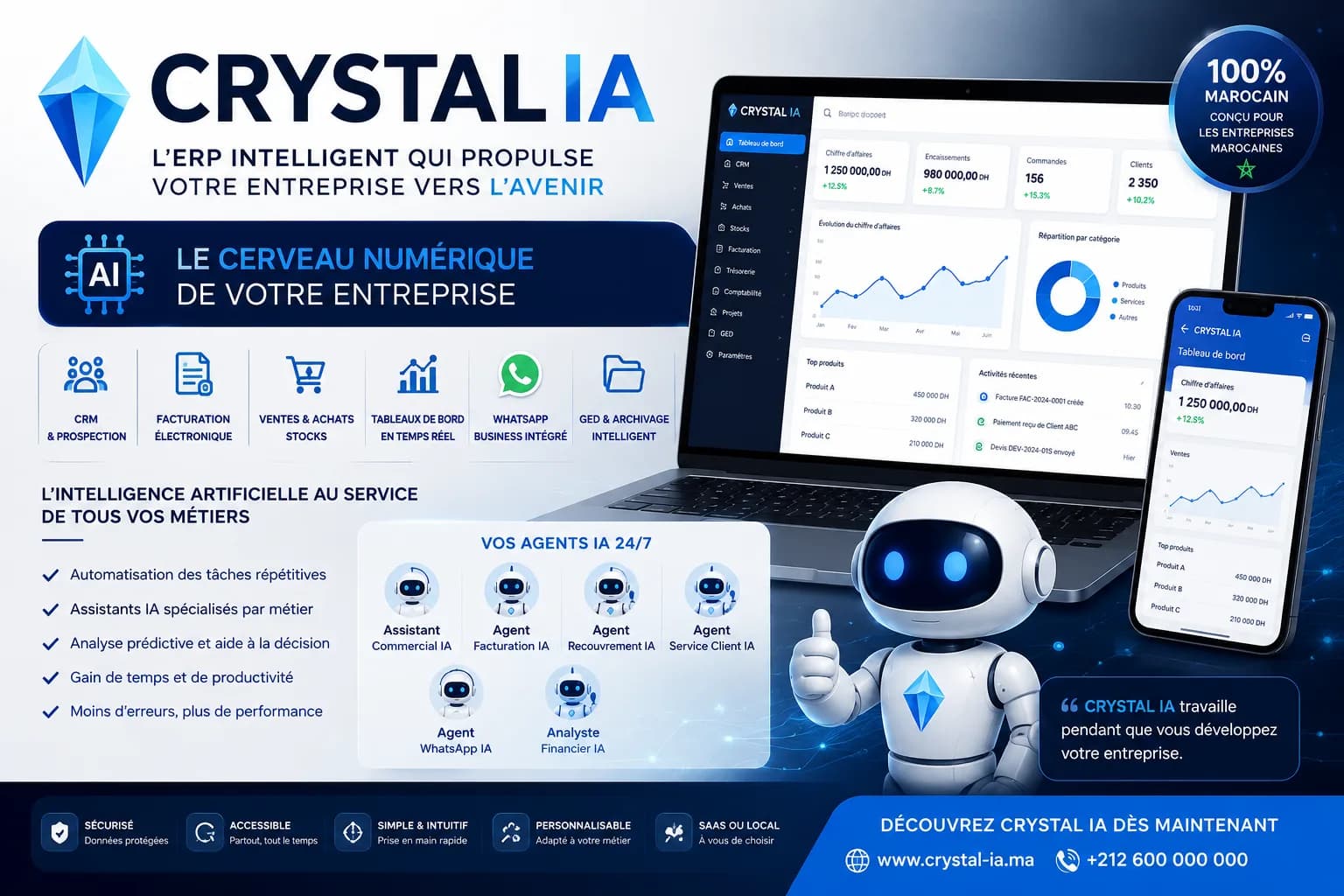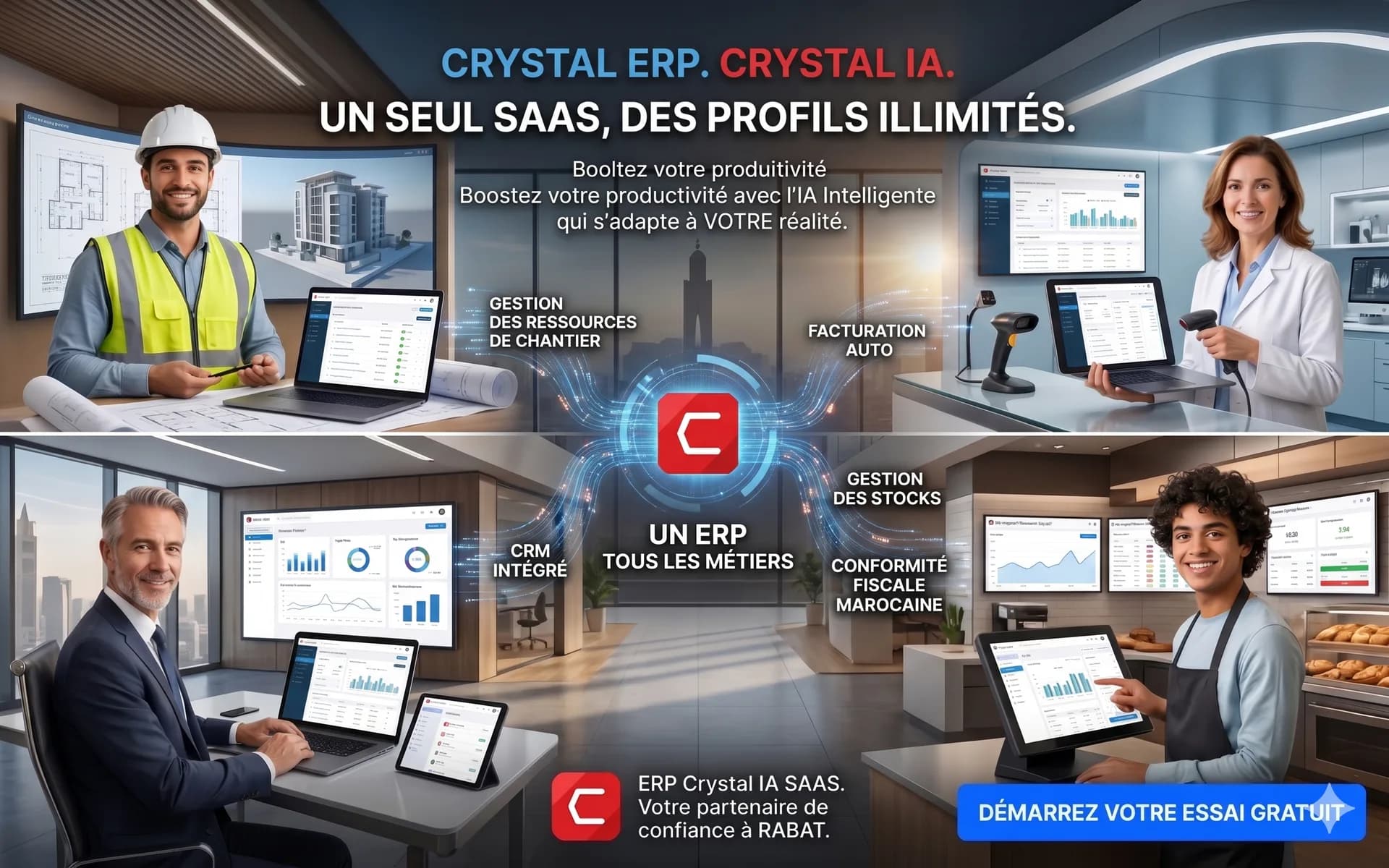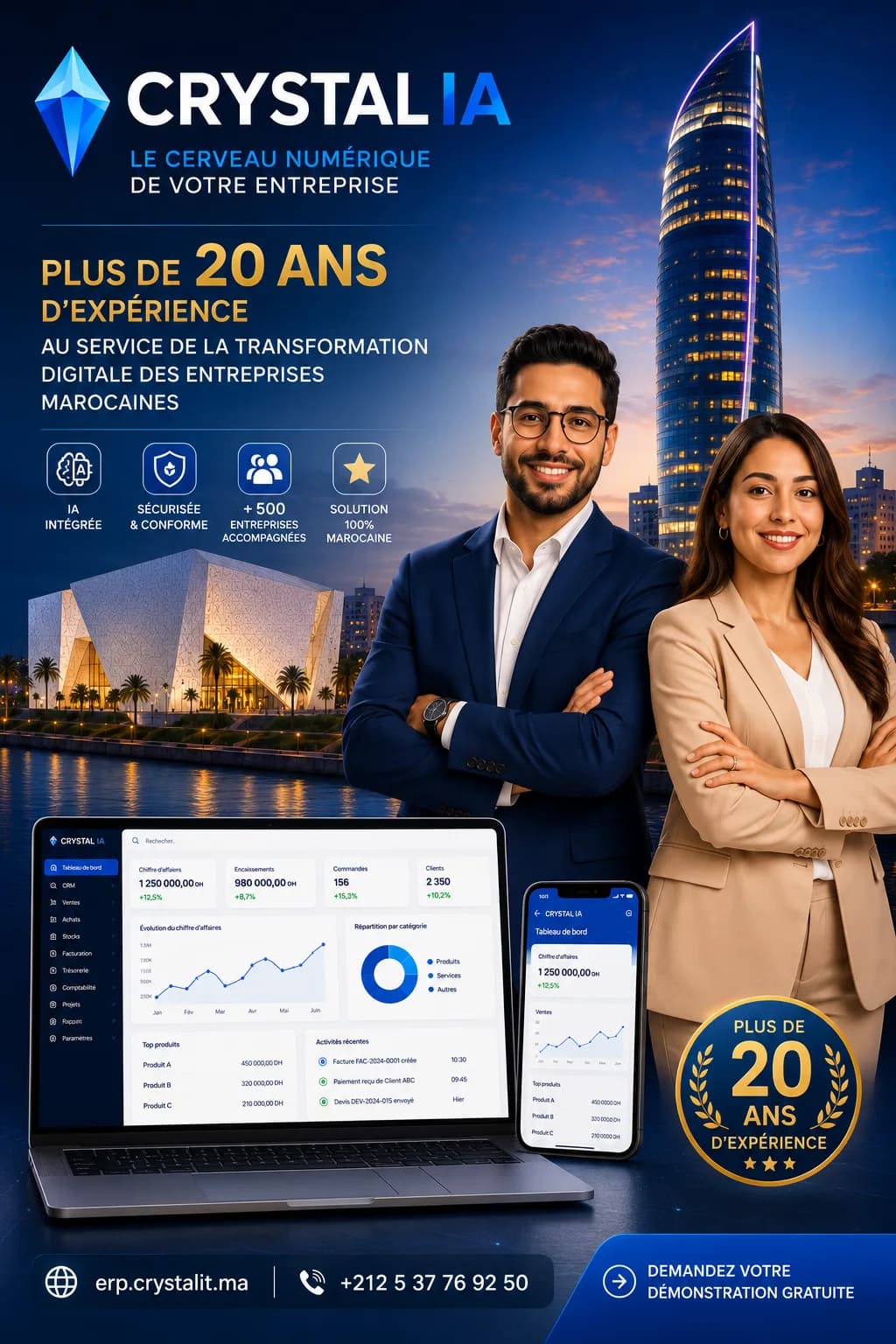
Moroccan companies that import or export goods face a layer of management complexity that generic tools simply do not cover: supplier orders denominated in euros, dollars or yuan, supply lead times stretching over several weeks through multiple logistics intermediaries, customs formalities to prepare for every shipment, import duties and taxes to integrate into the true cost price, and export invoices to issue in the currency and under the Incoterms negotiated with the foreign buyer. Managing all of this in disconnected spreadsheets or unintegrated software means losing visibility over real costs, accumulating errors in customs declarations and missing negotiation opportunities with suppliers. An import/export management solution integrated within an ERP connects these flows into a coherent system: the purchase cost in foreign currency is converted at the applicable exchange rate, import duties and transit costs are included in each article's cost price, logistics documents are generated from validated purchase orders, and export invoices comply with the international buyer's requirements. Crystal ERP (erp.crystalit.ma), developed by CRYSTAL IT in Rabat with more than 20 years of experience serving Moroccan companies, provides an ERP suite that covers the needs of import/export companies — from international supplier orders to foreign-currency customer invoicing, through inventory management and multi-currency accounting. This guide details what a software solution must cover to support a Moroccan import/export company in 2026, and how to choose it.
The specific challenges of import/export management for Moroccan SMEs
International trade exposes Moroccan companies to a layer of complexity absent from purely domestic flows. An importer must track long and variable supply lead times: an order placed with an Asian supplier can take 45 to 90 days from confirmation to warehouse receipt, with intermediate steps (production, pre-shipment inspection, sea freight, customs clearance in Casablanca or Tangier Med) whose visibility is fragmented if the ERP is not designed to integrate them. Meanwhile, the company must manage its cash flow between supplier advance payments (often 30% on opening the LC or at order) and the recovery of VAT on imports, without accounting discrepancies between the foreign-currency liability and its dirham coverage.
Exporters face different challenges: issuing pro forma and commercial invoices in foreign currencies, managing international payment terms (documentary letters of credit, SWIFT transfers at maturity), verifying that export documents (packing list, certificate of origin, EUR1, phytosanitary certificate depending on the product) match exactly the foreign buyer's order, and recovering VAT on zero-rated exports. Without appropriate software, each shipment becomes a manual coordination exercise between the sales team, accountant, freight forwarder and warehouse.
- Long and opaque supply lead times: orders placed weeks in advance with no real-time visibility on progress (production, loading, customs clearance).
- Complex cash management: supplier advances, VAT recovery on imports, timing gap between foreign-currency payment and dirham receipts.
- Multiple export documents: commercial invoice, packing list, certificate of origin, customs documents — any error blocks the shipment or delays payment.
- Understated true cost price: if customs duties, transit fees and logistics costs are not integrated into stock, reported margins do not reflect reality.
- Regulatory compliance: foreign exchange controls with the Office des Changes, DGI and customs declaration obligations, export VAT exemption — each flow has its own specific treatment.
Multi-currency management: tracking orders in euros, dollars and yuan
Multi-currency management is the first prerequisite of import/export software. A supplier order denominated in US dollars must be recorded at its USD amount, then converted into dirhams at the current or hedge rate to feed Moroccan accounting. This dual display — transaction currency and MAD equivalent — is not merely convenient: it is an accounting requirement. The company must be able to record exchange differences between the order date, the letter of credit opening date, the receipt date and the final settlement date — each step potentially reflecting a different rate, with a direct impact on the actual margin of the transaction.
A suitable ERP handles several currencies simultaneously (EUR, USD, CNY, GBP, AED…), updates rates manually or via a rate feed, and automatically calculates realised and unrealised exchange gains and losses. Stock valuation in dirhams is recalculated at each receipt based on the rate applied to the purchase order, ensuring that the weighted average cost (PRMP) of each article reflects the true cost in local currency. Crystal ERP (erp.crystalit.ma) incorporates this native multi-currency engine, with automatic posting of exchange differences to the appropriate accounting journals — no manual year-end adjustments required.
- Orders in foreign currency: recorded in the supplier's currency (USD, EUR, CNY…) with automatic conversion to MAD at the configured or daily rate.
- Automatic exchange differences: calculation and posting of exchange gains and losses between the order date and the settlement date — no manual adjustments.
- Stock valued in MAD: the cost price of each imported article incorporates the exchange rate applied to the purchase order, import duties and ancillary costs.
- Simultaneous multi-currency management: the company can manage USD purchases, EUR export sales and MAD accounting in the same system without juggling files.
- Exchange rate history: the rate applied to each transaction is archived and accessible for accounting review or audit — complete traceability.
International supplier orders: from pro forma to goods receipt
The international purchasing cycle differs significantly from the domestic cycle in terms of duration, the number of parties involved and document complexity. Appropriate software must manage the entire chain from the internal purchase request to warehouse entry, encompassing the foreign-currency purchase order, order status tracking (placed, in production, shipped, in transit, under customs clearance, delivered), advance payment and bank guarantee management, partial receipt (when the order arrives in several batches), and reconciliation between the final supplier invoice and the original order.
Lead-time management is particularly critical. The ERP must allow procurement lead times to be defined by supplier and product family, plan orders in anticipation of requirements (net requirement calculation based on available stock, open orders and sales forecasts), and alert when an order is behind schedule relative to the confirmed delivery date. Crystal ERP (erp.crystalit.ma) also manages commercial terms by international supplier: negotiated prices in currency, volume discounts, payment terms, applicable Incoterms (FOB, CIF, EXW…), with a history of past conditions for annual renegotiations. For a deeper look at purchasing management, see our dedicated guide (Purchase management software in Morocco).
- Purchase order in foreign currency: generated in the supplier's currency and Incoterms, with automatic calculation of the CIF or DAP cost in dirhams.
- Order status tracking: configurable milestones (confirmed, in production, shipped, in transit, cleared, delivered) with estimated dates and delay alerts.
- Partial receipts: deliveries in several batches are reconciled with the original order — stock updated at each partial receipt, outstanding backorder visible.
- Supplier invoice reconciliation: the discrepancy between the final invoice and the purchase order is automatically flagged — approval or dispute before posting.
- Supplier terms history: prices in currency, discounts, lead times and Incoterms archived by supplier — a database for future renegotiations.
Customs documents and logistics: automating import formalities
Importing into Morocco goes through customs formalities managed by the Administration des Douanes et Impôts Indirects (ADII), with a mandatory set of documents: single goods declaration (DUM), supplier commercial invoice, packing list, bill of lading or airway bill, insurance certificate, and certificate of origin where applicable. The slightest inconsistency between these documents (quantity, value, goods description) can hold the cargo at the border and generate demurrage charges or penalties. For products subject to import licences or technical standards (food products, medical devices, electronics), additional documents are required (health certificates, laboratory test results, IMANOR conformity).
A well-designed import/export management solution generates shipping and customs documents directly from the data of the validated supplier purchase order: first the pro forma invoice (to trigger payment or LC opening), then the final commercial invoice and packing list once the order is ready to ship. This automatic generation from a single data source eliminates transcription errors — the leading cause of customs clearance delays. Crystal ERP (erp.crystalit.ma) includes customisable import/export document templates, adapted to the requirements of Moroccan operators. For aspects of stock management that follow goods receipt, see our guide (Inventory management software in Morocco).
- Automatic generation from the order: pro forma invoice, commercial invoice, packing list and delivery note produced from the same data source — consistency guaranteed.
- Import licence tracking: management of products requiring prior authorisation, with alerts when licences expire before a planned order.
- Customs duties integrated into cost price: duties calculated at clearance (MFN or preferential rate under an agreement) are allocated to the landed cost of goods entering stock.
- Ancillary import costs: transit, handling, insurance, inspection — all integrated into the final cost price for a margin calculated on true cost, not just the FOB price.
- Document archiving: all documents from every import transaction archived digitally and attached to the order — instantly retrievable in the event of an ADII inspection.
Export invoicing and international compliance
Moroccan exporters must issue commercial invoices in foreign currencies, often in formats required by the buyer or by the documentary rules of a letter of credit. The invoice must state the Incoterms, the currency, the place of delivery, the LC number where applicable, and sometimes specific particulars for certain countries (buyer's tax registration number, preferential certificate of origin EUR1 or Form A). Any error or omission in these details can lead the bank or the importing country's customs authority to reject the document, blocking payment.
On the Moroccan tax side, exports are in principle VAT-exempt: the exporter does not charge VAT on the sale, but can recover the VAT paid on domestic purchases related to the production or trading of the exported goods. This recovery is made through a specific declaration and may result in a refund from the DGI within the regulatory timeframe. Crystal ERP (erp.crystalit.ma) natively handles these flows: generation of export invoices in the buyer's currency, tagging of export sales with the appropriate VAT exemption code, tracking of export customer receivables by payment status (letter of credit, SWIFT transfer), and VAT statements distinguishing taxable domestic sales from zero-rated export sales. For more on invoicing and its legal obligations in Morocco, see our guide (Invoicing software in Morocco: preparing for DGI electronic invoicing).
- Export invoice in foreign currency: issued in the buyer's currency (EUR, USD…) with Incoterms, LC number and all particulars required by the importing country.
- Export VAT exemption: export sales are automatically tagged as exempt in Crystal ERP, with separation of taxable and exempt flows in monthly VAT returns.
- Letter of credit management: tracking of maturity dates, alerts for documents to be presented to the bank, reconciliation of LC terms with the issued invoice.
- Export customer receivables: tracking of foreign-currency collections, automatic reminders under international payment terms, history of received SWIFT payments.
- Export VAT refund: summary of recoverable VAT on purchases linked to export sales, ready for the DGI refund application.
Crystal ERP: the integrated solution for import/export companies in Morocco
Crystal ERP (erp.crystalit.ma) is the SaaS ERP developed by CRYSTAL IT — a publisher based in Rabat with more than 20 years of experience in management software for Moroccan companies — that centralises all management flows for an import/export company in a single system: international supplier purchases in foreign currency, inventory management with valuation at full cost price, export sales and invoicing in foreign currency, multi-currency accounting with exchange difference management, and real-time cash flow. The benefit of this integration is data consistency: the cost price of an imported article — calculated from the purchase price in currency, the exchange rate, import duties and logistics costs — is identical in the stock module, the accounting module and the margin dashboard. There is no manual reconciliation between a sales management application, a purchasing spreadsheet and a separately maintained set of accounts.
The integrated ERP also allows cash flow to be anticipated on international flows: upcoming supplier payments (advances, balances at shipment or receipt), expected export customer receipts (SWIFT transfers, LC realisations), and foreign exchange obligations to report to the Office des Changes — all visible in the cash management module. For companies that also print supplier payment cheques, Easy Print (easyprint.crystalit.ma) is available free of charge. For a broader perspective on purchasing management (Purchase management software in Morocco), inventory management (Inventory management software in Morocco), accounting (Accounting software in Morocco) and cash flow (Cash Flow Management for Moroccan SMEs), Crystal ERP covers all these modules in a single platform.
Digitising the import/export management of a Moroccan SME means choosing an ERP that understands the specifics of these flows: multi-currency with exchange difference management, long-cycle supplier orders with logistics milestone tracking, integration of customs costs into stock cost prices, export invoicing in foreign currency with VAT exemption, and cash flow projected over international flows. Crystal ERP (erp.crystalit.ma), developed by CRYSTAL IT in Rabat with more than 20 years of experience serving Moroccan companies, covers this entire scope in an integrated SaaS solution — from international supplier purchasing (Purchase management software in Morocco) to multi-currency accounting (Accounting software in Morocco), through inventory management (Inventory management software in Morocco) and cash flow management (Cash Flow Management for Moroccan SMEs). For printing supplier payment cheques, Easy Print (easyprint.crystalit.ma) is available free of charge. Contact the CRYSTAL IT team for a Crystal ERP demonstration tailored to your import/export operations and your industry.
Have a project or a question? Let's talk with a CRYSTAL IT expert.
Request a demo