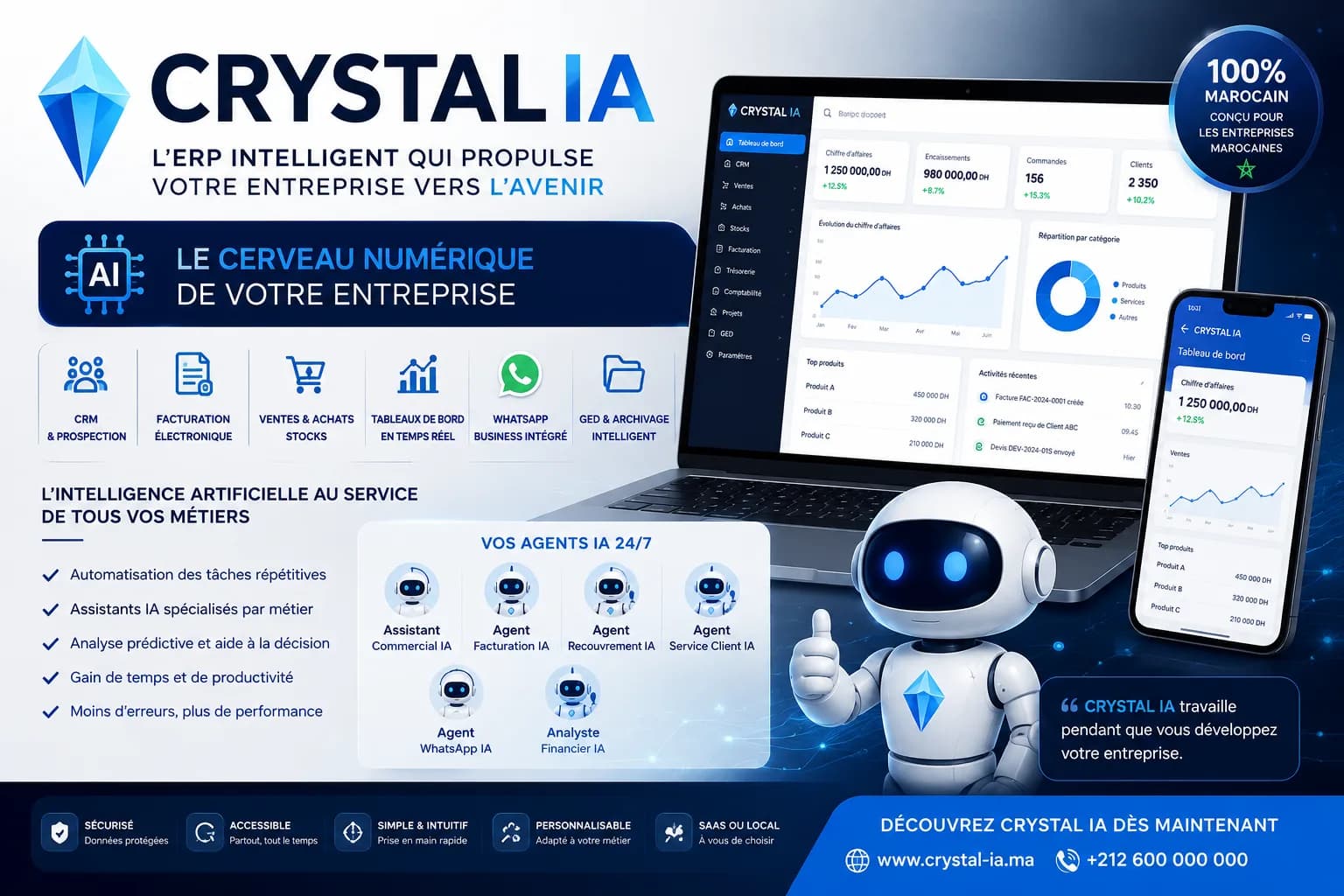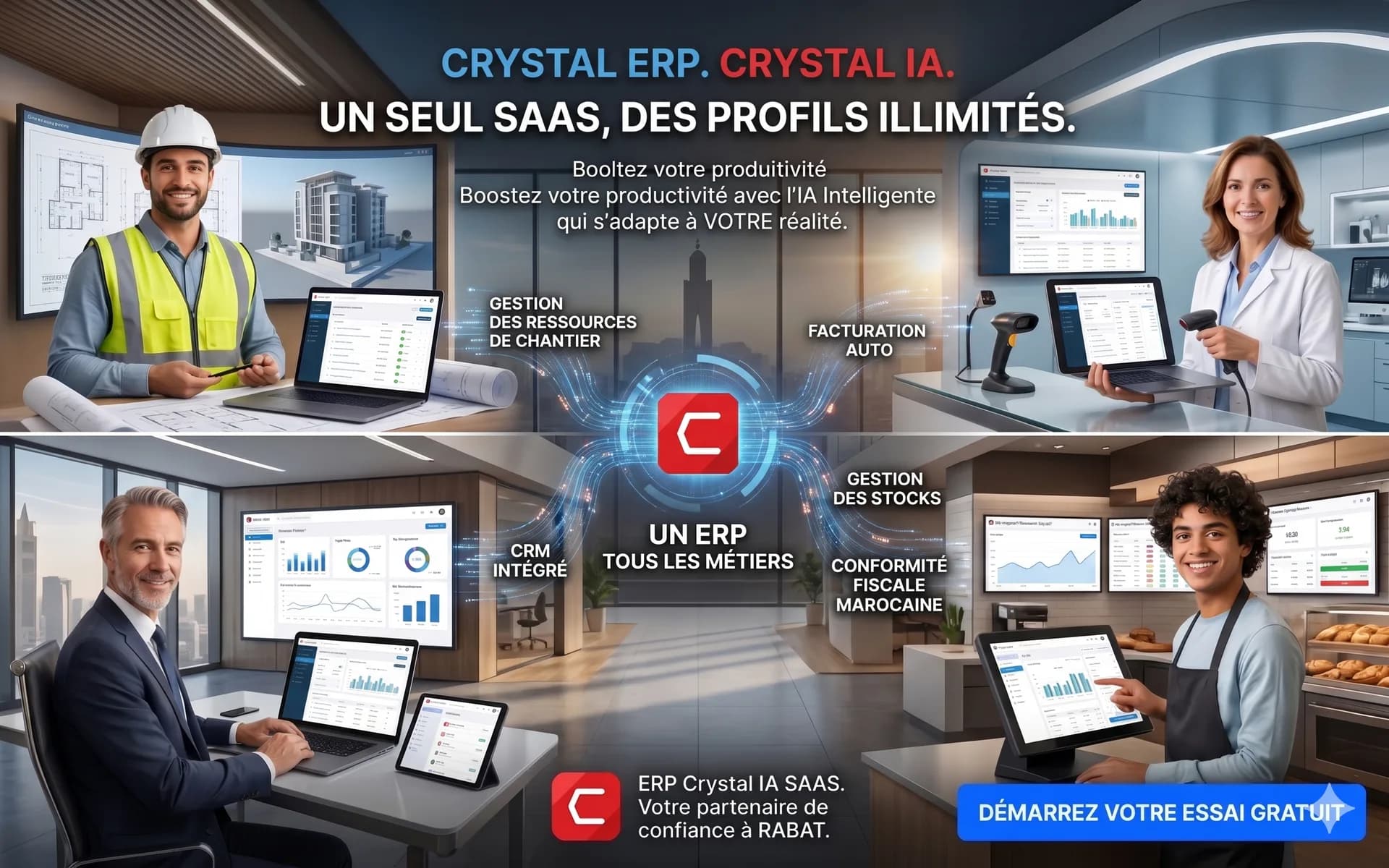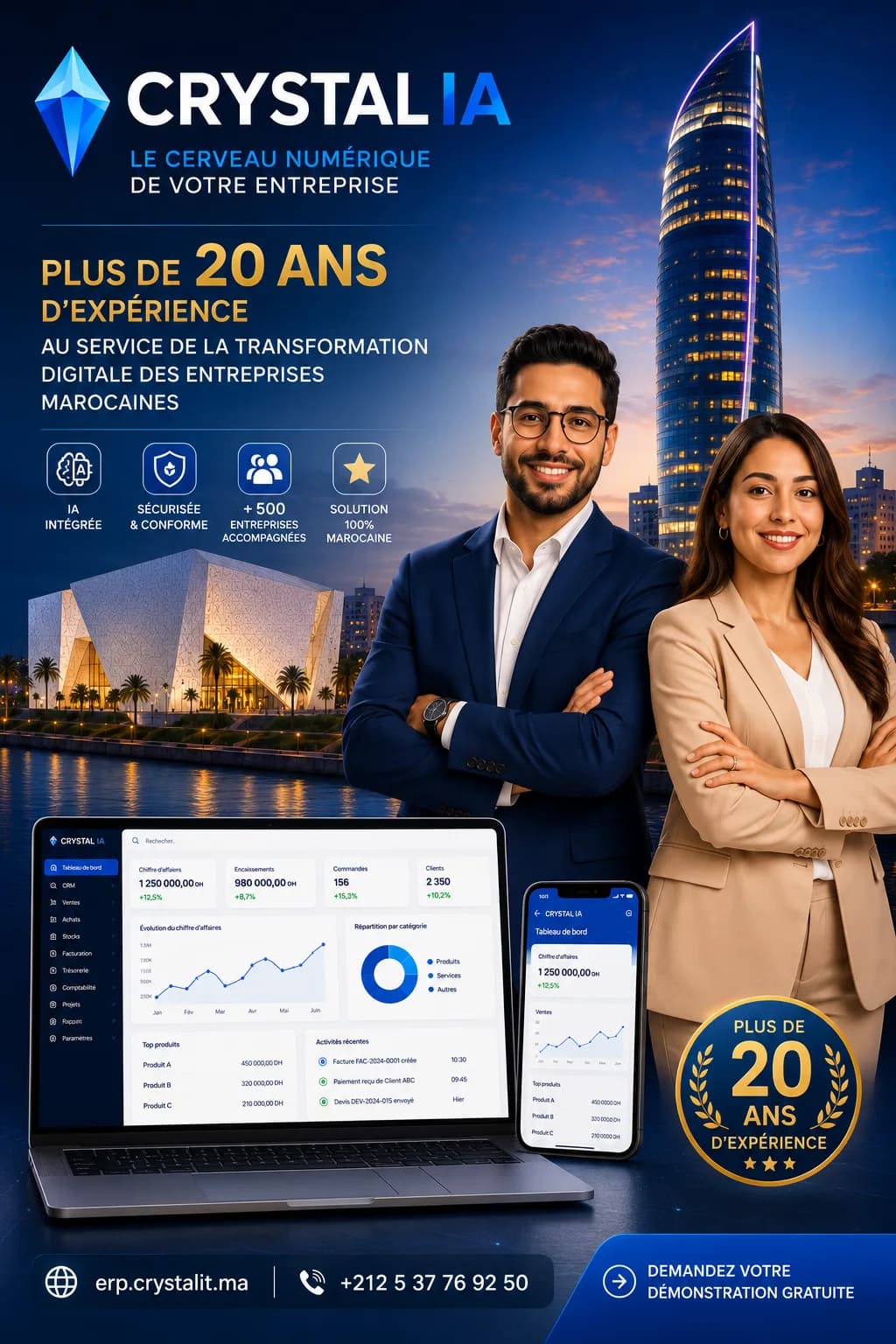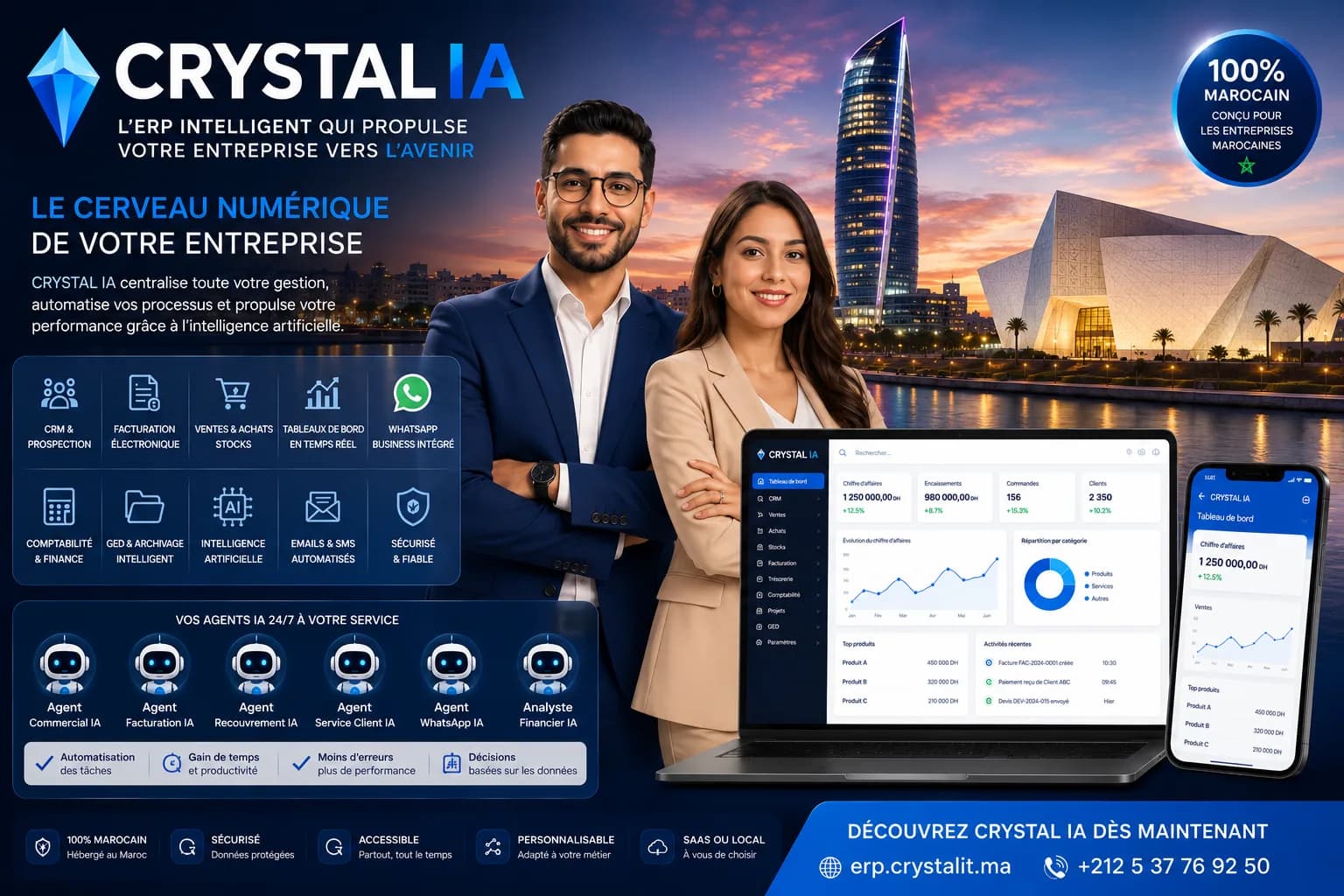
Excel is probably the most widely used management software in Morocco. Tens of thousands of SMEs keep their quotes, invoices, stock, customer due dates and sometimes even payroll in spreadsheets. Understandably so: the tool is everywhere, everyone knows the basics, and it costs nothing extra. But what works with five customers and fifty product references becomes a source of risk at five hundred customers and five thousand references: duplicated workbooks where nobody knows which version is authoritative, formulas broken by a row inserted in the wrong place, theoretical stock that no longer matches anything, VAT reconstructed by hand at month end. Migrating from Excel to an ERP is not a luxury reserved for large companies: it is the natural transition from artisanal to structured management, and it can be prepared methodically. This guide covers the signs that it is time to migrate, how to prepare your files, the concrete steps of a switch to an ERP such as Crystal ERP (erp.crystalit.ma), developed by CRYSTAL IT in Rabat, and the measurable gains a Moroccan SME can expect.
Why Excel always ends up hitting its limits
Excel was never designed to run a company: it is a spreadsheet, an individual calculation tool. As soon as several people work on the same data, its structural limits appear. The first is the absence of a single database: each department ends up maintaining its own copy of the customer or product file, and the versions silently diverge. The second is the absence of workflow: an Excel quote does not become an order, the order does not become an invoice, the invoice does not generate an accounting entry — every step is a re-entry, and therefore an opportunity for error. The third is the absence of control: nothing prevents anyone from modifying an issued invoice, deleting a stock line or overwriting a formula, without any trace or alert.
A regulatory factor now adds to this: the DGI's e-invoicing reform progressively provides for structured invoices, intended to be validated by the DGI's e-invoicing platform under the announced principle (Electronic invoicing in Morocco in 2026). An invoice formatted in Excel and printed to PDF does not meet these requirements. For SMEs within the scope of the reform's timetable, the question is therefore no longer "should we leave Excel?" but "when and how?" — and it is far better to migrate calmly than under the pressure of a tax deadline.
- Multiple versions: each department maintains its own copy of the customer or product file, and nobody knows which one is authoritative.
- Chained re-entries: quote, order, invoice and accounting entry are all separate keystrokes, with discrepancies that pile up.
- No traceability: a modified cell, a deleted row or an overwritten formula leaves no usable trace.
- Wrong theoretical stock: with no link between sales, purchases and stock, the gap with physical reality widens week after week.
- E-invoicing out of reach: Excel produces neither structured formats, nor guaranteed numbering, nor checks of mandatory invoice details.
The signs that it is time to migrate to an ERP
The right time to migrate is not read in the revenue figures but in the symptoms of daily life. If preparing the VAT return takes several days of reconstruction, if the director only knows the stock level or customer balance after asking three people, if two customers have received invoices bearing the same number, if the company has hired someone whose job essentially consists of copying data from one file to another: spreadsheet management is already costing more than an ERP — just invisibly and diffusely.
Another strong signal is dependence on one person: in many Moroccan SMEs, a single employee "holds" the files, knows their subtleties and their traps. That person's absence — leave, illness, departure — paralyses invoicing or payroll. An ERP reduces this risk by structuring processes in the tool rather than in someone's head. Finally, growth itself is a trigger: opening a second warehouse, recruiting field sales reps, launching a distribution activity — all situations where the spreadsheet can no longer keep up. To make the decision objective, our guide on choosing an ERP in Morocco (How to choose an ERP in Morocco: criteria, cost and mistakes to avoid) and the one on the real costs of an ERP project (What Does an ERP Cost in Morocco? A Price Guide for SMEs in 2026) provide concrete benchmarks.
- The monthly VAT requires several days of manual reconstruction from scattered files.
- Nobody can state the actual stock or the customer balance without consolidating several workbooks.
- Duplicate invoice numbers or invoices modified after issue have already been observed.
- One employee spends most of their time copying data from one file to another.
- The company depends on a single person who masters the files and their pitfalls.
Preparing the migration: cleaning and structuring your Excel files
The quality of a migration is decided before the migration. Excel files accumulated over years contain duplicates, inactive customers, obsolete products, multiple spellings for the same partner ("STE ATLAS", "Societe Atlas", "atlas sarl"). Importing this disorder as-is into an ERP is like moving into a new house with boxes of old papers. The first step is therefore an inventory: list the files actually in use, identify for each dataset the version that is authoritative, and decide what deserves to be carried over.
Then comes the cleanup: deduplicate customers and suppliers, complete the essential identifiers (ICE, tax identifier for business customers — they become unavoidable with e-invoicing), normalise product references, verify prices and VAT rates, and establish indisputable opening balances: physically counted stock, validated customer and supplier balances, reconciled bank balances. This work belongs to the company — nobody knows its data better — but an experienced integrator provides the import templates and consistency checks that dramatically speed it up. That is exactly the support the CRYSTAL IT team provides during a Crystal ERP deployment (Crystal ERP).
- Inventory the files actually in use and designate, for each dataset, the authoritative version.
- Deduplicate customers, suppliers and products; normalise labels and references.
- Complete the tax identifiers (ICE, IF) of business customers — essential for e-invoicing.
- Establish reliable opening balances: physically counted stock, validated customer and supplier balances.
- Carry over only what is useful: a dubious history is worth less than a clean, dated starting point.
The concrete steps of the switch to Crystal ERP
A well-run Excel-to-ERP migration follows a simple sequence. First, configuration: VAT rate structure, product families, payment terms, document templates (quotes, delivery notes, invoices with Moroccan legal notices). Then the import of master data — customers, suppliers, products — using the provided templates, with a consistency check at each import. Next, the entry of opening balances at a chosen cutover date, ideally the start of a month or fiscal year: initial stock, partner balances, bank balances. Finally, a test phase on real cases: redo in the ERP three quotes, two invoices and one stock receipt from the previous week, and check that the results match.
The cutover itself should be decisive rather than endless: a short period of parallel running — the ERP live, the old files as a safety net — is justified for two to four weeks, not beyond. Prolonging double entry exhausts the teams and keeps doubt alive about which tool is authoritative. With a SaaS ERP like Crystal ERP (erp.crystalit.ma), there is no server to install and no workstation to configure: access is through a browser, which considerably shortens the timeline compared with older-generation projects (SaaS ERP: why Moroccan companies are moving to the cloud to run their…). Teams start with the sales cycle — quotes, orders, invoices — then extend to purchasing, stock and accounting at their own pace.
- Choose a clean cutover date: start of a month or fiscal year, never in the middle of peak season.
- Import master data through controlled templates, then verify samples by hand.
- Replay real transactions from the previous week in the ERP to validate the configuration.
- Limit parallel running to two to four weeks: beyond that, double entry demoralises the teams.
- Start with the sales cycle, then extend to purchasing, stock and accounting progressively.
What a Moroccan SME concretely gains after the migration
The most immediate gains are operational: the end of re-entries between quotes, invoices and accounting, guaranteed continuous invoice numbering, stock that updates with every sale and every receipt (Inventory management software in Morocco), customer reminders based on a reliable balance. VAT preparation drops from several days to a few checks, since amounts are broken down by rate as transactions happen. And the company prepares for e-invoicing on sound foundations: reliable customer ICE numbers, checked mandatory details, invoices exportable in UBL 2.1 format — the foundation is in place, with transmission to the DGI platform to be added once its specification is published (Preparing for mandatory e-invoicing).
The most lasting gains are decisional. A director who used to steer by instinct on month-old figures now has a dashboard fed in real time: today's revenue, margin by product family, top customers, outstanding and overdue payments. With Crystal ERP, powered by CRYSTAL IA, this goes further: the Chat IA assistant lets you query your own data in natural language, and customer scoring helps the sales team prioritise their actions. Data that used to be scattered across workbooks becomes a steering asset — that is the real return on investment of the migration.
Migrating from Excel to an ERP is neither a leap into the void nor a project reserved for large organisations: it is a methodical sequence — clean your data, establish reliable balances, import, test, switch decisively — that a Moroccan SME completes in a few weeks with the right support. The spreadsheet served its purpose; it can no longer guarantee reliable figures, compliance with the DGI's e-invoicing, or the real-time steering that modern management demands. Crystal ERP (erp.crystalit.ma), developed by CRYSTAL IT in Rabat with more than 20 years of experience serving Moroccan companies, supports this transition end to end: import templates, configuration to Moroccan rules, team training and the CRYSTAL IA assistant to finally exploit your data. Contact the CRYSTAL IT team to assess your migration based on your current files.
Have a project or a question? Let's talk with a CRYSTAL IT expert.
Request a demo