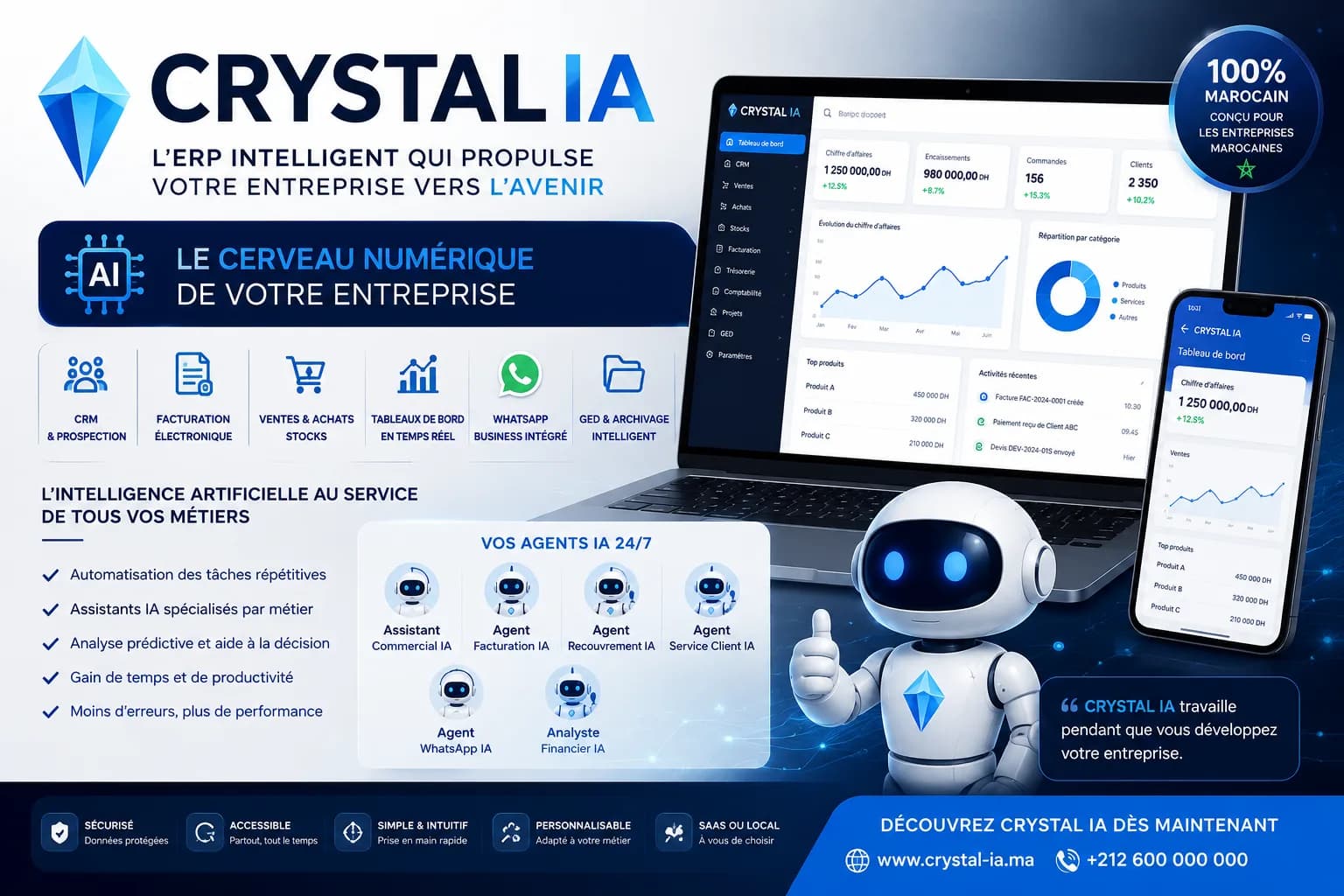
Business process automation in Morocco has shifted, over just a few years, from a competitive advantage reserved for large corporations to an operational necessity for SMEs that want to stay competitive. In most mid-sized Moroccan companies, a significant part of the working day is still spent on repetitive, low-value tasks: manually re-entering an email order into a delivery note, chasing a late-paying client after first hunting down their invoice in a spreadsheet, approving an expense claim by email with attachments, copy-pasting sales figures from Excel into a PowerPoint report at month end. These tasks are time-consuming, error-prone, and they tie up employees on activities that could — and should — be handled automatically. Business process automation (BPA) means replacing these manual, repetitive tasks with software workflows that execute according to predefined rules: an invoice is generated the moment an order is confirmed, a reminder goes out the day after a payment deadline is missed, a purchase request is automatically routed for approval the moment it exceeds a defined threshold, and a dashboard updates in real time without anyone exporting data. Crystal ERP (erp.crystalit.ma), developed by CRYSTAL IT in Rabat with more than 20 years of experience serving Moroccan companies, integrates automation of key business processes into one coherent system: the complete sales cycle, purchase approval workflows, automatic reminders, accounting entries without re-keying, and real-time dashboards. Crystal IA, the artificial intelligence layer of the same environment, extends this automation with predictive recommendations, intelligent alerts and automatic anomaly detection. This guide explains concretely what automation can change for a Moroccan SME, which processes to prioritise first, and how Crystal ERP and Crystal IA handle them.
What is business process automation for a Moroccan SME?
Business process automation is distinct from simple digitalisation: digitalising means replacing paper with a digital file; automating means replacing a repetitive human action with a software trigger. An SME that enters its invoices into a software application rather than writing them by hand has digitalised, but if it still manually emails each invoice and re-enters the received payment into a separate tracking spreadsheet, it has not automated. Automation creates a chain reaction: each event in the system (order confirmed, delivery signed, payment received) automatically triggers the next step without human intervention. It is this shift from manual entry to automatic flow that generates the most significant gains in productivity, reliability and processing times.
For a Moroccan SME, automatable processes fall into three broad families. Financial and commercial processes are the most immediate: invoicing, customer reminders, bank reconciliation, VAT returns, management reports. Operational processes cover purchasing, inventory, delivery scheduling and supplier order tracking. Support processes include leave management, expense claims, internal procurement requests and management sign-offs. All three families share a common characteristic: they consist of repetitive, sequential steps governed by rules — exactly the type of process that modern management software handles without error or omission. To explore the broader digital transformation of your company, see our guide on (Digital Transformation for Businesses in Morocco: Where to Begin).
- Automatic workflow: an event (order confirmed, deadline missed) triggers a predefined action without human intervention — the rule runs 24/7, with no risk of forgetting.
- Electronic approval circuit: purchase requests, expense claims and leave applications follow a predefined hierarchical path with automatic alerts to approvers, with no manual emails.
- Scheduled reminders: customer follow-ups, supplier alerts and internal notifications execute on a configured schedule, freeing teams from manual monitoring.
- Automatic accounting entries: every sale, purchase or payment generates its entries without re-keying, eliminating double-entry errors and month-end omissions.
- Real-time reporting: dashboards update instantly with every transaction, with no data export or Excel formula to recalculate.
The priority processes to automate in a Moroccan company
Not all automations deliver the same return on investment. For a Moroccan SME starting out, the strategic approach is to begin with processes that combine high frequency (executed several times a day or week), significant error risk and strong impact on cash flow or the client relationship. The sales cycle meets all three criteria: every customer order generates a chain of steps — confirmation, preparation, delivery, invoicing, chasing if unpaid — that are still handled manually in many SMEs. Automating this cycle end to end reduces the time between order and issued invoice, cuts keying errors and ensures no invoice is forgotten and no reminder missed. For more on managing the commercial cycle, see our guide on (Business management software in Morocco: the complete guide for SMEs).
The second high-priority process is purchase management and approvals. In an SME without a dedicated tool, a purchase request circulates by email between the requester, the department head and management, with risks of loss, duplication or untraced verbal approval. An automated approval circuit forces every request to follow the defined path, with a timestamped log of each approval or rejection and an automatic alert if a request remains unanswered beyond a set deadline. Then come customer reminders, stock management with reorder alerts, and monthly closing with bank reconciliation — all regular, time-consuming processes that automation makes invisible. To go further on purchase management, see our dedicated article (Purchase management software in Morocco).
- Complete sales cycle: quote → order → delivery note → invoice → reminder — no re-keying between steps, each transition automatically triggers the next.
- Multi-level customer reminders: at D+5, D+15 and D+30 after the due date, the client receives a graduated reminder email with an attached account statement — no accounting team involvement needed.
- Purchase approval circuit: any request exceeding the defined threshold is automatically routed to the relevant approver, with an alert if it remains unanswered.
- Stock alerts and reordering: when an item drops below its minimum threshold, an alert is sent and/or a supplier purchase order is pre-generated automatically.
- Periodic bank reconciliation: bank statements are imported and automatically matched against accounting entries — the monthly close goes from several hours to a few minutes.
Crystal ERP: automating financial and commercial workflows
Crystal ERP (erp.crystalit.ma) automates the commercial and financial workflows that occupy administrative and accounting teams day to day. On the commercial side, the module handles automatic conversion of documents: a signed quote converts to an order in one click, the order generates the delivery note, and the delivery note triggers the invoice with automatic carry-over of lines, quantities and agreed prices. Every transition is logged and timestamped, guaranteeing perfect consistency across documents and eliminating discrepancies between what was ordered, delivered and invoiced. Customer reminder management is fully configurable: the company sets its reminder scenario (timings, message tone, attachments) and Crystal ERP executes it automatically for every overdue payment, with a complete log of every reminder sent. For more on the electronic invoicing reform announced by the DGI, see our dedicated article (Electronic invoicing in Morocco in 2026).
On the financial side, Crystal ERP automatically generates accounting entries for every recorded transaction: sale, purchase, settlement, credit note or stock adjustment. Bank reconciliation is automated via statement import and matching against corresponding entries. Budget control compares each expense against the relevant budget line in real time, with configurable blocking or alert if the ceiling is exceeded. VAT collected and deductible is calculated automatically from transactions, pre-filling periodic returns without manual reconstruction. All these automations run in the background, so the finance director always has an accurate picture without asking the team to 'prepare the numbers'. To go further on cash management, see our guide (Cash Flow Management for Moroccan SMEs).
- Automatic conversion of commercial documents: quote → order → delivery note → invoice in one click per stage, with no re-keying of lines and no risk of discrepancy.
- Configurable customer reminders: multi-level reminder scenarios (friendly reminder, formal notice) set up once and executed automatically for every unpaid invoice.
- Automatic bank reconciliation: statement import and matching against accounting entries — the monthly close shrinks from several hours to a few minutes.
- Real-time budget control: every expense is compared against the relevant budget line with alert or block according to the defined rules, with no manual dashboard to maintain.
- Accounting entries without re-keying: every transaction (sale, purchase, settlement) automatically generates its entries in the appropriate journal with correct VAT breakdown.
Crystal IA: artificial intelligence for predictive automation
Rule-based automation — as implemented in Crystal ERP — covers repetitive, sequential processes. Crystal IA (erp.crystalit.ma) adds an intelligent automation layer that goes beyond fixed rules: it analyses the company's historical data to anticipate situations that standard rules cannot detect. Cash flow forecasting is the most concrete example: Crystal IA analyses the collection and disbursement cycles specific to each company, incorporates seasonality patterns, average customer payment times and scheduled supplier deadlines, to project the cash balance 30, 60 and 90 days ahead. This projection updates automatically without anyone exporting data or building a model. To explore Crystal IA's full capabilities, see our article (Crystal IA: artificial intelligence serving Moroccan businesses).
Crystal IA also automates anomaly detection: it flags supplier invoices that deviate from the usual price, customer orders with atypical behaviour, potential duplicate payments, or clients whose payment terms are gradually deteriorating — before the problem becomes critical. These intelligent alerts free the finance manager from manually monitoring indicators they cannot all track simultaneously. Finally, Crystal IA provides proactive recommendations: which clients to prioritise for follow-up based on their risk score, which stock lines to replenish before a foreseeable stockout, which suppliers to negotiate with first based on order volumes. Predictive automation thus transforms management data into proactive decisions. See our article on AI agents applied to business management (AI Agents in the ERP: When Your Management Software Starts Working for…).
- Automatic cash flow forecasting: Crystal IA projects the cash balance 30, 60 and 90 days ahead by analysing historical collections and scheduled deadlines — no Excel model required.
- Anomaly detection: the AI flags potential duplicate payments, invoices deviating from the usual price, or clients whose payment delay is worsening, before the problem escalates.
- Automatic client scoring: dynamic segmentation of the client portfolio by purchasing behaviour and payment risk — follow-up priorities and commercial development opportunities are calculated automatically.
- Intelligent KPI alerts: Crystal IA proactively flags key indicators (margin, stock turnover, overdue receivables) that deviate from their target trajectory.
- Proactive recommendations: suggestions for preventive restocking, bulk purchase optimisation and reminder prioritisation based on AI-calculated risk scores.
Setting up automation in your Moroccan SME: where to start?
Starting a process automation project may seem complex, but it follows a simple logic: identify the processes that consume the most time and generate the most errors, automate those first, measure the gains, then extend progressively. The first step is a quick audit of repetitive tasks: list recurring activities that take more than one person-hour per week — customer reminders, report preparation, purchase approvals by email, reconciling data between several tools. These activities are the priority targets for automation because their frequency guarantees a rapid return on investment. The sales cycle is almost always the best entry point: it is universal, its impact on cash flow is direct, and its automation delivers visible results from the first month. For guidance on choosing your management tool, see our guide (How to choose an ERP in Morocco: criteria, cost and mistakes to avoid).
Change management is just as important as the technology choice. A well-designed automation that is poorly understood by teams will be bypassed: employees revert to their habits if the new workflows do not feel clear or reliable. It is therefore essential to involve users from the configuration stage, to train them on new behaviours (supervising the automation rather than executing manually) and to measure concrete gains to build lasting buy-in. CRYSTAL IT in Rabat supports Moroccan SMEs through this journey: process audit, Crystal ERP and Crystal IA (erp.crystalit.ma) configuration, team training and post-deployment support. More than 20 years of experience serving Moroccan companies guarantees an implementation adapted to local specificities — DGI regulatory requirements, payment practices, sectoral seasonality. To explore management indicators after automation, see our guide (Business dashboard in Morocco: managing your company in real time).
- Audit repetitive tasks: identify manual activities that take more than one person-hour per week — these are the primary targets for automation with the fastest payback.
- Start with the sales cycle: quote → invoice → reminder is the most universal flow, with direct cash flow impact and automation gains visible from the first month.
- Involve teams from the configuration stage: users who understand and validate the automation rules adopt the new workflows and do not bypass them.
- Measure gains from month one: invoice processing time, average payment delay, manual reminders eliminated — the progress indicators are simple to track.
- Roll out in successive waves: automate one process at a time, validate results, then extend progressively — five well-mastered automations deliver more than a broad deployment poorly assimilated.
Business process automation is no longer the preserve of large companies with dedicated IT departments: Crystal ERP (erp.crystalit.ma) makes these capabilities accessible to Moroccan SMEs, with a progressive implementation and local support from the CRYSTAL IT team in Rabat. By starting with the highest-impact flows — the sales cycle, customer reminders and approval circuits — a Moroccan SME can free up several hours of work per week from the first weeks of use, shorten payment delays and make its financial reporting more reliable. Crystal IA extends this automation with predictive capabilities: cash flow forecasting, anomaly detection and intelligent alerts that turn management data into proactive decisions. Contact the CRYSTAL IT team for a process audit of your company and a demonstration of Crystal ERP and Crystal IA tailored to your sector and operational challenges.
Have a project or a question? Let's talk with a CRYSTAL IT expert.
Request a demo