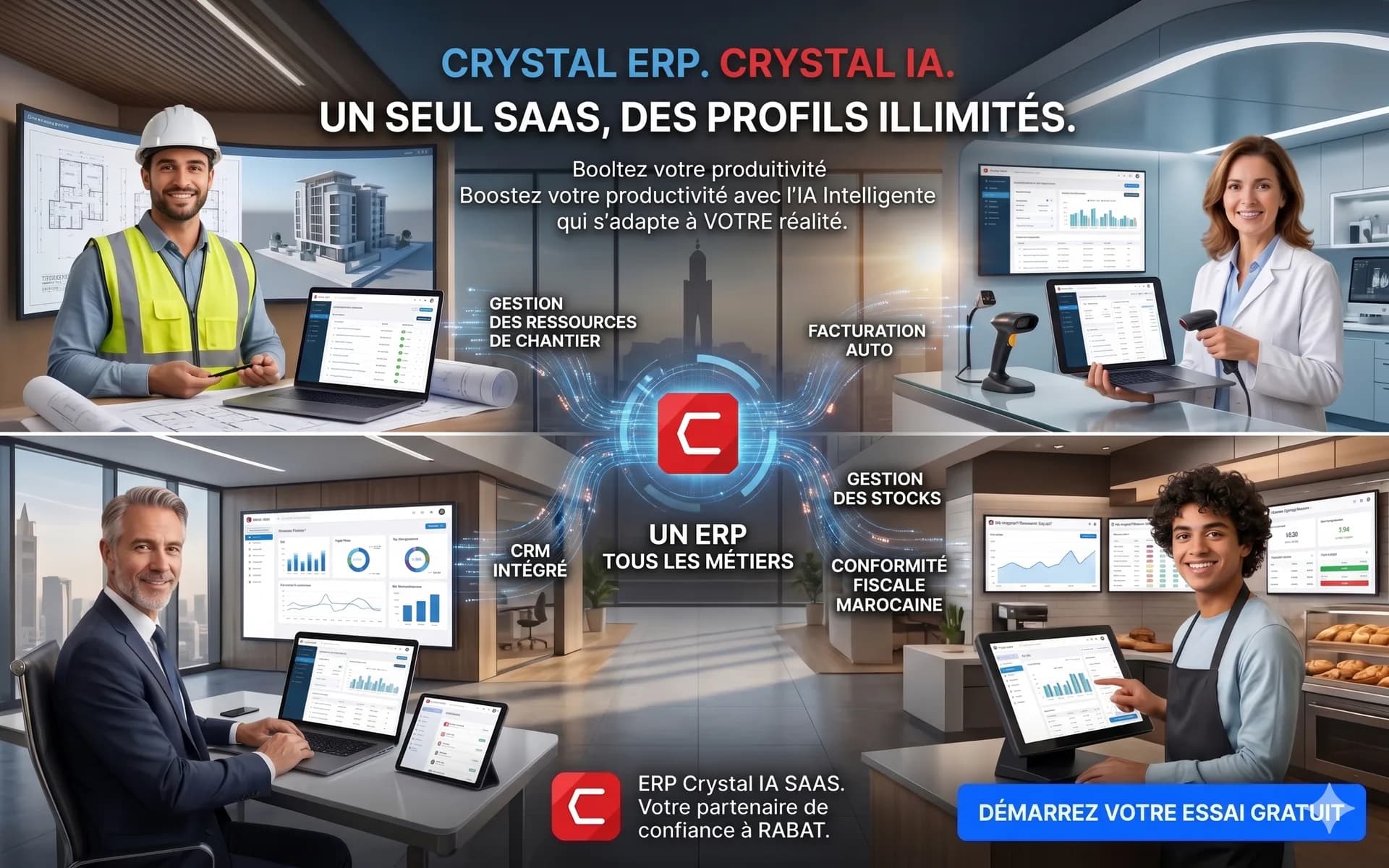
The printing industry in Morocco operates under tight deadlines, costly raw materials and clients who demand quality and punctuality. Whether commercial printers in Casablanca, screen-printing workshops in Marrakech, packaging companies in Tangier or advertising print providers in Rabat, every operation faces the same challenges: turning a client request into an accurate quote quickly, managing a constantly changing stock of paper and inks, tracking multiple production orders simultaneously and invoicing on time to avoid cash-flow tension. Crystal ERP (erp.crystalit.ma), developed by CRYSTAL IT in Rabat with over 20 years of experience in management software for Moroccan businesses, covers the full scope: from receiving the client brief to collecting payment, including materials management, production tracking and integrated accounting. This guide details what a print shop management system in Morocco must cover in 2026 and how to choose one.
The specific challenges of managing a Moroccan print shop
A print shop is a production business operating on continuous flow: every order triggers a chain of transformations — brief intake, artwork or proof approval, materials preparation, press run, finishing and delivery — each stage depending on the one before it. This sequential nature makes management highly sensitive to information gaps: a misrecorded purchase order, a miscalculated paper quantity or a job ticket not transmitted to the workshop is enough to delay the entire chain and miss a deadline for a client whose marketing campaign is locked to a specific date. Moroccan print shops that rely on scattered tools — spreadsheets for quotes, notebooks for stock, Word documents for invoices — regularly suffer these breakdowns without the means to anticipate them.
In 2026, two factors are intensifying the pressure on print shops. The e-invoicing reform announced by Morocco's DGI requires that B2B invoices be issued in a structured format (UBL 2.1 or UN/CEFACT CII) and transmitted to the DGI's e-invoicing platform on a timeline that starts in 2026 for large companies (turnover > 200 million MAD), then extends to SMEs in 2027-2028 and micro-businesses after 2028 — precise dates to be confirmed by decree on the official DGI portal (tax.gov.ma). The competitive pressure from digital printing services also forces traditional print shops to shorten lead times and improve their commercial responsiveness. For more on the DGI reform, see our dedicated article (Electronic invoicing in Morocco in 2026).
- Untracked quotes: a quote sent by email and forgotten means a lost order and a client gone to the competition.
- Stock-outs mid-press run: discovering insufficient coated paper when launching a job costs time, money and credibility.
- Manual press scheduling: without visibility on active jobs, scheduling conflicts are detected too late to resolve.
- Delayed invoicing: without an integrated system, invoices are issued late, pushing back collections and creating cash-flow tension.
- No profitability tracking: without per-job material cost tracking, it is impossible to know which jobs are genuinely profitable.
Quotes and client orders: from request to production launch
The quote is the entry point for every commercial relationship in printing. Its accuracy determines job profitability: a quote that underestimates paper consumption or press make-ready time immediately produces a negative margin. A good print shop management system must enable the creation of structured quotes in minutes, incorporating the variables specific to printing: size, weight, number of colours, finishing (folding, die-cutting, binding), quantity and delivery date. Quotes must be stored, trackable and subject to automated follow-up if the client does not respond, with a full history of exchanges and revisions. For more on quoting and commercial management features, see our dedicated guide (Commercial Quoting Software in Morocco).
Once a quote is accepted, its conversion to a confirmed order and then to a production job ticket must be automatic and require no re-entry: the sales rep validates the purchase order, the software generates the job ticket with all technical specifications, and the workshop manager receives the instructions directly from the system. Crystal ERP (erp.crystalit.ma) manages this chain from commercial management through to invoicing: every step is recorded, documents are linked (quote, PO, job ticket, delivery note, invoice) and accessible from the same client file. This integrated flow eliminates double-entry and reduces the risk of a mismatch between what was sold and what the workshop produces.
- Multi-variable quotes: calculation incorporating size, weight, colours, finishing and quantity for accurate pricing in minutes.
- Automatic follow-up on unsigned quotes: notification to the sales rep when a quote passes its validity deadline.
- Quote → order → job ticket conversion without re-entry: client approval triggers the entire downstream chain.
- Complete client history: immediate access to previous quotes, past orders and usual technical specifications for recurring clients.
- Status tracking for every order: from pending quote to completed delivery, every stage is visible on the commercial dashboard.
Raw materials stock: paper, inks and consumables under control
A print shop's stock is complex: references run into the hundreds (paper sizes and weights, specialty substrates, inks by colour and technology, plates, finishing consumables), quantities vary widely by job, and the tied-up value is significant. Managing this stock in a notebook or spreadsheet means exposure to unanticipated stock-outs, costly overstock on low-demand references and an inability to calculate the true material cost of a completed job. An integrated management system links stock to client orders: as soon as a job ticket is validated, the required materials are reserved, available levels are updated and replenishment alerts fire automatically when a minimum threshold is crossed. For a deeper look at stock management, see our guide (Inventory management software in Morocco).
Supplier purchasing management integrates directly with this stock tracking. When a replenishment alert fires, the software generates a supplier order proposal that the purchasing manager approves in a few clicks. On receipt, stock is automatically updated and the supplier invoice is matched against the purchase order. This closed loop eliminates duplicate orders, prevents stock-outs and enables precise stock valuation at the weighted average cost (WAC). For optimised supplier purchasing management, see our dedicated guide (Purchase management software in Morocco).
- Permanent multi-reference inventory: every paper size, every ink type and every consumable tracked in quantity and value in real time.
- Automatic reservation on job ticket validation: materials required for a press run are immediately deducted from available stock.
- Replenishment alerts: thresholds defined per reference and per supplier — the alert fires before a stock-out, not after.
- Integrated supplier purchasing: purchase order, receipt and invoice matching in a single flow, with no re-entry.
- WAC valuation: weighted average cost recalculated at every stock entry for precise material cost per job.
Production tracking and delivery planning
Production tracking is a critical point for any print shop managing several orders at once. Without visibility on the progress of each job ticket, the manager discovers delays when the client calls, not when action is still possible. A workshop management system enables real-time visualisation of which orders are in progress, at what stage (make-ready, press run, finishing, packaging) and whether they are on schedule to meet the promised delivery date. This visibility is the prerequisite for proactive priority management and transparent client communication.
Delivery management completes this production tracking: the delivery note is generated from the completed job ticket, the date and time are scheduled, and the document signed by the client serves as proof of receipt to trigger invoicing. Crystal ERP (erp.crystalit.ma) connects this production-delivery-invoicing sequence in a continuous flow: no completed press run can be overlooked in billing, and the delivery history is accessible by client and period to facilitate the handling of complaints.
- Production dashboard: overview of active job tickets by stage of completion and promised delivery date.
- Delay alerts: automatic notification to the workshop manager and sales rep when an order is at risk of missing its deadline.
- Delivery note from completed job ticket: the delivery document is generated automatically on job closure, without manual entry.
- Delivery history by client: immediate access to archived delivery notes to resolve complaints or disputes quickly.
Invoicing, collections and integrated accounting
Invoicing is the moment when operational performance turns into cash flow. In a print shop, it must be fast, accurate and compliant with Moroccan tax requirements. An integrated system generates the invoice directly from the signed delivery note, with no re-entry: quantities, prices and VAT breakdown are automatically carried over from the validated purchase order. Advance payment tracking is integrated: the balance invoice carries only the remaining amount, and the payment history is available in real time. For more on invoicing features, see our guide (Invoicing software in Morocco).
DGI compliance is a growing concern for print shops that invoice professional clients. Crystal ERP (erp.crystalit.ma) checks that all mandatory fields are present on every invoice (ICE, IF, address, itemised VAT rate) and enables export in standard UBL 2.1 format for B2B transactions. Integration with the DGI's e-invoicing platform will be added once its technical specification is published. Accounting is synchronised in real time: every issued invoice generates the corresponding journal entries (gross revenue, collected VAT, client receivable), and every payment received updates the general ledger. The financial dashboard — revenue by client, by job type and by period, material margin, aged receivables — gives the print shop manager complete visibility over the financial health of the business (Business dashboard in Morocco: managing your company in real time).
- Invoicing from the delivery note: the invoice is generated in one click from the signed delivery document, with no re-entry of quantities or prices.
- Advance payment management: deposits at order stage are automatically deducted at final invoicing.
- UBL 2.1 export for B2B e-invoicing: mandatory field validation and export in the structured format announced for the DGI reform.
- Collections tracking and client reminders: aged receivables with automatic reminders by due-date bracket to reduce late payments.
- Integrated accounting: every invoice and every payment generates accounting entries without re-entry, for smooth monthly closes.
Managing a print shop in Morocco in 2026 requires far more than a spreadsheet and a standalone invoicing tool: quote accuracy, paper and ink stock control, real-time production order tracking, on-time delivery and structured B2B invoicing are interconnected challenges that exceed the capabilities of scattered tools. Crystal ERP (erp.crystalit.ma), developed by CRYSTAL IT in Rabat with over 20 years of experience in management software for Moroccan businesses, covers the full scope in an integrated SaaS solution — from commercial management and quoting (Commercial Quoting Software in Morocco) to B2B invoicing (DGI electronic invoicing: preparing your invoicing software), including raw materials stock management (Inventory management software in Morocco) and the management dashboard (Business dashboard in Morocco: managing your company in real time). Contact the CRYSTAL IT team for a Crystal ERP demonstration tailored to your print shop.
The CRYSTAL IT solution on this topic
Have a project or a question? Let's talk with a CRYSTAL IT expert.
Request a demo